Quote:
Originally Posted by oldradio99

How do I slide the neck covering?
|
There are two parts on the neck that can be slid off from the rear after you loosen them. The first is the purity coil assembly, a coffee-can like part. Through a hole in the can, you can reach in a screwdriver to loosen the clamp that holds it to the neck. Here's a photo of one of mine removed from the tube:

This diagram also points out the purity coil, along with the deflection yoke:
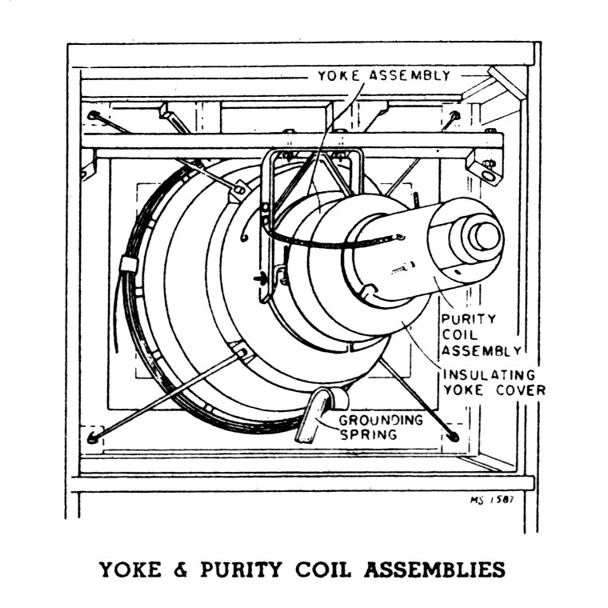
The purity coil is not very heavy. After loosening the clamp screw, turn or slide it gently in case it's kind of stuck to the neck. Once free, it just slides back off.
When that is off, you should be able to see the number 15GP22 stamped in black ink on the glass neck. If the neck is dirty, rub gently with a dry paper towel. Whether or not you find the tube marking, this looks like a 15GP22 to me.
You may be able to see the getter after removing the purity coil. In this photo, the getter is a darkish blob inside the neck glass, about halfway between the tan tube base and the area where the black coating begins.
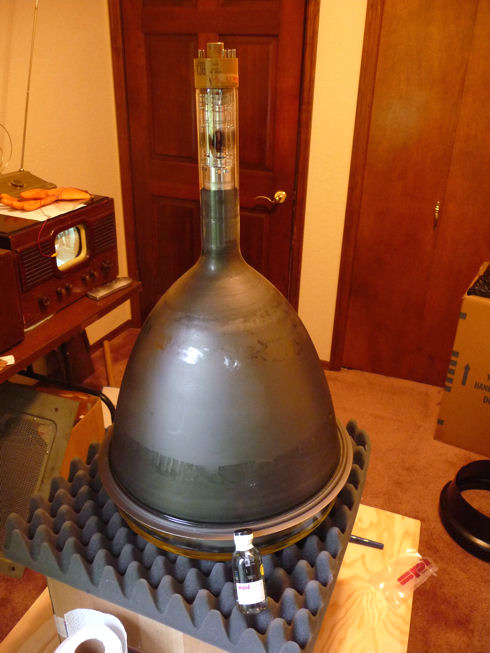
If the getter material has turned all white, that's a sign that your tube has lost vacuum and can't be used in a TV. If it's dark as in that photo, or even better, if it's nice and shiny looking, then cross your fingers that the vacuum is still holding. The tube might still have other problems, but at least it's not a stone dud.
If you can't see the getter after removing the purity coil, you'll need to remove the deflection yoke. This part is much heavier than the purity coil, so you'll want to work with care while removing it. It looks like you have a sort of homebrew yoke mount. (In a CT-100, the yoke is hung by a metal frame from a stout wooden bar.) After you loosen whatever screws or nuts that mount uses, you want to slide the yoke straight back off the tube neck, just as you did the purity coil. Here's a photo of the deflection yoke removed from my CT-100 (and still attached to its wooden bar).

If your getter doesn't look dark or shiny, don't lose hope as long as it's not all white. One of my 15GP22 tubes has a getter that's practically transparent, yet it tests and plays like a new one.
Taking a look at the getter will give you one piece of data, but that's not the whole story. You'll need a picture tube tester to tell whether your tube has strong enough emission to make a good color picture.
Even if the tube looks dead, it is still worth saving, since some day it may be possible to rebuild them just as in the good old days.
Phil Nelson
Phil's Old Radios
http://antiqueradio.org/index.html