About done.
I went after the vertical linearity issue this past week. I made sure all resistors in the circuit were good and changed any marginally bad testing caps. One odd thing I found is that a cap in the output cathode circuit was listed as a .47, but the original installed part was a .15uF....I stuck with the value was installed after trying a .47 with no improvement.
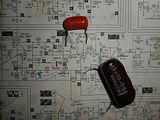
I'm not proud of my replacement for that .0082 1KV orange drop....The best I could do, since I don't stock new caps over 630V, was to connect a few 2KV rated blue disc caps salvaged from 90's BPC sets in parallel for the correct value as measured on my cap testers.....Not pretty, but it should function well...It's the kind of thing I regularly put in my sets when there is nothing better on hand, but I prefer not to do that in sets repaired for others (looks unprofessional, and I'm not right there laying in wait to replace if it fails).
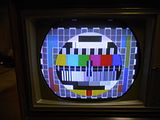

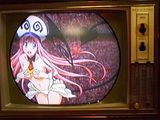
The vertical linearity issues were watchable, but bad enough to bother me.....After all that passive part verification (with little improvement) I was about ready to give up and say the linearity was not going to get better, but then I remembered that when it still had the under-scan issue tube swapping showed linearity differences....So I swapped the vertical tube and things got better...Much better.
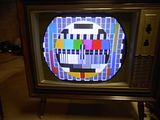
One odd thing that happened is that after around 1 hour on the flyback got rather hot....I know because I started smelling wax, then heard a sizzling noise from the HV cage. As soon as that happened I switched it off and opened the HV cage immediately the sizzling continued and was visually confirmed to be coming from the center of the fly windings, and a drop or two of wax had freshly landed on the small existent wax stalagmites. Many of my sets have evidence of this happening before and during my ownership, but I've never seen or heard it in action before....So I don't know whether to interpret this as normal or a warning sign. I had checked cathode current to be just under 200mA not more than 5 minutes before this happened.....
5-10 minutes after powering it off I powered it back on to do a few adjustments for 10-20 minutes....It worked fine, and it did not sizzle again.
Might be a good idea for you to drill some vent holes in the HV cage and add a computer fan to help cool it.
At this point all there is worth doing is to test all the tubes, test the lytics/replace any bad ones (if present) and reassemble it. The cans were cool after over an hour run time, and it's working like a champ, so I'm not sure the tubes and lytics need my attention.....If you want me to I'll go over them, otherwise I could skip them for speed.
Chroma synch has been reliable, but I make no guarantees that it will hold after a bumpy car ride back to your place, so I'll give you some instructions on how to adjust it when you pick it up.
If you are worried about the fly I could work on the CTC-20 after returning the 16....Then if the 16 dies (and if I can fix the 20) I could swap you a working CTC-20....
Let me know what you think.