Many TVs played the part of "kitchen sets" when I was growing up, though none of them were specifically intended as such. Most were 13" color portables from the 80s and 90s. The last one was a 1983 Zenith in a silver cabinet, with a picture tube that had to have very few hours of use on it. It was rescued from the curb and served for several years until the DTV conversion made watching TV in a rural area with rabbit ears and a UHF "bowtie" basically impossible. I still have it in storage. A NiCad battery leaked into it, and I hope it didn't ruin the set. It certainly did a number on the cabinet.
I have a few "kitchen sets" in my collection. One is a GE with a very tired nine inch or so picture tube and FM radio.
The other is a Panasonic CT-10R10R (yes, that's really the model number) rescued from a thrift store. It's in much better shape, though I suspect it had been disused for long enough that components had begun to drift out of tolerance. At first power up, the only color displayed was that of the on-screen display elements. Only later did the color "dribble" on and it's been rock solid ever since. Somewhat surprisingly, this set has A/V inputs. (As best I remember, it's intended to run from AC power only.)
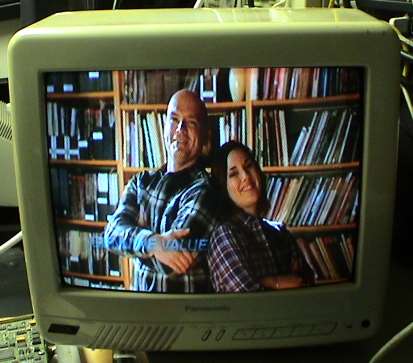
Picture quality is far better than it looks:
I got the original remote with it, and like the TV itself, it was utterly filthy. So I washed it, only I did not wait long enough for it to dry out completely. This turned out to be something of a happy accident, as it revealed hidden functionality.
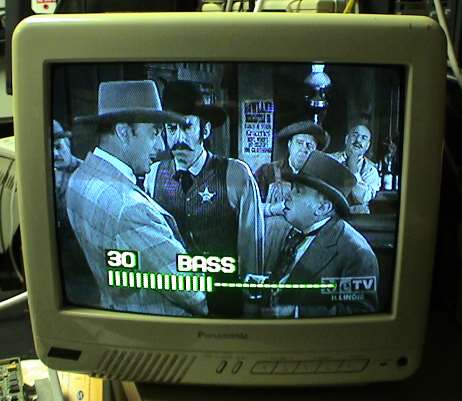
There are controls for bass, treble and balance. None of them actually do anything. Fair enough. Panasonic likely skipped out on an audio processing IC or circuit that wasn't officially supposed to be accessible to the end user. (The headphone jack plays through both speakers on a stereo headset, but this is only by duplicating the monophonic audio.)
There is another hidden feature that seems like it might actually
BE functional! Changing the audio reception mode results in a brief silence, as though the tuner is actually processing and complying with it!
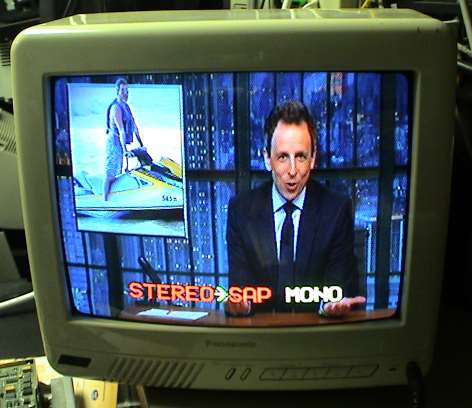
You'll notice that "mono" is in green, which would be correct if the different color means that only monophonic audio is being received. I should haul out my MTS-capable RF modulator and see if the word "stereo" turns green.
Unfortunately, no broadcaster around here used SAP when analog broadcast TV signals were still a thing, and there are no analog broadcasts left here now.
I wonder if anyone actually made a "kitchen" or portable set where SAP, if not MTS stereo audio would have been made accessible.