UPDATE, JANUARY 26, 2021
In our quest to extract more color information from 1954 NTSC color television and continued experimentation with the 1954 Westinghouse H840CK15 with RCA 15GP22 CRT, we realized the need for a pro or semi-pro photo editor. The obvious choice was Photoshop, but I don’t own a PC or laptop, just my friendly iPad Pro 2 with P3 color gamut. Photoshop requires a $10 monthly rental, so we looked elsewhere and found the Affinity Photo app. A one time purchase of $30 and boom, we were in business. I have never used a pro editor, so a learning curve was in order. We can choose from 7 color spaces and 7 color profiles, color channels, transitions, A/V editing and much more. Just what we were looking for.
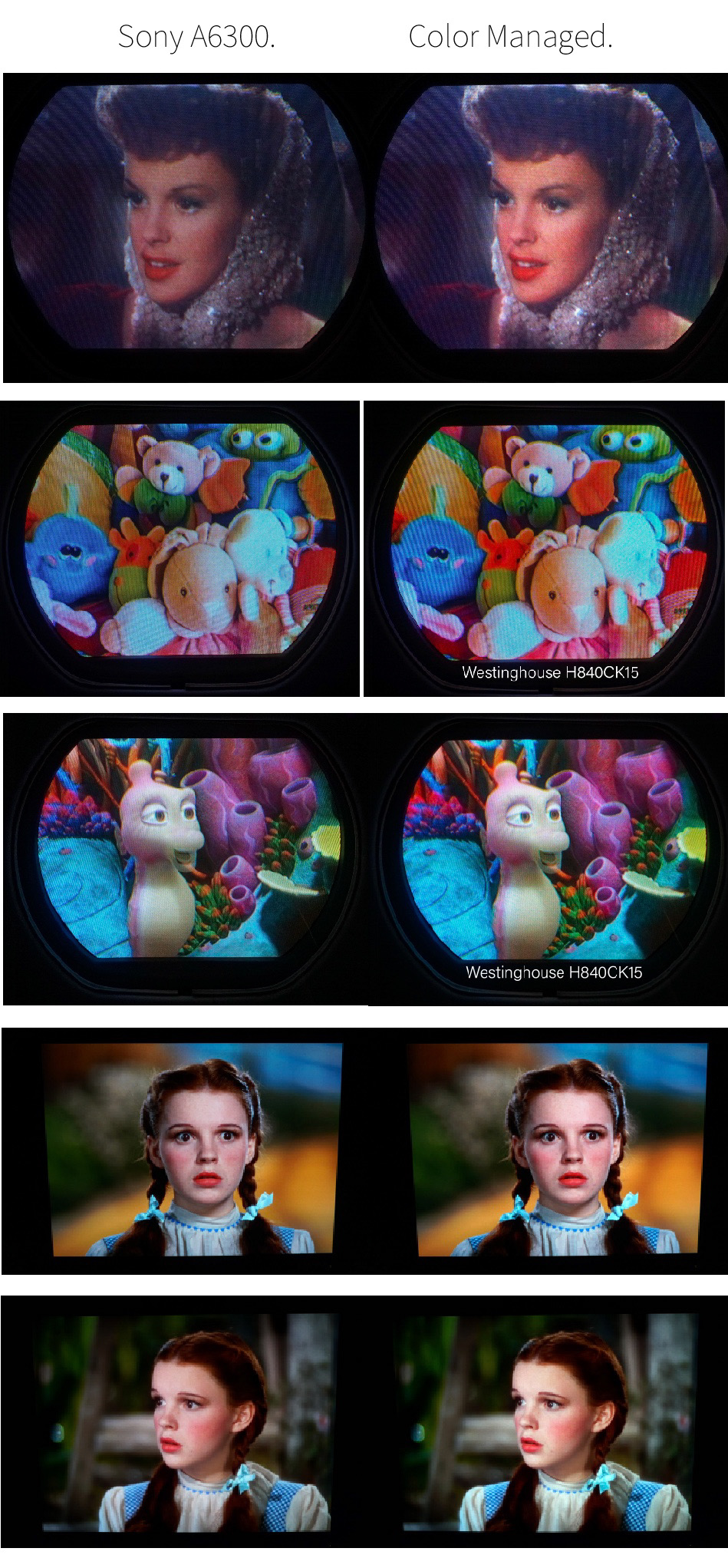
Much has been said about the 15GP22 extended color gamut phosphors, can we see the extended reds and Kelly greens? We used five favorite screenshots on this test from the movie, Meet Me In St.Lois, broadcast television and the movie, Wizard of Oz. The movies used three strip Technicolor process and the broadcast images were from PBS.
The first image below is a low resolution sample of the images to fit this forum page. This down sized image introduced terrible moire artifacts wich are not present in the originals. The left column images were shot straight out of my Sony A6300, set on s/RGB color space. Should I have chosen a different color space on the camera? The right column show edited images using the Affinity editor. For color management, we used auto channels, auto contrast and auto white balance and chose RGB/16 color space with P3 color profile since my display covers P3 extended color gamut. Three strip Technicolor, P3 color gamut display, will the editor extract the extended color from the NTSC correct color phosphors and can we see extended color?
 https://visions4netjournal.com/wp-co...3473A2660.jpeg
If you want to see the full resolution shots of each image, I’ve provided the photos below with commentary. These images are best viewed on an extended color gamut monitor.
First edited image: One of my favorite facial shots because of the color depth and shading and a night shot. The moire is gone. I see more yellow in Dorthy’s face as opposed to the pink tones. The colors are more saturated. The color managed image removed artifacts and noise from the original.
Note. Using the A6300, I’m relying on manual settings viewed on a 3 inch LCD monitor screen attached to the camera body. Not exactly ideal to see color accuracy. We can adjust aperture, shutter speed, focal length, ISO, or white balance, but never get the shot perfect as we see it on the television screen. A tripod and darkened room helps together with filling the camera viewfinder with the television image is best for accurate sensor rendering
Second edited image: This image was rather flat with nice pastels when photographed. The edited version shows extended color depth and saturation. The moire is gone.
Third edited image: Edited version has deeper saturated colors, wider color gamut.
Forth edited image: Source, 4K HDR BLURay on LG OLED. Edited version slightly warmer with deeper color. LG’s OLED out the box preset color profile appears very accurate using ISF PRO DARK ROOM.
Fifth edited image: Same source as forth image. Very close to original with whiter whites. As a novice in photo editing, we just set the mods on auto and let it do the work.
The last image is to show the pixel structure. Yes, low resolution, but not as bad as the first generation GE Portacolor.
Did we learn anything? Yes. Did we see extended colors? Maybe. Deeper saturated colors, improved shading with brighter images in all cases to improve on the 15GP22 low light output. About 86% of the tri-color light energy is blocked by the shadow mask. This specification is from RCA’s own technical paper.
My question is, did the engineers that developed 1954 NTSC color, actually see the full color gamut on an advanced display, or is the specification just mathematical? The phosphors must have been stimulated in some fashion to output light.
https://visions4netjournal.com/wp-co...CDDC5CFB6.jpeg
https://visions4netjournal.com/wp-co...5F671CF708.png
https://visions4netjournal.com/wp-co...0DD760B60.jpeg
https://visions4netjournal.com/wp-co...AECF90E43.jpeg
https://visions4netjournal.com/wp-co...A16502729.jpeg
https://visions4netjournal.com/wp-co...045989779.jpeg
https://visions4netjournal.com/wp-co...C2512D62D.jpeg
https://visions4netjournal.com/wp-co...9082EA07E.jpeg
https://visions4netjournal.com/wp-co...11F960FE3.jpeg
https://visions4netjournal.com/wp-co...0AA928B78.jpeg
https://visions4netjournal.com/wp-co...2E45E1D71.jpeg