
|
|
|
#1
 03-30-2010, 09:01 PM
|
||||
|
||||
|
Australian Philco radio
Looks just like the American version, though the chassis is quite different. Power transformer. Which every Australian set seemed to have. Did they ban hot chassises? Not unreasonable, as their powerline is 240VAC. Speaker looks to have been replaced.
The American version: But one thing I notice, most Australian radios were "stationized", but this Philco wasn't. But this Tasma has been "stationized" (like Packard Bell used to call it). full disclosure, I pirated these pix from these Australian ebay auctions (no affiliation): http://cgi.ebay.com.au/PERFECT-TASMA...71466844172902 http://cgi.ebay.com.au/PHILCO-1948-A...item3caba4a5b6 http://cgi.ebay.com/Vintage-Philco-4...item588691d56e
__________________


|
|
#4
03-31-2010, 07:30 AM
|
||||
|
||||
|
As was noted I see in the Oz version somebody replaced the oval with a round speaker but didn't bother to change the baffle board, still some oval cutout showing. Maybe in this version multifunction tubes made a difference in the tube count?
__________________
Reece Perfection is hard to reach with a screwdriver.
|
|
#5
03-31-2010, 12:39 PM
|
|||
|
|||
|
I have an American Philco Hippo with a square 4 inch speaker(not the usual oval one). The mounting looks original, so I think it came from the factory that way. As many of these were manufactured in 1946, just after WWII, I think Philco used what they could find.
I have several Hippos from around 1946 with varying tube line ups. I have both 35Z5 and 35Y4 rectifiers. The output tubes include 50L6s, 50B5s and 50A5s. I also have 1946 versions with both field coil and PM speakers. The 1948 version of the Hippo has a different tube lineup with a 14AF7 converter and two 7B7 IF tubes(but no RF amplifier as the 1946 version has).
|
| Audiokarma |
|
#6
03-31-2010, 02:42 PM
|
||||
|
||||
|
Right: after WWII, the pent-up demand for radios was so great the mfrs. could sell as many as they could make and used whatever tubes they could get, often switching tubes in midstream of a run. Love dem Hippos!
__________________
Reece Perfection is hard to reach with a screwdriver.
|
|
#7
03-31-2010, 03:53 PM
|
||||
|
||||
|
Quote:
Wonder if these sets were sold elsewhere in the 220V 50Hz world. Australia's population I understand is something like 25 million today, and must have been around 5 million back in 1948, would be a tiny market.
__________________
|
|
#8
03-31-2010, 04:30 PM
|
||||
|
||||
|
The circuit in my 6 tube 49-900 is somewhat strange also. I assumed that since it had 6 tubes it would have an RF stage, but it only has a 2 gang tuning capacitor
 . Two 7B7s coupled together by just a 220pf cap comprise a "2 stage" if amp between the 2 if transformers. . Two 7B7s coupled together by just a 220pf cap comprise a "2 stage" if amp between the 2 if transformers.jr Last edited by jr_tech; 03-31-2010 at 04:48 PM. Reason: correct model #
|
|
#9
03-31-2010, 06:24 PM
|
|||
|
|||
|
The 48 and 49 models have the two IF stage design(with no RF amplifier). The 46 designs that I have all have a 7C7 RF amplifier, 7A8, pentagrid converter, and 7B7 IF amplifier. They also have only two gang tuning caps, just as the 48/49 models have.
I do have one Hippo that must have been the super-deluxe model. It has white knobs, not red ones. The station display is also slightly different. It has a painted white case. The other colors I have are unpainted brown(with red knobs) and unpainted black(with black knobs). Both designs seem to work well. I can pick up the only AM station that I like listening to on either design. The station is 60 miles away and I have some trouble picking it up on tube radios without an RF amp or dual IF stage.
|
|
#10
04-01-2010, 06:27 PM
|
|||
|
|||
|
The Australian Philco is a bit of a puzzle but I'll attempt to solve some of it.
The picture refers to a model 203A made in 1948. The references I have don't list the model 203A and the tubes used limit the set to a specific period. The IF transformers are typical of components made by Philips during the 1950's and 60's and at a guess I believe the set was made by Philco Australia using local components and possibly using an imported case. The nearest set (based on tube types) I can find are the 1952 models using metal base octal tubes (loctals are extremely unusual in Australian radios). An example would be the F103 using the following tubes: 6SA7GT (converter), 6SK7GT (IF), 6SQ7GT (detector/audio), 6V6GT (audio Output) and 6X5GT (rectifier). The tube line up is a typical 5 tube arrangement of the period however the types used were not in use for long as the all glass 7 and 9 pin tubes were becoming more popular in the early fifties. Live chassis sets were made and sold in Australia and were called AC/DC models. They tend to not be so common as by the early 1950's 240v DC mains had been mostly phased out. The need for special (costly) tubes and other parts to make 240v series heater strings meant it was more economical to use a transformer.
|
| Audiokarma |
|
#11
04-04-2010, 01:23 AM
|
||||
|
||||
|
I actually submitted a bid on the Tasma radio, but as it often happens on ebay, a few other people wanted it worse than I did. Besides, shipping from Australia to the USA would likely be expensive. And would the bakelite case survive?
 It is a really nice looking radio, and the little Australia map in the middle of the dial looks cool. And all those callsigns, though they leave out the prefix "VL" as Australia isn't near anywhere else. It is a really nice looking radio, and the little Australia map in the middle of the dial looks cool. And all those callsigns, though they leave out the prefix "VL" as Australia isn't near anywhere else. 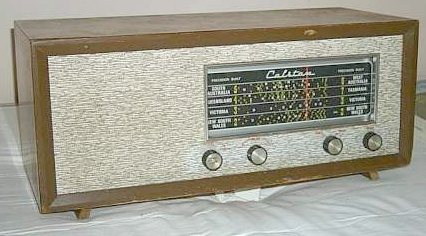 Looks like my Australian made Calstan radio will just have to get by without a "mate" from its home.
__________________
Last edited by wa2ise; 04-04-2010 at 01:30 AM.
|
|
#12
04-04-2010, 12:08 PM
|
||||
|
||||
|
Quote:
BTW: Does Australia have a standard AM broadcast band as we do here in the US, or is all VK-land (amateur radio callsign prefix for Australia) broadcasting done on shortwave? I notice that at least one of the Australian radios shown in this thread has three or four bands, but no frequency markings; the firm that made this radio must have gotten the idea for "stationizing" from Packard-Bell. If Australia does have an AM BC band, what frequency range would it be--above or below the US broadcast band?
__________________
Jeff, WB8NHV Collecting, restoring and enjoying vintage Zenith radios since 2002 Zenith. Gone, but not forgotten. Last edited by Jeffhs; 04-04-2010 at 12:15 PM.
|
|
#13
04-04-2010, 02:08 PM
|
|||
|
|||
|
Out of curiosity, is Austrailia planning to convert all radio to digital as the UK is doing?
As to the US, I know of no plans to do this. Unlike TV, there is not enough spectrum to be gained to be worth the hassle(millions of obsolete car radios, etc.). The US does have so-called HD radio(nicknamed "Huge Disaster" by some), but it does not seem to be killing analog radio. (I have a HD radio, but other than seeing the song title displayed, my ears cannot hear any improvement over FM, but then again, I do not have an Ipod and have no need for the HD advertised tagging feature.)
|
|
#14
04-04-2010, 06:39 PM
|
|||
|
|||
|
The Australian AM broadcast band is similar to the American one ranging from 525 kHz to 1606 kHz.
As we have only a relatively small number of stations in each state, manufacturers used to print the stations call signs on the dial as it was easier for listeners to find their favorite station. Multiband radios included one or more shortwave bands for listening to international broadcasts. As VHF FM broadcasts did not occur until the 1970's, all our tube radios did not have this band. Australia has just started Digital Radio broadcasting however it can only be received in the mainland capital cites at the moment. At this stage their is no intention of shutting down existing radio frequencies, instead Digital radio will be a third service that will take over the frequency bands of our soon to be shutdown analog TV service.
|
 |
|
|


 Linear Mode

