
|
|
|
#1
 01-26-2012, 11:43 PM
|
||||
|
||||
|
Replica Parts Made in Milwaukee
About a year ago I found a guy who runs a company here in Milwaukee that makes custom products for the advertising and sign industry. He has a couple of very expensive $200,000 machines. A 5'x10' CNC programmable flatbed router, and a huge flatbed printer that uses UV cure ink.
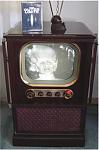
The first item I had him make for me was a replica back for a CTC4. He can do large stuff for big console sets, whereas the other company that makes replica backs only has a machine that will do small table top sized sets. If you are in need of a replacement back, and if you are able to borrow one to use as an example from someone, this guy can program his CNC router to make a copy of the original. If you need a dial glass or a glass front for a tv set that was reverse painted on the back (reverse silk screened) the flatbed UV printer can be programmed to reproduce these kinds of parts. John Folsom and I had some dial glasses made for our Wards Airline sets, and John had a front glass made for a GE801 and a Raytheon Belmont set. This stuff is expensive. You not only pay for the finished parts, but you also have to pay for the one time charge to have the part programmed into the printer or Router. Time is money and this kind of time is not cheap. And this guy will only do this kind of "one off" work when he has slack time in his regular production schedule. It took us 7 months of patient begging to get these parts. Below are some examples of the kinds of work we have had done. John Folsom had a large replica back made for his CBS205 color set. It took abot 90 minutes to produce this part on the CNC router because of the hundreds of holes. The CTC4 back took about 1 hour to make. Here are some photos to give you an idea of what can be done if you need a part for a valuable set and you are willing to spend whatever it takes to reproduce a part.
__________________
Vacuum tubes are used in Wisconsin to help heat your house. New Web Site under developement ME http://AntiqueTvGuy.com Last edited by ohohyodafarted; 01-27-2012 at 12:23 AM. 
|
|
#2
01-27-2012, 12:25 AM
|
||||
|
||||
|
Bob, That it really impressive.
Do you mind me asking what kind of money we're talking to have something like that 801 screen mask made?
|
|
#3
01-27-2012, 06:32 AM
|
||||
|
||||
|
If you have time and skills, chances are you can get a discount by measuring/drawing the part yourself in an accepted vector format - that way they only have to load the file and convert it to the gcode used by the machine.
|
|
#4
01-27-2012, 09:16 AM
|
||||
|
||||
|
On the first job he did, (the CTC4 back) he charged $75/hr set-up and the charge for one back was $50. I thought that was fair for the back itself, and duplicates will only be $50 each. But when you are doing a one-off piece the cost of setting up the program adds a lot to the price of only one piece. And depending on how complex the program is, you may have an even higher program price. I will post an update with actual costs on the printed parts when I recieve the invoice for this work.
As for drawing myself, I do not have a proper drawing program anymore. I used to have a program called ProfileLab that I could do this in, and it would generate HPGL instruction file to drive plotters and routers. (HPGL=Hewlett Pakard Graphics Language) That is no longer available to me. If it was I could do the drawings myself and eliminate that part of the expense. I wish I still had ProfileLab, It was a nice program to do this sort of stuff. Does anyone have a suggestion for an inexpensive program that could be used to do the drawings? and possibly generate the HPGL plotter code? The art file for the Wards Airline dial glass was generated from a flatbed scan of a reasonably good part, and imported into PhotoShop (I used a trial version of Photoshop Elements). I find PhotoShop to be a difficult and complex program to use, but it has many features that enable you to do stuff like make seperations by color etc. So I made 4 layers for various colors (based on the imported scan) and overlayed them. Then I took the art files to this company and he used the art files to generate the necessary code to print the parts with the UV flatbed printer. I don't know what kind of file the printer works with. For all I know it just takes a standard .JPG and prints like a normal computer printer does.
__________________
Vacuum tubes are used in Wisconsin to help heat your house. New Web Site under developement ME http://AntiqueTvGuy.com
|
|
#5
01-27-2012, 03:42 PM
|
||||
|
||||
|
Just a note: The one part is for a GE 803, not 801. :-)
__________________
John Folsom
|
| Audiokarma |
|
#7
01-27-2012, 05:42 PM
|
||||
|
||||
|
I'd definitely pay 50$ for a back for my CTC4....once I can lay my hands on that kind of money that is.
Do those backs have the labeling on them, and the CRT neck box (I can't remember the proper term) reproduced as well?
__________________
Tom C. Zenith: The quality stays in EVEN after the name falls off! What I want. --> http://www.videokarma.org/showpost.p...62&postcount=4
|
|
#8
01-27-2012, 06:01 PM
|
||||
|
||||
|
Great job, I wish I knew what you were up to, I have the Artwork for the Airline already scanned and restored, I would have been happy to offer it to you.
Did you make any extra parts by chance? I wouldn't mind getting a dial glass for my Airline that's actually printed on the Glass instead of glued on.
|
|
#9
01-27-2012, 07:31 PM
|
||||
|
||||
|
Eric,
The Wards Airline glass was printed on what is either Lexan or possibly Plexiglass (I think Lexan because it is not as rigid as Plexiglass) The plastic is a bit thinner than the original glass. I still do not have the final bill so I don't have the price as of yet. I think I may have 1 extra copy, that is not spoken for. I will let you know after I get the final bill.
__________________
Vacuum tubes are used in Wisconsin to help heat your house. New Web Site under developement ME http://AntiqueTvGuy.com
|
|
#10
01-27-2012, 07:35 PM
|
||||
|
||||
|
Quote:
In my book inexpensive would be sub $100
__________________
Vacuum tubes are used in Wisconsin to help heat your house. New Web Site under developement ME http://AntiqueTvGuy.com
|
| Audiokarma |
|
#11
01-27-2012, 07:36 PM
|
||||
|
||||
|
Quote:
__________________
Vacuum tubes are used in Wisconsin to help heat your house. New Web Site under developement ME http://AntiqueTvGuy.com
|
|
#12
01-28-2012, 12:30 AM
|
||||
|
||||
|
Way back when I used to draw PC board layouts on what I recall was Autocad version 2.6 .
 That was back before auto router programs were common. The machine was something like a CompuAdd 286 with warp drive. That was back before auto router programs were common. The machine was something like a CompuAdd 286 with warp drive. 
Last edited by Kevin Kuehn; 01-31-2012 at 07:15 PM.
|
|
#13
01-28-2012, 05:33 AM
|
||||
|
||||
|
MSRP of autocad is $3995, I don't think that qualifies as "inexpensive" When we bought ProfileLab, it was $2000 and I dont consider that inexpensive either.
You can get older versions very cheap, I got Autocad version 13 for 30.00 and it was unused. Where I used to work they used fabricad to make dxf files for cnc lasers and turrent presses. They mainly used laser to cut sheetmetal, but did some jobs cutting formica, plastics, even plywood and leather.
|
|
#14
01-28-2012, 05:18 PM
|
||||
|
||||
|
Quote:
__________________
Vacuum tubes are used in Wisconsin to help heat your house. New Web Site under developement ME http://AntiqueTvGuy.com
|
|
#15
01-28-2012, 08:21 PM
|
||||
|
||||
|
Quote:
I've been using Gimp for about 10 years and find it much simpler than photoshop and it can do almost everything that photoshop can. I've got Gimp 1.4 on a DOS based computer running Win ME and 2.1 on Win XP. The current version is 2.7. Gimp is a free software. I've found Gimp to be a heck lot more user friendly and more idiot-proof than Photoshop, two computer features that I badly need. http://www.gimp.org/ I'm thinking about replicating a Bendex Aviation phantom radio dial using this program. It would have to be a two layer transparency with the outside layer in color and the rear one in B&W. I'm not that much into radios, but this baby has been in our family for 64 years. I last repaired it in 1956. Where is your Ward's dial project described? James.
|
| Audiokarma |
 |
|
|









 Linear Mode

