
|
|
|
|
|
#1
 02-26-2015, 11:24 PM
|
||||
|
||||
|
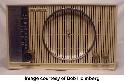
Circa '46 Emerson portable tube radio
Here's an interesting Emerson portable radio that I recently picked up. It must be one of the better models, since it has a 3-gang tuning capacitor and RF stage, as well as dual audio output tubes. A 50B5 output tube is used when the set is operated off of AC power, probably for greater volume and better tonal quality. When operated on batteries, a 3Q5 output tube is switched in circuit. Here is the schematic: http://www.nostalgiaair.org/PagesByM...8/M0004628.pdf
 
__________________
http://www.youtube.com/user/radiotvphononut 
|
|
#2
02-26-2015, 11:32 PM
|
||||
|
||||
|
Intriguing design that set has.
__________________
Tom C. Zenith: The quality stays in EVEN after the name falls off! What I want. --> http://www.videokarma.org/showpost.p...62&postcount=4
|
|
#3
02-27-2015, 09:26 AM
|
|||
|
|||
|
Quote:
If you notice, it uses a filter choke in the power supply. It must be, because of the heavier current demand of the tube filament circuit. Also note, the IF frequency is 262 KC. The audio output transformer is also dual primary, to match the plate load impedance of the two different output tubes. BTW, I never saw the model using the octal output and rectifier tubes. It must've been a real short production run. 
|
|
#4
02-27-2015, 06:59 PM
|
||||
|
||||
|
Someone must have goofed on that IF frequency. Shouldn't it be 455 kHz?
Also, if this radio has push-pull audio output, shouldn't the tubes be identical, e. g. two 50C5s?BTW, one of the knobs is mismatched; I don't know which one is still original. Someone must have lost one or the other and replaced it with one from the junk box.
__________________
Jeff, WB8NHV Collecting, restoring and enjoying vintage Zenith radios since 2002 Zenith. Gone, but not forgotten.
|
|
#5
02-27-2015, 07:08 PM
|
||||
|
||||
|
Quote:
262kHz is the second most common IF frequency (455 being first by a VERY wide margin), and IIRC was common in tube era car radios.
__________________
Tom C. Zenith: The quality stays in EVEN after the name falls off! What I want. --> http://www.videokarma.org/showpost.p...62&postcount=4
|
| Audiokarma |
|
#6
02-27-2015, 07:34 PM
|
|||
|
|||
|
Quote:
Hope to see you at the next meet! 
|
|
#7
02-27-2015, 07:27 PM
|
|||
|
|||
|
Quote:
I still maintain, that the radio is highly engineered, to provide performance that exceeds the competitive makes. Regarding the output stage, it is not push-pull, but designed to run on AC, as well as battery power, so that's the reason for the novel audio output stage. Zenith could have used that idea on their TO's, instead of the push-pull 1LB4's, that didn't sound, nearly as good. One of the knobs, looks like a GE. The original knob, was either lost on broken.
|
|
#8
02-28-2015, 10:50 PM
|
||||
|
||||
|
Quote:
Some prewar 45MHz band FM radios used an IF around 8MHz. I think the FCC avoids assigning powerful transmitters on the popular IF frequencies. 455KHz, 10.7MHz, 45MHz and so on.
__________________

|
|
#9
02-28-2015, 10:18 AM
|
|||
|
|||
|
Quote:

|
|
#10
02-27-2015, 11:30 PM
|
||||
|
||||
|
Fortunately, someone on one of the facebook antique radio pages is sending me a knob. When I get caught up with other projects, I'll tear into this one. Concerning IF frequencies, I've found that a lot of superhet radios made before the mid '30's to be all over the map, in terms of the IF frequency. That's why I always look at the service information, especially on older sets, before assuming that the IF frequency is 455 KC.
__________________
http://www.youtube.com/user/radiotvphononut
|
| Audiokarma |
|
#11
02-28-2015, 10:08 AM
|
|||
|
|||
|
Quote:
|
 |
|
|




 Hybrid Mode
