
|
|
|
|
|
#1
 12-12-2007, 03:25 PM
|
||||
|
||||
|
Delco R1128 Mess
Folks, ive hit a wall...
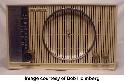
My schematic skills must be rusty.. Heres a photo of the workmanship of the previous owner. An attempted cap job ide assume... Heres the schematic link and a photo of the victim. can you make sense of it? http://www.nostalgiaair.org/PagesByM...4/M0022574.pdf Steve 
|
|
#2
12-13-2007, 01:16 PM
|
|||
|
|||
|
It looks to me as if you rotate the schematic/picture sheet (not the jpg pic that you posted) 90 degrees clockwise, it will match up to the jpg. The black rectangle at the bottom is the power transformer. The schematic/pic sheet has all of the parts labeled (1, 2, 3, etc.) and the schematic shows where they are connected and what the values are. Unfortunately, no voltages are given. I don't know what your skill levels are, but any of the paper capacitors that have the value and voltage on them should be matched as closely as possible. Values can vary +/- 20% but voltages should never be lower. Higher voltage ratings are OK. The round brown tubes with colored dots and wires wrapped around each end are resistors. The colors indicate the value. They are also referenced on the schematic. Because the old parts and schematics can be difficult to decipher sometimes, if you want to do a complete restoration using modern parts, it might be wise to consult someone locally, again, according to your skill level. Good luck.
Rich
|
|
#3
12-13-2007, 02:31 PM
|
||||
|
||||
|
Thanks Richfro
My problem is isolated to the 2 filter caps that used to fill the 2 holes above the transformer. I have 9 wires i cant account for. Someone removed the 2 caps and left it at that. The big tan capacitor marked G04 is an add on. Without the 2 (8MFD@450V) caps in place, I cannot tell how many pins they had, were the cans of the caps chassis grounded, and which wire(s) went to which legs of the capacitors. The schematic doesnt denote +or - of these 2 caps. I admit im having problems deciphering the schematic.. I wish SAMS covered this radio, but they dont. Somehow, i need to get a pic of this area so i can see how it was originaly layed out. Or find someone who can decipher the schematic and draw me up a diagram, i can handle the rest  Calling all radio pros..... help steer me through these troubled waters  Steve
|
|
#4
12-13-2007, 11:27 PM
|
||||
|
||||
|
I suspect that may have been a wartime repair. During WW2 techs often couldn't get the right parts and had to scab in whatever they could get. It looks to me like those 2 holes at the left had stud mount can caps, and since they are not grounded to the chassis, they would have had to have insulated mountings. That works out to two ungrounded terminals per cap.
I wonder what the third hole is for? On the schematic, there is a 1mfd capacitor, or maybe 0.1. If it was .1, it could have been electrolytic, and it might have gone in the third hole. This cap had it's positive terminal grounded, so it would have also been insulated from the chassis. That ground strap from the chassis could have gone to the positive lead. When I am having trouble reading a difficult schematic, sometimes it helps to draw it out in a more orderly fashion. I tried that with yours and this is what I came up with.  There are several screwy things going on here. First of all, the field is on the negative side of the power supply. This was sometimes done in the old days so the field didn't have to withstand B+ voltage. Second, the center tap of the power transformer is not connected to the chassis. This was done to develop bias voltage for the tubes. It's strange because the chassis is not the most negative part of the power supply. The taps on that schematic are, starting at the top: B+ (probably 250-300 volts or so) B- (chassis) Bias1 (negative voltage) Bias2 (more negative) Bias3 (even more negative) Here's how I would approach it. I would solder a long terminal strip below the chassis where those holes are. You will need at least 6 terminals, 5 of which are NOT grounded. Technically you could get by with less, but thats how many there were probably originally when the old caps were there. (This is assuming the 1uf was also a can. If it wasn't, then four terminals, all not grounded). I would start at the power cord and work my way toward the tubes. You should be able to trace the wiring through the switch, to the .02 line filters, which you should replace with modern safety caps, to the primary of the transformer. OK, now theres 2 transformer leads you don't have to worry about. On the other side, 2 wires will be for the 6.3 volt filaments. That winding also powers the pilot lights. One side is grounded. Trace to the pilot lights. Theres another two wires you can forget. Whats left now is the 5v rectifier tube winding, and the high-voltage winding, which is center tapped. 5 wires in all. Probably the five volt winding (2 wires) will be one color, and the HV winding (3 wires) another color. The center tap of the HV will have a black stripe or something. Now look up the pinout of the 5y3. You can get it at http://www.nj7p.org/. Here it is:  On an octal tube, looking at it from the bottom, with the key slot down, pin 1 is to the left of the key slot. The numbers count clockwise from there. You are looking for pin 4 and 6. These are the high voltage winding, and they should connect to these pins and nothing else. Found them? Good. Theres 2 more wires you can ignore. Now find pin 2 and 8. These are the rectifier filament pins. there should be wires connected to these pins from the 5v winding on the power trans. One of them has other stuff connected to it. The one with other stuff connected is the highest positive DC voltage in the chassis. Note. where it is. Ignore the other wire. At this point, there should be only one power transformer wire left. This is the HV center tap, and is the most negative DC point in the chassis. Note where it goes. These two points we just identified originally had wires that went to the first capacitor. You can probably identify which hole it was in. Put a terminal strip there, and connect the wires to 2 insulated terminals. Put an 8uf cap (450v oughta do it) across those terminals with the NEGATIVE side connected to the power transformer center tap, and the POSITIVE side to the wire that goes to either pin 2 or 8 of the 5y3 socket. Ok, from there, the side connected to the NEGATIVE side of the capacitor should have a wire going to the speaker socket for the field. Connect it too. Coming back from the speaker socket, it might get a little interesting. I'm gonna assume something here. Since the 220ohm, 32ohm, and 32(52?)ohm resistors are labeled 10a, 10b,and 10c on the original schematic, I think they were a single tapped resistor. It was probably a "candohm" crimped metal thing. I think I see it at the far left in your picture. They fail a lot, and also can short to ground, so check it carefully. Working on that assumption, coming back from the speaker socket, the other field lead should come back to one end of the candohm. There will also be a resistor connected to the 6f6 grid. Moving down the candohm, the first tap we come to will be the other end of the 220 ohm section. There should be a wire heading over to where the one of the old caps was. Again, the length of the wire may tell you which hole. Mount a second 8uf@450 capacitor on 2 insulated lugs on the terminal strip. Connect this wire from the candohm to the negative side of the 8uf cap. Connected here also should be a 3 megohm resistor that goes to the grid cap of the 6q7. Connect the positive side of the second 8uf capacitor to the positive side of the first 8uf capacitor. Note that neither of these caps is connected to the chassis. Next is the 1ufd cap, if it really is 1uf. I can't read it. It was probably mounted in a third hole I suppose, but you can probably skip adding the terminal strip for it. Electrically, it goes from the negative connection of the second 8uf capacitor to the chassis. The POSITIVE lead of the 1ufd goes to the CHASSIS. Moving right down the candohm, the next tap should go to the cathode of the tuning eye, the cathode of the 6q7, and the volume control. The next tap is at the other end, and should be connected to the chassis. Where the positive leads of the two 8uf caps connect together is the main b+ supply to the set. There should be a connection from there to the output transformer, connections to both IF transformers, the magic eye target pin, a 100k resistor to to the 6q7 plate, a 10k resistor to the 6c5 plate, and a 10k resistor to the 6k7 screen. Good luck, John
|
|
#5
12-17-2007, 01:44 PM
|
||||
|
||||
|
Thanks John
That is truly a tidelwave of knowlege and very helpfull  I also got connected to an ebayer who rebuilds R1128s and he sent me this pic. The 2 8MFD@450V caps are isolated from chassis and the rest of the caps are wax paper jobs.. Heres what my radio SHOULD look like... If this was a wartime repair, ide say the radio LOST hehehehe Thanks for your help John That schematic makes MORE sense Steve
|
| Audiokarma |
|
#6
01-16-2008, 08:08 PM
|
||||
|
||||
|
It Runs!!
On a happier note..
A fellow r1128 owner sent me a dud he had lying around which produced a decent cabinet and a couple tubes... I got my caps on Monday and had it runnin Tuesday. Even the tuning eye responds to tuning well.. I have enough caps to rebuild the dud if i want to... HOWEVER, mine is missing the ON/OFF/ VOL controll, it needs dial string, and period correct knobs (wood or bakelite half moon shaft) Anyone with a box of spare parts for this period of radio is encouraged to chime in Steve
|
|
#7
01-16-2008, 08:39 PM
|
||||
|
||||
|
Glad to hear it turned out!
John
|
|
#8
01-21-2008, 05:08 PM
|
||||
|
||||
|
Thanks John for the help and thanks to the others who helped me in this thread
I have enough caps to re-do the donor radio however im missing a major component, The schematic says i need a 1meg volume controll 1/4" half moon shaft it appears, anyone have one lying around or can show me a link to one online? The first delco is operating fine It gets AM 535-1720 kc.. and the foreign short wave 5.2-18.1 M.C. works well also.. However, the police and ameteur band 1695-5500 K.C. seems a bit quiet, im getting noise and some buzzing in certain places on the dial... Just wondering what kind of traffic i should be recieving in this bandwith?Steve
|
|
#9
01-21-2008, 11:28 PM
|
||||
|
||||
|
Quote:
__________________
Jeff, WB8NHV Collecting, restoring and enjoying vintage Zenith radios since 2002 Zenith. Gone, but not forgotten.
|
|
#10
01-22-2008, 03:36 AM
|
||||
|
||||
|
Hehehe yeah i wasnt expecting to hear "calling all cars"
My roof antenna was a throw together.. It consists of a stainless steel whip bolted to a copper vent pipe (ex CB) and some RG26 A/U i had lying around as sheilded cable. Im sure its not matched but my dads ZENITH trans oceanic seemed to enjoy it Mind ya, i just did a re-cap on it and dont have the tools or the knowlege to give it a tune-up if it needs one.. I just thought ide get some kind of reception even with a throw- together roof setup.. Trying to figure out if the rado is okay or i need to upgrade the antenna.. ? Steve
|
| Audiokarma |
|
#11
01-22-2008, 01:56 PM
|
||||
|
||||
|
Quote:
 If you can hear stations on the broadcast band and one shortwave band, the radio is basically working. If you have an outdoor antenna, even as simple as yours appears to be, as I said in my first post you should hear some stations on the 1695-4000 KHz band as well. My best guess is that the signal circuits for that frequency range may be terribly out of alignment, or there could be an open component somewhere between the antenna and the ... I want to say the grid of the RF amplifier tube, but I saw the schematic on Nostalgia Air and noticed that there is no such stage in this radio. You might also try cleaning the contacts of the band switch; in a radio as old as yours the switch may not have been cleaned for decades, if at all, since the radio was new. Many times poor contacts on the switch will kill reception on one or more bands; I have a Zenith C845 AM/FM radio that I am almost certain has an intermittent contact on the band switch, as the signal cuts in and out when I move the shaft. This may also be the case with your Delco radio; as I said, in a radio made some 70 years ago, the controls will definitely need a good cleaning. There is also the possibillity that the band switch is just plain worn out after seven decades, but if the radio works on two bands but not the third, I would suspect dirty contacts before doing anything really drastic. In over 35 years in amateur radio I have never heard of RG36A/U coaxial cable. The mismatch between it and the antenna input of your Delco radio, however, may be enough to cause very severe signal loss at 1.69-5 MHz. Another thing just occurred to me: On the Nostalgia Air schematic for this set, the antenna input is shown as a terminal strip, which is definitely not meant for coax cable. You almost certainly have an incredible mismatch right there. These radios were designed to be used with a single-wire antenna and a ground. One more thing. Full-length Citizens Band antennas are 108 inches long, so your best reception would likely be on the second shortwave band, which on your set tunes to 18.1 MHz. You may hear some signals on the 1.6-5 MHz band using just that antenna, but I would use a separate antenna for optimum reception there. Good luck. Those older radios were made much better than today's transistor sets. Shape up the antenna, get the signal circuits aligned (professionally, if such is beyond your capabilities), and you will have an excellent set. I'm not familiar with Delco radios (the old sets in my small collection are Zenith and Sony), but generally speaking, your set should work very well once it is shaped up to specifications. Those old sets work and sound better than today's no-name or rebadged Korean/Japanese/Chinese imports. As I have said many times in these forums, they don't make them like they used to....unfortunately. 
__________________
Jeff, WB8NHV Collecting, restoring and enjoying vintage Zenith radios since 2002 Zenith. Gone, but not forgotten.
|
|
#12
03-05-2008, 08:00 AM
|
||||
|
||||
|
Quote:
A recap is usually indicated before any alignment procedure is taken, so it is possible you won't need to touch the alignment at all. All too often an "alignment-happy" tech will diddle the coils when the cause of alignment drift is aging capacitors. Other than that one of the chief enemies of AM reception is the flourescent light. Most of us energy-conscious citizens have strayed away from Edison's lamp to the flourescent sub-ins, and these--along with their conventional tubular counterparts--wreak havoc on the AM bands, especially the lower frequencies. Your lower shortwave band should have decent activity from 3MHz up, with less activity below that. Unfortunately most of it is in the form of SSB transmissions as a rule. You can sidle a normal AM broadcast radio next to this one and diddle with the dial to get its local oscillator to supply the needed carrier if you care to listen to the slopbucketers.
|
|
#13
01-22-2008, 04:08 PM
|
||||
|
||||
|
Thanks for the input Jeff, Yes, i cleaned the selector upon rebuild, and pretty much ruled that out.
So it comes down to my antenna..... The radio does have 3 terminals marked- A, D, and G. G is of course ground. Theres a factory jumper from G to D. I removed the jumper and the signal improved.. So, what would be an ideal antenna for this setup? (length etc.?) I have an empty roof to work with. Not to mention my dad has a ZENITH transoceanic (h-500) that will need a similar antenna once its rebuilt. If i construct the proper antenna, then i will be able to rule out antenna and focus on tuning issues. Thanks for the input.. Steve
|
|
#14
01-22-2008, 04:55 PM
|
||||
|
||||
|
A,G,and D generally means Antenna, Ground and Dipole. When using a longwire, connect it to the A terminal, and jumper the D terminal to ground. When using a dipole, connect one half to A and one half to D, leaving D ungrounded.
A dipole would be two equal halves, cut to a particular frequency of interest, at the expense of others. Probably what you want is a longwire (and a ground), with the D terminal grounded. I dont know why floating the D terminal improves it. I dont think it should. Are your line filters ok for sure? Thats the two caps at the far left of the PS schematic I posted. If you do not have the set grounded, the antenna system finds it's ground through the line filters. If they're original, and not trying to catch fire  , they're probably open. If theyre open, performance is likely to be lousy because there is no ground. , they're probably open. If theyre open, performance is likely to be lousy because there is no ground.Hook up a random long wire to the A terminal. It sounds as though space is limited. Get it as high and as long as you can. Ground the G terminal and jumper D to G. Generally speaking, don't zigzag it all over the place to get it longer, but you could go around a corner. There might not be a lot to receive there. Not all portions of the shortwave spectrum are used for ordinary AM voice transmission. Some portions of the spectrum might be used for other things that would just sound like a bunch of noise. Also, we are in the bottom part of the sunpot cycle, and than means SW reception is horrible. It's not as bad as it was a year ago, but still not good. I should mention is that some frequencies work better in the day, and some better at night. Here's a rundown covering some of the bands. Scroll down to N9DD's post: http://antiqueradios.com/forums/viewtopic.php?t=82248 One thing you should be able to get on that band is WWV, the time service Broadcast from Fort Collins, Colorado and Hawaii. They transmit on 2.5mhz and 5mhz in the band of interest (they also transmit on 10, 15, and 20). Conditions being what they are, you probably wont hear all of them, but you might get one now and then. Also the 160 meter ham band is from 1.8-2.0mhz. I'm not hearing much traffic down there lately. Your mileage may vary. John
|
|
#15
01-23-2008, 02:11 PM
|
||||
|
||||
|
EUREKA!!!
Everything improved the first time i unplugged it. The volume ramped up and faded when i pulled the plug..... This radio HATES to be hooked up to a back up power supply... I had a battery backup supply on the bench i was charging in case of power loss.. I was utilizing the extra outlets on it.. Once i plugged the radio into the wall, everything improved.. The AM got stronger and so did the short wave.. and i ACTUALLY heard the time service broadcast in the MW. All of this from the steel whip setup.. I will try the wire antenna as soon as it stops raining. Thanks all for the wonderfull help and links. Steve
|
| Audiokarma |
 |
|
|







 Hybrid Mode
