
|
|
|
|
|
#1
 08-04-2012, 11:35 PM
|
||||
|
||||
|
Zenith H511Y reception problems
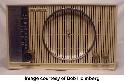
I have a Zenith H511-Y "Consol-Tone" (black bakelite cabinet) 5-tube AC-DC radio that works, but not very well. During the day I get only two stations, one a 50kW station 35+ miles away, the other a 1kW local just two miles distant from my apartment. At night, however, I get stations from several Great Lakes states (Ohio [Cleveland, et al], SE Michigan [Detroit], NE Illinois [Chicago], Indiana [Fort Wayne], but not Wisconsin) and up and down the east coast. I have no reception below about 800 kHz. Could this be due to bad capacitors? The antenna connections are good.
The speaker is shot as well (cone is unbelievably torn up -- but, somehow, it still works). The only thing stopping me from replacing it is the fact that the original is 3.2 ohms. Would an eight-ohm speaker work just as well, or would I be running the risk of burning out the output transformer and/or the 50L6 audio output tube with a speaker of higher impedance? Lastly, I am wondering what the significance is, if any, of the pilot light in my H511 (and all other Zenith radios of its type; Zenith probably made tens of thousands-plus of these sets in the early to mid-1950s, including an AM/SW battery set, the model J402T) other than just as an on-off indicator. The bulb in mine burned out with a brilliant white flash as soon as I turned on the radio for the first time after winning it in an eBay auction (I did not know then, about ten years ago, the importance of recapping old radios before using them). There was no damage that I could see, and the radio worked after the bulb burned out, but I noticed the 35W4 rectifier tube was glowing much brighter than normal. Someone on another antique radio forum (not ARF) told me shortly thereafter the rectifier tube will burn out soon if the radio is operated without the pilot light in the circuit. My question: Is the #47 pilot light in the H511 radios an integral part of the power supply? It must be, if the rectifier tube glows red if the bulb is burned out or is otherwise out of the circuit, but I don't see how, unless the bulb is part of a voltage divider or serves some other function in the B+ power supply. Thanks much.
__________________
Jeff, WB8NHV Collecting, restoring and enjoying vintage Zenith radios since 2002 Zenith. Gone, but not forgotten. 
|
|
#2
08-05-2012, 09:24 AM
|
||||
|
||||
|
Quote:

__________________

|
|
#3
08-05-2012, 11:21 AM
|
||||
|
||||
|
Quote:
I also mentioned a Zenith AM-shortwave battery set (farm radio?), 1952 vintage, similar in appearance to the H511. I spent literally hours last night on Google and even eBay looking for information on it (I am interested in this model because of its similarity to the H511), but couldn't find anything. Were these radios any good on shortwave or just so-so? I would think the latter, since the radio was primarily designed for AM broadcast reception. Also, what types of batteries did this radio use, and where were they stored inside the set? The cabinet doesn't look anywhere nearly big enough for the large 90-volt B battery needed for the plate supply or the smaller batteries needed for the filaments. As large as the H511 cabinet is, it almost certainly isn't big enough for a combo AB battery pack either. The chassis sits on the floor of the cabinet with no space, that I can see anyway, for batteries underneath it. Unless the battery-powered AM-SW version's cabinet is actually larger than that of the line-operated H511s, I cannot imagine where the batteries would be stored. Having a large battery pack sitting alongside the radio wouldn't settle well with most people, unless the batteries were in a separate case that could be hidden under the table on which the radio sits. Also, the schematic you included with your response is not specifically for the H511. I realize that diagram is for generic 5-tube AM radios (commonly known as AA5s), but is it close enough to the H511 circuit design as to be usable with the latter? I am asking because the H511 has at least one circuit refinement most AA5s do not have -- namely, a tone-compensation network in the audio stage, before the output tube. This probably has no bearing on the configuration of the power supply (when you've seen one AA5 power supply, you've seen them all, except for those weird series-parallel arrangements sometimes found in high-end sets; I have a Zenith MJ1035 with such a filament configuration), but I mention it as a point of interest. Thanks much.
__________________
Jeff, WB8NHV Collecting, restoring and enjoying vintage Zenith radios since 2002 Zenith. Gone, but not forgotten. Last edited by Jeffhs; 08-05-2012 at 11:50 AM.
|
|
#4
08-05-2012, 01:27 PM
|
||||
|
||||
|
If you have no reception below 800kHz both day and night, inspect the tuning cap, it may have a slightly bent plate that is shorting out either the antenna coil or the oscillator coil as the plates are meshed. Inspect it closely as you run the tuning up and down. You may be able to hear a scratchy sound as you tune below 800kHz.
Can you patch the speaker? Elmers glue and tea-bag paper works well. Of course, recap it and replace the #47 bulb! Why even ask? jr PS: I suspect that you are looking for info on the Zenith J420T, (J402T does not exist): http://www.radiomuseum.org/r/zenith_j420t_ch4j60t.html Is that it? Last edited by jr_tech; 08-05-2012 at 02:28 PM. Reason: add j420t info
|
|
#5
08-05-2012, 03:51 PM
|
||||
|
||||
|
As jr tech mentions
 The cap on the AVC line may be leaky and interfering with the automatic gain function. Just change one wax cap at a time, so you don't forget where its replacement connects to. Change the electrolytic caps too. Thought comes to mind: check that the antenna circuit doesn't have a broken wire. Though I'd think that the 12BE6 grid would not be biased properly and the set would be deaf. Though it's way down on my list of suspects today, a weak IF tube or 12BE6 could be the problem. But I always blame wax caps first, just replace them on sight.
__________________
|
| Audiokarma |
|
#6
08-05-2012, 07:36 PM
|
||||
|
||||
|
Quote:
Yes, it is. I had forgotten the exact model number and was wondering why I couldn't find it through Google. Thanks much for the correction. Thanks much as well for the info on possible causes of no reception below 800 kHz on my Zenith H511Y. I took the radio apart this afternoon and looked at the tuning capacitor; yes, there were at least two plates on the tuning cap rotor that were bent out of shape. I rebent them (carefully!), put the chassis back in the cabinet, and fired it up. One of the first stations I received was WJR in Detroit on 760 kHz, which I had heretofore been unable to tune in on this radio because of the short in the tuning capacitor. The radio now picks up many more than just two stations; since repairing the tuning cap problem, I found I could receive 740kHz (CFZM, Canada), 850kHz (WKNR, Cleveland, ESPN sports), 970kHz (WFUN, Ashtabula, near Lake Erie, also ESPN), 1100 kHz (WTAM, Cleveland, FOX news/talk/sports), and several other local stations besides, to say nothing of the many out-of-state stations I hear on this set after sundown. I never hear any stations from Florida, Alabama, Mississippi or other areas of the southern US except Georgia on any of my radios, though; I wonder why. (I live in northeastern Ohio near Cleveland.) I believe there is an ESPN sports talk radio station near Tampa which does just that (cuts power back from 50kW to 0.25 kW or less), and drives people close to the towers crazy during the day when they may be hearing the station not only on their radios, but also in their stereo systems between local AMs, through the amplifiers of the stereo phonograph, even on the burner coils on their electric stove if they have one, or on bedsprings! (I've actually heard of this happening in areas extremely close to high-powered AM radio stations, and I personally had a problem similar to this when, in the early 1970s, I lived within one city block of a local FM station, running 27.5 kW ERP, on 92.3 MHz; the signal would come in on just about everything, even a solid-state stereo tape deck and, amazingly, on channel 6 on my Silvertone roundie color TV.) People living near the towers of then-500kW (in the 1930s) WLW-AM radio in Cincinnati had problems like this and worse whenever the station was on the air. Light bulbs would glow even if they were not in sockets or were in unplugged table lamps, fluorescent bulbs would glow and had to be put in closets when not in use ..... What a mess! I bet Cincinnati's farmers breathed a collective sigh of relief when the FCC finally set the present power limit for AM radio stations at 50 kW, and ordered WLW to shut down its 500kW monster for all time. Of course, people living very close to such towers, or even lower-power ones, may still have problems with the extremely strong signal coming in over their stereo phonographs, lighting incandescent bulbs unintentionally, the station coming in on bedsprings or electric stoves, etc. Amazing what a little bit of judicious bending of a tuning cap plate can do to bring an old radio back to life. This Zenith was an eBay score about ten years ago. I've liked anything and everything Zenith for years, and in fact had an H511Y just like this one in the early 1970s (it was given to me by relatives who were doing major housecleaning). The one I had got lost many years ago; I missed it, so was very glad to find an identical one on eBay in 2002 or so, the year I joined VK (then AK). There is hardly anything to go wrong with sets like this except bad tubes, although I do hope I don't have to replace the 3-section electrolytic in the power supply, since it is a special non-inductive type that cannot be replaced with a standard, off-the-shelf filter capacitor unless a special modification to the chassis is made (this modification is detailed in a note on the schematic). Why Zenith decided to design the H511s with such an oddball type of filter cap is beyond me. 
__________________
Jeff, WB8NHV Collecting, restoring and enjoying vintage Zenith radios since 2002 Zenith. Gone, but not forgotten. Last edited by Jeffhs; 08-05-2012 at 07:41 PM.
|
|
#7
08-05-2012, 10:53 PM
|
||||
|
||||
|
Quote:
 Pip, the DX cat says that ICOMS are purrrrrty good! jr This station list might be helpful: http://www.ac6v.com/clearam.php Happy DXn! Last edited by jr_tech; 08-05-2012 at 11:17 PM. Reason: add cc list link
|
|
#8
08-07-2012, 09:56 AM
|
||||
|
||||
|
The noise problem in the building is one thing, but an AA5 can often do amazingly for DX at night if it's tuned up right. If you recap that little Zenith and max tweak the IF's, it should be easily able to pick up WWL New Orleans 870 Kc at night, and WSB Atlanta 750 Kc. Try it near a window and turn it about to aim the loop antenna. If it doesn't have an X type safety cap install one going from the cold side of the power switch to the other side of the line. That will often cut a lot of the noise carried by the power line.
__________________
Reece Perfection is hard to reach with a screwdriver.
|
|
#9
08-07-2012, 01:24 PM
|
||||
|
||||
|
Quote:
BTW:One thing I've been wondering about for the longest time is why Zenith used a special non-inductive type of electrolytic filter capacitor in the H511 series of table radios. If this cap needs to be replaced at any time, Zenith states (on the schematic) that the capacitor must be replaced with the same type as originally found in the radio, or else, if the cap is replaced with a standard one, a special circuit (shown in dashed lines on the diagram) must be installed. I wonder why Zenith chose to use a non-inductive type of electrolytic in these radios, rather than an ordinary, garden-variety 3-section one. What is/was so special about the design of these radios as to require the use of a non-inductive main power supply filter capacitor? I realize the H511 series was one of Zenith's best small table radios in the early to mid 1950s, but to use a special (and likely unavailable except on special order) filter capacitor in the B+ power supply doesn't make a lot of sense to me. As to tweaking the IF transformers, I'll have to leave those alone since they require a special tuning tool (Zenith 68-19), which is probably no longer available. I couldn't do anything with those transformers even if I had the alignment wrench, since I do not have an RF signal generator. I am amazed at the simplicity of the circuitry in the H511 series; the schematic takes only one page, at least in the Riders schematic series (the Sams Photofact folder for this set probably has a much larger diagram). This is probably because these are simple 5-tube (AA5) radios with the same basic circuitry as has been used in such radios since they were introduced in the 1940s or '50s. The only difference I can see in the H511s (commonly known as Zenith's "Consol-Tone" and/or "racetrack" sets and housed in rather large oblong-shaped cabinets) is the tone- and volume-compensation circuits in the audio stage (a hallmark of this series), either between the 1st audio stage and the output tube or between the output tube and the speaker. Some of these radios used a small 3- or 4-lead encapsulated printed circuit component in the audio output to perform the audio shaping task. My H511 doesn't have this part (I've looked high and low in and under the chassis trying to find it), but probably uses discrete components to achieve the same results.
__________________
Jeff, WB8NHV Collecting, restoring and enjoying vintage Zenith radios since 2002 Zenith. Gone, but not forgotten.
|
|
#10
08-07-2012, 02:43 PM
|
||||
|
||||
|
I have a Zenith J615 (one year newer than the H511) with the extra 12BA6 RF amp stage. This makes a difference, especially in the daytime reception. One thing I did was "peak" all the IF can trimmers. I am confined at work to a brick-metal building, a literal "faraday cage , so I had a challenge to optimize daytime reception. This is the best performer in this building to date.
Jeff, if you need the Sams for the alignment procedure, PM me. It may be the last thing (after those caps) you need to do. The other radio I used to make this daytime reception comparison is a Motorola H56, a typical AA5. I restored it at work "in the cage" over several lunchtimes, and I could barely get more than a few non-local stations after doing the standard alignment. Now its on loan to a family member as a daily driver for the kitchen. Motorola 56H.jpg The Motorola does not have the RF amp stage either, so I imagine your Zenith would be slightly better. Reece is spot on advise........ get close to a window or at least an outside wall. AM hates tunnels. 
Last edited by DavGoodlin; 08-07-2012 at 03:10 PM.
|
| Audiokarma |
|
#11
08-07-2012, 04:10 PM
|
||||
|
||||
|
Quote:
A curious thing about radio and TV reception here is that FM reception is great on all but a few stations, but television reception with an antenna (particularly digital) is not as good, which is why almost everyone in the building, myself included, has cable. I do not receive two Cleveland TV stations on VHF DTV channels 8 and 10 (virtual channels 8 and 19) on an indoor antenna -- and don't you know it, the subchannels of those stations (Antenna TV and MeTV, respectively, retro TV channels showing old programs from the 1950s to about the mid-'80s) are the two channels I watch the most. The others (5, 8, 19, 25, 43, 55, 61) come in on an antenna as nice as you please on my flat screen, and I think they look even better now than they ever did in analog. The Zenith H511 series doesn't have an RF stage. It is just a basic AA5; the only refinements, as I mentioned in my post, are tone-compensation circuits. This series was known as the "Consol-Tone" series because of their rich, full sound from a 5" speaker. Since most AM stations these days do not play music, I guess the high-fidelity feature of these radios is lost -- unless you live in an area that has one or more music stations. One AM music station with a decent signal is CFZM in Toronto on 740 kHz. If you live in the northeastern US or the Great Lakes region, you can probably hear "AM 740" quite well. I live within one mile of the south shore of Lake Erie and can hear the station just about all the time. CFZM also has an Internet audio stream at www.am740.ca if you cannot hear the station OTA.
__________________
Jeff, WB8NHV Collecting, restoring and enjoying vintage Zenith radios since 2002 Zenith. Gone, but not forgotten. Last edited by Jeffhs; 08-07-2012 at 04:15 PM.
|
|
#12
08-07-2012, 06:51 PM
|
||||
|
||||
|
I've gotten 740 at night as far south as southern Georgia.
__________________
Tom C. Zenith: The quality stays in EVEN after the name falls off! What I want. --> http://www.videokarma.org/showpost.p...62&postcount=4
|
|
#13
08-08-2012, 08:49 AM
|
||||
|
||||
|
Jeff,
I have a 3.2 ohm speaker from a 70's era Zenith TV, I think its 4" are you interested?
|
|
#14
08-08-2012, 12:50 PM
|
||||
|
||||
|
Quote:
Yes, thanks, I would be. I'll send you a PM with my name and address.
__________________
Jeff, WB8NHV Collecting, restoring and enjoying vintage Zenith radios since 2002 Zenith. Gone, but not forgotten.
|
 |
|
|




 Hybrid Mode
