
|
|
|
|
|
#3
 06-28-2006, 12:06 PM
|
||||
|
||||
|
Quote:
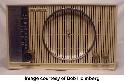
BTW, if I remember correctly, this model also has an external antenna terminal on the back cover. Be careful that you do not touch this terminal and a grounded object at the same time while the radio is plugged in; if you do, you will get a nasty shock. The same warning applies to the chassis itself. Don't touch it and ground at the same time; here's why. These AC/DC five-tube radios were made long before the era of polarized plugs, so you have an exactly 50-50 chance of plugging the cord into the wall outlet so that the hot side of the line is connected to the chassis or that the chassis is grounded through the power line; that is, with the plug in the outlet one way, the chassis is grounded. Turn the plug upside down and plug it in again, the chassis will be hot. Another reason for being sure the radio is plugged in such that the grounded side of the line connects to the chassis is hum reduction. If your radio has a slight hum when operating, and you are sure the filter cap is OK, try reversing the line plug in the socket. Many times the hum will disappear; if it doesn't, you probably have a defective filter capacitor. In a radio of that vintage, this wouldn't surprise me. Even though you say the radio works now, there is no telling how long a 50-year-old filter capacitor will hold out. My grandmother had a 1936 Silvertone table radio, bought new, that worked well for 40+ years with its original filter caps (in fact, the insulation on the power cord crumbled before the caps went bad), but this was an exception to the rule. Filter capacitors were not expected to last anywhere near that long in radios made in the '50s and later. As a rule, any radio made 50 years or more ago either has bad filters now, or the filters will fail soon. I'd recap that Packard-Bell set as soon as possible, again even if it works well at this point.
__________________
Jeff, WB8NHV Collecting, restoring and enjoying vintage Zenith radios since 2002 Zenith. Gone, but not forgotten. 
|
|
#4
06-28-2006, 02:22 PM
|
||||
|
||||
|
The schematics of most AA5 AM tube radios are pretty much all the same.
  BTW, the only thing in common with Packard Bell radios and Packard Bell PCs is the name. Someone bought the rights to the brand name.... Brand names don't mean much anymore. Last edited by wa2ise; 06-29-2006 at 12:13 PM.
|
|
#5
06-28-2006, 08:43 PM
|
||||
|
||||
|
Most of the AC/DC sets which have exposed chassis or antenna connections have the chassis isolated from the circuit ground with a capacitor to minimize the shock hazard. Most that have the power line right to the chassis have an interlock and an insulated cabinet and knobs so you shouldn't get shocked.
I would replace all capacitors though and check the wiring as the isolation capacitor can short and make the chassis truly "hot". Although, some of the earlier AC/DC's do have an exposed chassis and powerline right to the chassis. I would not even use these without an isolation transformer.
|
| Audiokarma |
 |
|
|





 Hybrid Mode
