
|
|
|
#16
 01-26-2012, 01:14 PM
|
||||
|
||||
|
Re: "free power" crystal radio: people are still building these and some report feeding a speaker with such a set that can be heard a room away.
__________________
Reece Perfection is hard to reach with a screwdriver. 
|
|
#17
01-26-2012, 02:04 PM
|
|||
|
|||
|
Quote:
http://www.ke3ij.com/nopower.htm http://www.youtube.com/watch?v=gcui0K7JZXA
|
|
#18
01-26-2012, 02:13 PM
|
||||
|
||||
|
If you are near a very powerful station, say 10, 25 or 50kW (!), an arrangement like this could probably be heard at much greater distances. The transmitters for most Cleveland AM stations, for example, are located in a west-side suburb of the city, and if you are anywhere near them, an amplified crystal set tuned to any of them would probably be so loud as to be annoying, if not downright unbearable; an ordinary free-power set probably could drive a small loudspeaker to a decent listening volume.
The other problem with all crystal sets is poor to downright non-existent selectivity. If you are very near one or more high-power stations, your galena-crystal radio would have the heck of a time separating the signals; in fact, I think you would only hear a mishmash of noise, as your set received all the stations at once. I had a Remco crystal set when I was a kid. The radio worked well enough (using a 50-foot wire antenna in my back yard) to receive the local station in the next town west of me, and I'll never forget the time when, after that station signed off (it was an 0.5-kW daytime only station at that time, late 1960s-early seventies), I actually heard a faint signal from a top-40 rock station in the city of Cleveland, the transmitter being in a western suburb. The station itself was not that powerful, either, only running 5kW daytime and, IIRC, 1kW or less at night. I was living at the time in a Cleveland suburb some thirty miles from the transmitters of all the city's radio and TV stations, so I was surprised -- nay, astounded -- to hear that 5kW station on a crystal set, albeit faintly, like a gnat sighing through a window screen at 10 paces. The only thing I can figure is the propagation conditions that night must have been unusually good. Never heard any other Cleveland stations on that Remco free-power radio, though, and the radio itself is long gone.  I hate to think how loud Cincinnati's WLW must have been on crystal sets when that station was running its 500-kW transmitter in the 1920s-'30s. A plain crystal set without an amplifier would have picked up the station with room-filling volume, and then some; one could probably use a speaker in place of headphones easily. However, I would hope that any crystal set driving a loudspeaker, with or without an amplifier, would have some sort of output limiter or even an actual control to allow the listener to reduce the volume if desired or if necessary -- especially if listening to a close-by 50-kW station.
__________________
Jeff, WB8NHV Collecting, restoring and enjoying vintage Zenith radios since 2002 Zenith. Gone, but not forgotten.
|
|
#19
01-26-2012, 07:13 PM
|
||||
|
||||
|
The typical toy or oatmeal-box crystal set is very lossy which cuts both sensitivity and selectivity. The only power that an unamplified set has is the power coming in on the antenna, so for high performance, as much of that signal as possible has to be conserved. Many advanced crystal set constructors these days build sets with super low-loss tuning capacitors, air-core litz wire coils and special insulation techniques that are as sensitive as and separate stations as well as a superhet, as incredible as that may seem. Even the interchannel band flutter can be heard on some of these sets. If you search for "selective crystal set" or "crystal set contest," you'll find descriptions and pictures of such sets and see that many have logged up to hundreds of confirmed stations on their sets. Special techniques are used to keep losses low and to match sensitive headphones
 to the high impedance of the set. These are unpowered sets and do not use amplification of any kind. In the case of a local flame thrower, a coil/cap wave trap can null it out. to the high impedance of the set. These are unpowered sets and do not use amplification of any kind. In the case of a local flame thrower, a coil/cap wave trap can null it out.
__________________
Reece Perfection is hard to reach with a screwdriver.
|
|
#20
01-28-2012, 12:49 AM
|
||||
|
||||
|
thanks
Thanks for all replies, info is great, the most fun post I have done in a while.
Depending on skip and antenna used, headphone volume is medium to even loud at certain times. Those type C are awesome, just bought a second pair, going to sale other headphones, makes a big differance. I'm really sold on these type C phones. Interesting link says 1n34a preferred crystal, I was using a silicon w/ good results. I saved a extra large old archaic 1948 sylvania 1n34 years ago, pulled from first tv I worked on, simply to save it since ITS very EARLY solid state diode. Volume is great now! set even works well no earth ground! Make's it perfect and portable to bring out to yard or anywhere to listen to. Will check additional info, Thanks. There is a cross talk problem with two statios only part of the time. The slider can discriminate the primary station and cancel out the other, only happens part of time. Further improvements such as a tuning cap probaly will help with selectivity. That video w/ Kent guy is amazing, his set is loud enough to drive a small speaker. Investing in time to tinker really makes a nicer set. Awsome homebrew. Everyone check out Ken't loose coupler. I would of kept it the same as first video since closely to vintage coupler, other video shows coupler wildly modified. IF ANYONE BUILDS THEIR OWN LOOSE COUPLER, USE three slides, more selective w/ better results as video demonstrates.
__________________
1977 Zenith Chromacolor II A Very Modern Zenith Last edited by vintagecollect; 01-28-2012 at 10:43 PM.
|
| Audiokarma |
|
#21
01-30-2012, 03:35 PM
|
||||
|
||||
|
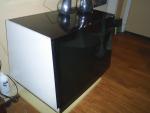
Here's a better pic of set.
CAN someone please tell me the benefit of a Double galena Detector????? 
__________________
1977 Zenith Chromacolor II A Very Modern Zenith
|
|
#22
01-30-2012, 06:56 PM
|
||||
|
||||
|
Experiments have been done since "ancient" times with multiple detectors. I believe in most cases little or no advantage was found when using more than one detector at a time in some rectifying circuit. On advanced sensitive sets, often several samples of detector are tried to find the "hottest" one. Some have used a switch to go between two diodes, to pick the more sensitive one. Then that one would be compared to another, and so on going through the stock of detector diodes.
__________________
Reece Perfection is hard to reach with a screwdriver.
|
 |
|
|


 Linear Mode

