
|
|
|
#18
 04-16-2012, 06:53 PM
|
||||
|
||||
|
Quote:


|
|
#19
04-17-2012, 01:34 AM
|
||||
|
||||
|
Quote:
 See this excellent video for further information on the subject. I am well aware that the lipsync and flutter leave a lot to be desired. http://www.youtube.com/watch?v=1vh-wEXvdW8
|
|
#20
04-17-2012, 11:57 AM
|
||||
|
||||
|
Quote:
As far as color curves, for Technicolor, I'm not aware of any being published. Technicolor patented the earlier (late 20's early 30's) single-strip two-color version of Technicolor, and in doing so described the complete process. Kalmus always thought that he accidentally gave away the store, by making it easier for his competitors to duplicate his results and eventually improve on them. So, later when Technicolor patented the improved three strip version, he patented the process as a whole, but intentionally left out many key details. Today, it is easy to color correct a Technicolor print digitally, but the biggest problem today is that the younger color correction people have never seen an original Technicolor print and usually get it way too beefy. In pre-digital days, I occasionally had to make made photographic copies of Technicolor prints where the originals had been lost or damaged and until you actually do tests on each and every job, you can never tell how the color used in the dyes will react on color negative film. This almost always required either a negative contrast mask or a specific color flash or both to keep the color acceptable. James.
|
| Audiokarma |
|
#21
04-17-2012, 04:34 PM
|
||||
|
||||
|
I have a copy of "Colour Cinematography" (1951) by Adrian Cornwell-Clyne, which has an extensive section on Technicolor. It has a diagram of the printing machine. It gives some formulas for dyes, with a warning that they are presented for schematic purposes only and different ones may have been used. It gives no spectral curves.
The closest thing I have is a neutral density spectral curve that was published as part of a BBC paper in the mid 60s about the problems of low deep-red and infrared density of Technicolor dyes causing a red fog when televising these movies. This ND curve is convincing, as it shows the decreasing density towards deep red, which was also a known problem for Technicolor dye sound tracks that caused the use of a silver soundtrack instead. Unfortunately, there is no determinate way to separate the neutral density spectrum into the three individual spectra for Y, C, and M. Edit: Regarding the variability when printing to chromogenic film, references say the Technicolor dyes were changed significantly in 1946, producing denser and more neutral blacks, and eliminating the need for a silver base image. Technicolor dyes (the later ones, I presume) were also said to produce better color than Kodachrome (which version, they don't say). Last edited by old_tv_nut; 04-17-2012 at 04:44 PM.
|
|
#22
04-17-2012, 05:07 PM
|
||||
|
||||

Thank you all for the replies! It's a learning experience, for sure. Let me start by saying that the TV does need an alignment of the chroma section, as it has trouble with blues and greens. The RF/IF sections provide a very good and sharp pic, so i won't go there for now.
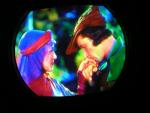
The DVD I used is from the two-disc set of "Robin Hood" that Warner Bros issued a few years back, and the second disc has a feature about Technicolor, the 6th program including some scenes from "OZ". Today I found some time to run the DVD in my newest computer, and took a few shots. It seems that the camera adds purple and blue to the clouds and hills, but not too much. The shots from the TV are over-saturated, for sure, but not that far off from the clips on this particular DVD. As has been mentioned, perhaps different copies used different parameters, and that's why color is different, but my CTC-4 needs some help  . .I've attached two shots, one from the monitor, and the other from the TV. Thanks again for all the comments and info! It is much appreciated .
__________________
stromberg6
|
|
#23
04-18-2012, 03:51 AM
|
||||
|
||||
|
Quote:
the same one on betamax and VHS, two on Laser disk, 4 on DVD and the 70th anniversary editions on DVD and BluRay. No two look the same. Cliff
|
|
#24
04-20-2012, 11:25 AM
|
||||
|
||||
|
Quote:
Cliff
|
|
#25
04-20-2012, 10:51 PM
|
||||
|
||||
|
Quote:
as Oz (Australia) used PAL.
__________________

|
| Audiokarma |
|
#26
04-21-2012, 12:33 AM
|
||||
|
||||
|
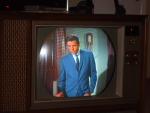
Here's a shot of my CTC-16 of the same scene. 70th anniversary DVD. The color on this set is outstanding. The picture does not do it justice.
__________________
"It's a mad mad mad mad world" !! http://www.youtube.com/user/mwstaton64?feature=mhee
|
|
#27
04-21-2012, 02:09 PM
|
||||
|
||||
|
Quote:
Walter Burridge, scenic artist who painted sets for 'The Wizard of Oz', continued the yellow brick road into the valley behind Dorothy and nearly over the horizon and into those white clouds. Dorothy is I believe just a few feet from the beginning of that photographically inserted image when she turned around to wave. There are also some blue fields far into the painting through which the yellow brick road meanders. The CTC16 image does suggest those patches of blue. Reproducing that rendering with NTSC chrom modulation/demodulation has gotta be one tough job IMO. For the record, my 'reference' image is from the 70th Anniversary Edition Blu-ray Disc played on a PS3 with component interface to an RCA f38310 (38-in. 9X16 CRT 1999 set which, as I learned at a recent ETF Convention from a former member of the team who designed it, was not considered a true hi-def TV because it didn't qualify pixelwise). Also, my Canon overexposes screen shots for some reason, so for a reference image it appears somewhat unsaturated, which in this case does not compromise sharpness. It is a 3.37-meg jpeg that may not be allowed by VC. If not, I'll send it if you'll email me. And. The Oz artist Burridge painted a curtain in a theater here in MI that's still used today. (my daughter plays Cello there sometimes; the connection to the movie was a treat) Pete
|
|
#28
04-21-2012, 02:30 PM
|
||||
|
||||
|
The colors on mine may be a little over saturated(my opinion) but I think they are very close, about as close as you can get from a roundie.. It may be due to the camera. My camera is 14.4 megapixel. I had to reduce the size and that reduces the quality. The pic on your set of course is much better and your PS3 will do a better job than the cheap Phillips player I have with a converter. I only use it because I can turn the macrovision off. Besides yours is not running through the tuner. I may try to add RCA jacks someday. That will increase the picture quality tremendously. Glad that painted curtain is still around and is still in use. VERY cool!
__________________
"It's a mad mad mad mad world" !! http://www.youtube.com/user/mwstaton64?feature=mhee
|
|
#30
04-21-2012, 05:05 PM
|
||||
|
||||
|
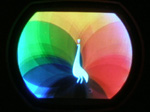
OK, here's my version, full 1080p on a 2 year old Plasma.
Probably should have used a Tripod to avoid the pincushion at the bottom but I didn't want to dig it out.
|
| Audiokarma |
 |
|
|






 Linear Mode

