
|
|
|
#1
 11-30-2013, 05:54 PM
|
|||
|
|||
|
Found: 15GP22 (I think)
First of all I am not a TV guy. I am a radio guy. I know enough to generally just get me in trouble.
Purchased some radio related items and found this. I knew enough that I knew portal tubes were generally collectible. But that was my limit. After I got it home and started dusting and doing some research I discovered this may be a 15GP22 that was used in a RCA CT-100. In speaking with the seller, this tube may never have been installed in a set. Her dad was always bringing home prototypes. I know that good tubes are better than non working. So how can I get this tested? And how do I verify that this is a rarer color portal tube and not just some black and white portal cheapie? Thanks 
|
|
#3
11-30-2013, 06:25 PM
|
||||
|
||||
|
Definitely looks like a 15GP22. The 20 pin base is a dead giveaway. This looks like it was a homebrew test jig for working on very early color sets.
There should be a marking on the neck somewhere near the base. You will want to get a look at the getters in the neck area to see if the tube has gone to air anyway.
|
|
#4
11-30-2013, 06:38 PM
|
|||
|
|||
|
Quote:
How do I slide the neck covering? Is it screwed?
|
|
#5
11-30-2013, 07:09 PM
|
|||
|
|||
|
Very cool find. Why can't I ever find treasures like that? Oh well, hope it tests good for you.
|
| Audiokarma |
|
#6
12-01-2013, 03:13 AM
|
||||
|
||||
|
Quote:
 This diagram also points out the purity coil, along with the deflection yoke: 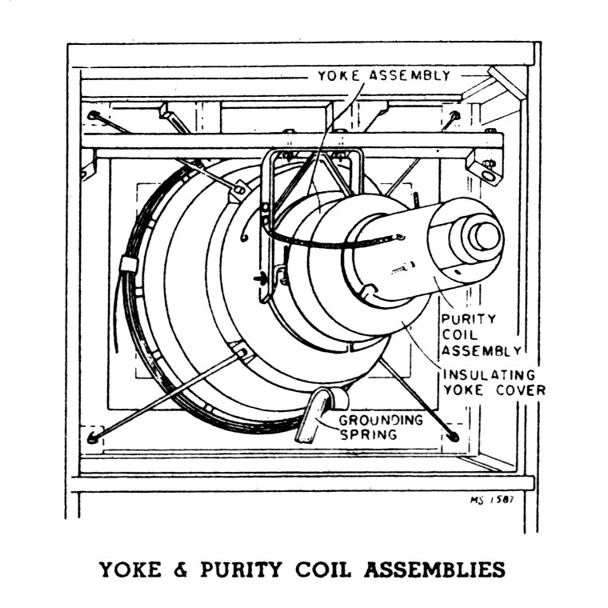 The purity coil is not very heavy. After loosening the clamp screw, turn or slide it gently in case it's kind of stuck to the neck. Once free, it just slides back off. When that is off, you should be able to see the number 15GP22 stamped in black ink on the glass neck. If the neck is dirty, rub gently with a dry paper towel. Whether or not you find the tube marking, this looks like a 15GP22 to me. You may be able to see the getter after removing the purity coil. In this photo, the getter is a darkish blob inside the neck glass, about halfway between the tan tube base and the area where the black coating begins. 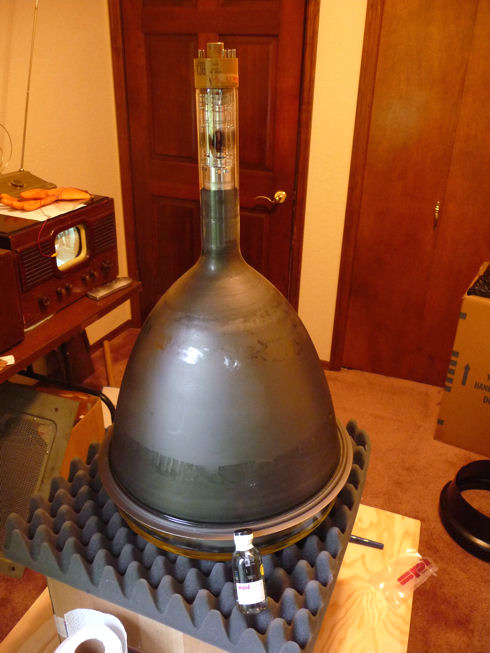 If the getter material has turned all white, that's a sign that your tube has lost vacuum and can't be used in a TV. If it's dark as in that photo, or even better, if it's nice and shiny looking, then cross your fingers that the vacuum is still holding. The tube might still have other problems, but at least it's not a stone dud. If you can't see the getter after removing the purity coil, you'll need to remove the deflection yoke. This part is much heavier than the purity coil, so you'll want to work with care while removing it. It looks like you have a sort of homebrew yoke mount. (In a CT-100, the yoke is hung by a metal frame from a stout wooden bar.) After you loosen whatever screws or nuts that mount uses, you want to slide the yoke straight back off the tube neck, just as you did the purity coil. Here's a photo of the deflection yoke removed from my CT-100 (and still attached to its wooden bar).  If your getter doesn't look dark or shiny, don't lose hope as long as it's not all white. One of my 15GP22 tubes has a getter that's practically transparent, yet it tests and plays like a new one. Taking a look at the getter will give you one piece of data, but that's not the whole story. You'll need a picture tube tester to tell whether your tube has strong enough emission to make a good color picture. Even if the tube looks dead, it is still worth saving, since some day it may be possible to rebuild them just as in the good old days. Phil Nelson Phil's Old Radios http://antiqueradio.org/index.html
|
|
#7
12-01-2013, 06:49 AM
|
|||
|
|||
|
Great post, Phil. That should help Art immensely.
Wish I wasn't 200+ miles away, or I would have been right down there to test that tube for him. Maybe someone closer could help him with that? He's located in Bolingbrook, IL. .
|
|
#9
12-01-2013, 09:49 AM
|
||||
|
||||
|
Shoot, I would be able to test it for you, but I'm out of town for a while.
I live in Naperville.
|
|
#10
12-01-2013, 11:16 AM
|
|||
|
|||
|
Quote:
|
| Audiokarma |
|
#11
12-01-2013, 11:18 AM
|
|||
|
|||
|
Well I felt ambitious enough to remove the purity coil but that is as far as I think I will go.
From the pictures this tube almost looks brand new. And it is confirmed to be a 15GP22. What do you experts think?
|
|
#12
12-01-2013, 11:56 AM
|
||||
|
||||
|
The next question is: just what kind of set did this tube come out of?
__________________
tvontheporch.com
|
|
#13
12-01-2013, 12:20 PM
|
|||
|
|||
|
Quote:
|
|
#14
12-01-2013, 12:22 PM
|
|||
|
|||
|
Quote:
I like priceless?  . . 
|
|
#15
12-01-2013, 12:44 PM
|
||||
|
||||
|
Quote:
__________________
tvontheporch.com
|
| Audiokarma |
 |
|
|



 Linear Mode

