
|
|
|
#16
 06-25-2016, 09:43 PM
|
||||
|
||||
|
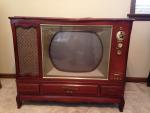
Figured out that's coil near the audio output needed tweaked a little and I replaced the audio output tube. There was also a lot of interference in my set I couldn't figure out. I finally narrowed it down to the original telescoping antenna. I unhooked it on the back and the reception issue cleared right up! I'm considering this one restored!

|
|
#17
06-26-2016, 05:56 PM
|
||||
|
||||
|
Lookin good!!
Might tweak the vert lin a bit...... Beaver has a case of cone-head syndrome hehe  SR
|
|
#18
06-26-2016, 06:18 PM
|
||||
|
||||
|
I tried and got it better, but too much movement on either the vertical linearity or height and the vertical collapses.
|
|
#19
06-27-2016, 01:22 AM
|
||||
|
||||
|
Quote:
The reason I ask is that sometimes an old potentiometer will behave normally through part of its range, but conk out in other parts where it is gunky or worn out. One way to test this is to disconnect the potentiometer and then measure its resistance while turning it all the way back and forth. This works best with an analog ohmmeter where can watch a needle rather than try to interpret a stream of changing numbers. You should see the resistance change smoothly throughout the entire range of travel. Or, you can just clean the control and see if that helps. This article has a little section with the basics of cleaning pots: http://antiqueradio.org/FirstStepsInRestoration.htm Regards, Phil Nelson Phil's Old Radios http://antiqueradio.org/index.html Last edited by Phil Nelson; 06-27-2016 at 01:31 AM.
|
|
#20
06-27-2016, 04:01 PM
|
|||
|
|||
|
those old pots are often bad, IIRC one or both are WW low ohms with built in range limits. Not to hard to find the correct replacement (you may have to add a limit resistor to be completely safe). You should fix it as its only going to cause issues later.
|
| Audiokarma |
 |
|
|






 Linear Mode

