
|
|
|
|
|
#1
 12-31-2007, 06:01 AM
|
||||
|
||||
|
Quote:
Yellow should be the brightest color of all colors. - Eckhard 
|
|
#2
12-31-2007, 08:08 AM
|
||||
|
||||
|
Quote:
"Those of us directly involved with the 15GP22 project last May at ETF 2007 were relatively pleased with the results, as has been stated before. Not all was perfect of course and so I have attempted to address the most serious anomaly, the poor color bars green-to-magenta transition. To that end, I acquired a B&K-415 generator with the specific purpose of sweeping the chroma circuitry. Before the first attempt however I used a Fluke 77 to troubleshoot a pesky rare intermittent that has been plaguing me on and off for over a year — bright flashes of green in the picture. Turns out the Q demodulator plate load resistor was running 50 to 100 percent high depending on how it was bumped. But unexpectedly there were a number of off-value resistors in the R, and G, amps. As you can see in the accompanying photos, there was distortion in about the first 25-percent of the magenta bar (overexposed screen image shows it off well) before the fix, but a close up now shows much improvement afterword. With three replacement resistors in the amps and the new 18K plate load the set was stable although no longer calibrated. The picture looked ‘orangey’ with brownish greens. Last night I ran a complete new calibration beginning with red purity. The results were quite nice. I suspect better than ever. A word about calibration: before the fix, both the B and G Drive controls needed to be fully CCW; now the picture calibrates with them cranked up somewhere in mid range. The full range of color on the Robin Hood DVD is back, having been lost after the fix. Purple is royal again; trees are green again; Maid M. has stage-makeup red lips again. I also touched up the convergence and lucked out as I managed to avoid a slippery slope and the need to start from scratch; photo attached. The color bar screen photo was taken to illustrate the much improved G-to-M transition, the most technically challenging in NTSC bars, and it was taken before the set was recalibrated. Henceforth Eckhard, you shall be known as eagle eye.  Pete
|
|
#3
12-31-2007, 06:50 PM
|
||||
|
||||
|
Quote:
However, green is still fairly dark. - This could be a combination of low Q gain (or high I gain); the response of the still camera; the matrix in the still camera that converts its raw sensor output to sRGB (which has a smaller gamut than NTSC); or some other factor, like clipping in one of the matrix stages. Note that the cyan is quite bright (brighter thatn the yellow) even though the green is dark. This leads me to suspect that most of what we see is due to the still camera. Pete - Some things you could try: you could set your camera for a slower shutter (like 1/8 or slower). Also, you can check if the green appears this dark and the cyan this light to the eye. Also, you could check the relative gain of I and Q. If you look at the R, G, and B outputs with a scope, you can check for waveforms that are nice and flat and equal-height sqiare waves.
|
|
#4
01-01-2008, 12:38 AM
|
||||
|
||||
|
Quote:
Attached are G1 waveforms (taken waiting for the Times Square ball to drop), plus my best shot of the screen image those waveforms generated. I think you can see an improvement over the other (pre-cal) color bar image. The screen looked okay to me through R, G, and B filters. The A630 overexposes my scope shots, but you can see the red trace amplitude is greater than green and blue, as it should be driving a 15GP22. Vertical sensitivity is 50 V/cm. I have yet to check the I gain (later today maybe), but the control is so narrow I will be surprised to find a problem there. ------------------------------------------------ 1-1-2008 Yesterday after downloading images to the computer and while still connected to the computer I found a menu showing sRGB. There were options for many other color spaces including 1953NTSC, which I promptly invoked. I can't believe it was that easy to shift an A630 to the coveted original NTSC specification. Anyone familiar with the Canon A630 who can make some sense of it? The three shots below were taken after the 'change' if that's actually what I did... ------------------------------------------------ Last edited by Pete Deksnis; 01-01-2008 at 08:36 AM. Reason: Added text 1-1-2008
|
|
#5
01-01-2008, 07:05 AM
|
||||
|
||||
|
The unweighted color reproduction is not only due to the camera. I have made two screenshots, both with the same color control position but with changed brightness. You can see that the yellow bar is darker in comparison to cyan with lower brightness, but it is brighter than cyan with high brightness.
These old color tv sets do not provide a full contrast range which is necessary for correct displaying the colors. So, people usually watch tv with low contrast and brightness, but high color control setting. Since the color green is computed in the dematrix circuit out of I and Q and Y, the green (and also the yellow) will be much darker in comparison to other colors with reduced brightness, which is a reduced Y. You have to adjust a correct contrast-rich black and white picture before you add color. Is this correct? Kind regards, Eckhard
|
| Audiokarma |
|
#6
01-01-2008, 07:42 AM
|
||||
|
||||
|
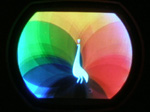
Here is another try of correct color vs. Y relation with the 21AXP22A of the CTC5. Note that the green does not look enough greenish like it is displayed on the screen. This is a true camera artifact.
- Eckhard
|
|
#7
01-01-2008, 08:46 AM
|
||||
|
||||
|
Quote:
|
|
#8
01-01-2008, 10:28 AM
|
||||
|
||||
|
Hi Pete,
take this file http://bs.cyty.com/menschen/e-etzold...mg/rainbow.JPG burn it on a CD, and play it with a DVD-player. What would it look on your CT-100? The white is 100%. Contrast and brightness at maximum with a bright white and a dark black, just before blooming, and then add color. - Eckhard
|
|
#9
01-01-2008, 08:28 AM
|
||||
|
||||
|
Quote:
I agree the contrast range must be ideal before color is added; so I went back to my library of shots, ones taken 12-28-2007, and selected this example of contrast range. This remember was taken before the set was calibrated and so the colors are imperfect. However, note the range of brightness from white (that little wedge showing but mostly masked by the roundy CRT) down 8 steps to black. This test signal remember is from the DVE test disk -- it was made for modern digital sets, and the CT-100 displays it perfectly. It seems also that the A630-camera-to-monitor link displays an analog of that CT-100 screen fairly well. So, based upon this and other examples, I suspect the contrast range of this CT-100 is correct. Keep in mind that the CT-100 was designed to display the 1953 NTSC standard. It may be the only consumer set that could (at least up until today's wide color LCD LED sets, and with those I wonder if they can actually display a full analog NTSC signal or just do the wide color space through a digital interface like HDMI). I believe the CT-100 will reproduce the full contrast range, decode the full chroma signal in a wide-as-possible bandwidth (ameliorated by issues with the quadrature encoding-decoding scheme), process that decoded chroma in a 1953-correct NTSC matrix, and display the resulting RGB signal with 1953 NTSC spec phosphors. I don't know if anything other than a true clone of the CT-100 can do those things. A word about calibrating the CT-100. My method or methods for adjusting a CT-100 come from multiple sources (oh to be able to watch the CT-100 techs setting up these sets coming off the line). The well known SAMS and other sources are basically derivatives of RCA material. But fortunately, one of the Zenith engineers deeply involved with color set design back in 1953 casually related a bit of kernel information that promotes linear operation of the video circuitry (an advance rather than retard thing when setting the screen controls early in the setup procedure). A luckly bit of history available today. Pete
|
 |
| Thread Tools | |
| Display Modes | |
|
|




 Hybrid Mode
