
|
|
|
|
|
#1
 02-10-2008, 07:02 AM
|
|||
|
|||
|
Try pulling the 50L6 out. That will kill your filament current (breaks the string) and your B+ (no rectifier filament, no output). See what happens. If the resistor still smokes, then there is a short somewhere. Go over it with a clear mind and a bright light - look for dripped solder, bent tube socket pins touching, capacitor leads touching something, etc. It's easy to bend things just close enough to touch while you're working. We have all been there, and done that. Don't worry - you'll find it.
And the resistor didn't smoke with the 15W bulb because the 15W bulb has a much higher resistance than a 40W bulb. It couldn't get enough power to smoke.  Can you post a photo of the underside of the chassis? -Ian 
|
|
#2
02-10-2008, 10:20 AM
|
||||
|
||||
|
Quote:
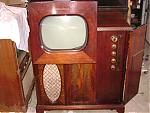
I pulled the 50l6 with no change, so i went looking for the short again. This time i found it,a pair of leads touching- when looked at from one angle it looked fine but from another angle it was touching. fresh eyes made the difference. I had looked at this thing so long yesterday that my eyes were crossing. Now the radio works great. Another word of caution (to the new guy or gal that reads this), I knew it was time to stop last night when after putting both hands in the chassis i realized that i had not unplugged the radio, just turned it off at the volume knob. I didn't get shocked but i was getting tired and careless. I figured i dodged a bullet there. I probably should have stopped a couple of hours before i realized i needed to stop. Lesson learned. I appreciate you guys helping me out. Here's a pic of the two (now functional) radios i have under my belt so far. Time to start another. (1947 Bendix Model 697A step table radio with phantom dial) Chris
|
|
#3
02-10-2008, 10:37 PM
|
|||
|
|||
|
Good going! Don't worry - it's easy to make these simple little mistakes, especially when you're tired. No matter how much experience you have, every now and again you'll do something like this. Case in point, a few weeks ago, I recapped a simple Airline console radio/phono. I did a full recap and replaced the selenium rectifiers with diodes. Plugging it into the dim bulb tester after this read a direct short, and a power resistor inside was starting to smoke. I went over the wiring time and again, checked and rechecked the electrolytics and diodes. Everything looked good. Start pulling tubes and testing - still no go. I didn't have a schematic, so I was just going by the components in the set. Eventually find out that I had installed both diodes backwards. I had gone by the markings on the old selenium rectifiers, and not by the circuit itself. You see, the + on a selenium stack is really the _cathode_. Not the anode as I had thought with a tired mind. Silly me.
Being patient, rechecking, coming back with a clear head, and using proper test gear - like the dim bulb tester - are all great ways to solve problems. And it's very satisfying when you find it too! -Ian
|
|
#4
02-17-2008, 08:19 AM
|
||||
|
||||
|
Amen to the caution about working on gear when tired or perhaps otherwise impaired. Best to go at things with a fresh, alert mind, and with care.
A long time ago a friend of mine sustained serious injury when he brushed a couple of terminals in the power supply of a mighty tube amp he had just built. He was tweaking the bias and balance controls underchassis when his pinkie finger on his right hand went some place in the chassis where no pinkie should go. He burned two craters clean to the bone in that finger, and his whole arm turned black-and-blue, and was numb and paralyzed for several minutes. He said he felt like he was trampled in a stampede, and his arm tingled and buzzed for several hours after the incident. He was tempted to get himself to hospital, but wasn't sure he could drive safely, and nobody else was home at the time. The power transformer was a mil-spec type with a series of windings wired up and rectified to produce a 900V potential at 1 ampere. It was the terminals of the 1000mf main filter he brushed. He laid out the following rules after that: 1) No working on such gear when impaired by fatigue or imbibement. 2) Try to have an assistant on hand (usually me) if undertaking a hazardous task with powerful equipment. 3) Always be sure that one can get help if things go bad. 4) Never place both hands in the chassis unless the power is down and the 'lytics are double and triple-checked for charge. My good friend is still around to tell the tale, because his left hand happened not to be on the bench at the time, and the lion's share of the current went through 2 inches of finger. If it had gone through his torso from hand to hand God only knows.... 
|
 |
| Thread Tools | |
| Display Modes | |
|
|






 Hybrid Mode
