
|
|
|
|
|
#1
 03-01-2011, 06:35 PM
|
||||
|
||||
|
The Tech Preservation Schematic Bank website shows the AM loop antenna does go through the RF stage. Bandswitch is shown in AM position.
http://techpreservation.dyndns.org/s...C845M_175.djvu
__________________
Reece Perfection is hard to reach with a screwdriver. 
|
|
#2
03-01-2011, 07:58 PM
|
||||
|
||||
|
You could try a 12BA6 in place of the 6BJ6. pins 2 and 7 are swapped, but as one is the cathode and the other G3 (which is usually at ground) it should work. The tuned circuits around this tube would be a little off, but if you don't get any better results than what you currently have with a 12BA6, the odds are it's not the 6BJ6 tube and you can put it back in.
The 12BA6 and the 6BJ6 have the same heater current, and in a series string set that's what you want. It's possible (and likely with wax caps still in the set) a B+ or screen grid bypass cap has gone shorted. That could drag down the set's B+ enough to disable the FM local oscillator, and make hum on AM. And you might as well replace the other wax caps while you have it on the bench, the rest of the wax caps will soon fail as well.
__________________

|
|
#3
03-01-2011, 10:59 PM
|
||||
|
||||
|
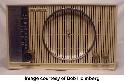
C845 Zenith sings again!
Reece, wa2ise, jr_tech:
Thank you all for your help. I am happy to report that my Zenith C845 high-fidelity radio is once again working as it should. All I did was take the two tubes I mentioned (6BJ6, 12AT7) out of their sockets and reseat them. I also tried substituting a 12AX7 for the 12AT7, with no luck; according to a substitution table I found on the Web this afternoon (I did a Bing search for "12at7 tube" and found the table among about 10000 other search results), this sub should have worked -- the two tubes are identical in every way except for gain figures -- but it didn't, still the same white noise on FM and ground buzz on AM, so I put the 12AT7 back in the set. As soon as I did that and plugged it in again, the radio began to play just as well as it always did. I don't know what I did or didn't do to correct the problem, but in any case the set now works every bit as well as it did before it fell silent the other evening. I left it on one of the local Cleveland FM stations for awhile this afternoon to make absolutely certain I had found the problem. The set worked, but it drifted quite a bit until it was good and warmed up, as these older AM/FM sets had AFC circuits that were probably as good as the state of the art allowed in 1960 (the C845 uses a separate tube, a 6AB4, in this position). Once it warmed up, however, it was rock-stable and played very nicely, bringing in stations from one end of the dial to the other on FM including several from Erie, Pennsylvania -- I'm only 50-60 miles from that city, 35 miles from Cleveland, and about 60 miles from Youngstown and Pittsburgh, so when the FM band opens up I often can hear one station after another as I tune the dial, and it works passably on AM. I have a noise problem here in my apartment (mostly harmonics from TV horizontal oscillators) that makes daytime AM radio all but unlistenable on my older radios, including my C845, but my 1970s-vintage battery-powered portables work perfectly well, bringing in all local stations and even one daytime-only nostalgia station about 80-90 miles from here; of course, I get more stations than I can shake a stick at on AM after dark on every radio I own, including my C845. BTW, I believe it was wa2ise who mentioned some time ago (in response to a question I had posted here regarding AM RF stages in older radios, particularly in the 800 series of Zenith table models) that the 6BJ6 RF amplifier in the C845 series of Zenith hi-fi radios is used both on AM and FM; a look at the schematic will verify that fact.
__________________
Jeff, WB8NHV Collecting, restoring and enjoying vintage Zenith radios since 2002 Zenith. Gone, but not forgotten.
|
|
#4
03-02-2011, 11:18 AM
|
|||
|
|||
|
Congrads. Sounds like removing/re-inserting those tubes cleaned some connections that had opened due to oxidation/corrosion. Bill(oc)
|
 |
| Thread Tools | |
| Display Modes | |
|
|




 Hybrid Mode
