
|
|
|
#106
 02-01-2010, 07:20 PM
|
||||
|
||||
|
Waiting for Stromberg67 to come up with a schematic. The only references to NEC IQ demods on the web are for their digital demodulator chip (NOT a chroma demodulator), but it could have been.

|
|
#107
02-01-2010, 08:22 PM
|
||||
|
||||
|
I just did a comparison of component to S-video using one of the excellent Disney DVDs extra feature gallery of artwork stills, and find the differences are quite small. They probably are greater going in composite and still greater going in RF, but I don't have time to do all that right now.
|
|
#108
02-01-2010, 09:23 PM
|
||||
|
||||
|
The Kloss Videobeam 1000 projector from the early 1970s had full I&Q demod. I guess Henry thought it would be necessary with a 54 inch diaginal screen. A friend has one of these and a manual. I don't know if it was done with ICs or discrete transistors. Cliff
|
|
#109
02-03-2010, 02:57 PM
|
||||
|
||||
|
WB IQ schematic found!
Stromberg67 of Rectangle and Solid State posted this, check it out:
[QUOTE]Hi Folks: I have the SAMS for my CTC-133B open in front of me, and the chip designated "U 700" , a 42-pin DIP, shows I and Q demodulators and amps, and the integration of luma and chroma signals on the chip.[QUOTE Kevin.........That CTC133B schematic is a great find! The RCA number 176225 crosses with Hitachi, maybe its the same chip? The fact that it combines luma and chroma at low levels instead of at the CRT is great. It's probably why you get such great color detail. I bet there's a lot of inductors and caps around the chip to do all the required filtering in analog. Is there any way you can scan or photo the small schematic portion around the chroma demod chip? Can you PM me for my email address. If the chip is available ($5.00), it would be fun to attempt to build up the circuitry and try it out. Thanks, Tom
|
|
#110
02-03-2010, 07:19 PM
|
||||
|
||||
|
Why WB IQ was abandon?
Quote:
|
| Audiokarma |
|
#111
04-14-2010, 05:23 PM
|
||||
|
||||
|
So, let me see if I'm following this correctly. Y'all are saying that the CTC2 (CT-100) and CTC2B (21CT55) were the only early sets that used wide-band I and Q demodulation?
Was the change to R-Y/B-Y done just for cost savings? Or possibly the average viewer wouldn't appreciate the difference, anyway . . . ? Just curious. Phil Nelson
|
|
#112
04-14-2010, 06:31 PM
|
||||
|
||||
|
RCA was not the only manufacturer to field a wideband 15" color TV in 1954. The Admiral, sylvania and CBS 15" sets are wideband I/O sets. There may be others, but I cannot recall for certain. The Westinghouse, Sears, Hoffman, GE, Motorola, and Zenith are narrowband.
__________________
John Folsom
|
|
#113
04-15-2010, 01:23 AM
|
||||
|
||||
|
the changes in circuit design were definitely aimed at cost savings. The CTC-5 came in two versions, with the Deluxe being cost reduced from the CTC-2B, and the Super being even more cost reduced. They apparently found that some of the shortcuts in the Super were going too far, as later chassis used a number of circuits first tried in the Deluxe.
|
|
#114
04-15-2010, 07:24 PM
|
||||
|
||||
|
WB CTC2b vs NB CTC4
RCA started its CTV cost reduction with the first chassis after the CTC2B, namely the CTC4. A few comparisons should be noted:
.................................................. ....... CTC2B.................CTC4 Tube compliment:......................................3 7......................26 Stages of picture IF amplification:.................6.................. ......3 Stages of luminance processing:...................2................... .....2 Stages of chrominance processing:...............21...................... .10 I wrote the following in one of my earliest posts on this thread on March 23, 08: I brought the 21CT55 into the house in 1964 after I got it working and ran it along side my Dad's old CTC4 he left me. Both had 21FBP22s so it was a good comparison of narrow BW color R-Y, B-Y vs. full BW color I,Q. The extension of full color into fine detail on the CTC2B was startling! Color persisted in fireworks until extinction that I never saw before. The CTC4 fireworks turned into white long before extinction. The CTC2B carried full color way into the shadows, the CTC4 went gray to black. I kept the CTC4 in the house for the kids but brought the CTC2B back to the garage workshop for further study. Last edited by Tomcomm; 04-15-2010 at 07:35 PM. Reason: Editor doesn't like spaces
|
|
#115
04-17-2011, 05:57 PM
|
||||
|
||||
|
RCA 21CT55 B8802897 is Alive Again!
Now that my 21CT55 picture quality with the FBX transplant its about the same as the original, its time to return to my original 1/13/08 "....Its Alive!" thread. I think it would be good to repeat the first posting of this thread since my objectives remain the same:
I've got this 21in roundie in 1965 from a newspaper want ad, for $50 I think. It didn't work but I got it running with a few tube changes. Picture looked good on the 21AXP22 metal but was was very dim. I exchanged it at the CRT re builder for the brightest rebuilt he had, a 21FBP22 glass for $45. He told me the "FB" meant Full-Bright", what did I know? When I started the conversion from metal to glass, I decided to cut-up the cabinet and mount the chassis vertical so I could get to the under side much easier. This was no big deal since it was never going into the house and would reside in my garage TV repair workshop.This B88002897 proved to be the highest serial and last discovered 21CT55 with CTC2B chassis on a list of only 15 known to still exist! Anyway, I got it working this week after 38 years of storage. I'm using external video since the tuner/video IF isn't passing chroma yet. The 21FBP22 sure is bright, no problem with room lights. The reds are closer to CT-100 then most TV I've seen. I am truly grateful for the interest that John Folson, Pete Deksnis and Ed Reitian took in this reactivation project. I only wish I didn't destroy the cabinet, but that's life. I'm not a restoration person. I hope the restoration members of this forum are tolerant of my efforts to reactivate and possibly improve the performance of this classic color TV. I hope this explains where I'm coming from, thanks..... So lets see if we can pickup this upbeat "....Its Alive" thread from where we left off the depressing "...Its Dead" thread. Does anyone have a listing of all the surviving 21CT55s arranged in ascending serial numbers, including present owners? The ETM doesn't seem to have this info........Tom Last edited by Tomcomm; 04-17-2011 at 06:30 PM.
|
| Audiokarma |
|
#116
04-17-2011, 06:43 PM
|
||||
|
||||
|
Quote:
The FBP/FJP tubes have an orange-red color to me, while the earlier ones were closer to actual red. Placed side by side showing the same color bar pattern, my CTC-7 with CYP tube gets closer to actual red than the later Philco with FBP does. Since I just got a good AXP for the CTC-4, I can confirm that the AXP gets even better (what I would call more accurate) color than the CYP but at reduced brightness. Sometime in the future I'll be doing a full writeup of all 3 tubes, so people can see the actual differences. It's slight, but perceptible.
__________________
Evolution... 
|
|
#117
04-18-2011, 11:59 AM
|
||||
|
||||
|
21FB22A Red Quality
That quote was from Jan 08. At the time I had only observed a live 21AXP22 from 1965 when I replaced it with the present 21FB22A. the AX was so dim that I was overwhelmed with the FB brightness I didn't ponder the red purity of either. In 2008, the red purity of the FB was clearly better that all my "modern" TVs but that was due to their orangeish red Sempti phosphors in general use. I have not directly viewed a CT100 but pics posted by Pete D had reds almost identical with my 21FBP22A. Point of interest, my FB has a llight gray denergized screen while my spare FB is green. I'm assuming the gray FB in use is a "rare-earth" which has supposedly better reds than the sulfide green screen?
Last edited by Tomcomm; 04-18-2011 at 02:47 PM.
|
|
#118
04-18-2011, 01:02 PM
|
||||
|
||||
|
Quote:
Pete
|
|
#119
04-19-2011, 06:46 PM
|
||||
|
||||
|
21FBP22A vs 15GP22 Reds
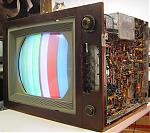
Only good pure red pix of Pete's CT100 I've got on right. Compare with pure red of 21CT55 with 21FBP22A on left. Of course very crude setup but they look very similar, depending on viewing monitor of course.
Last edited by Tomcomm; 04-19-2011 at 07:08 PM.
|
|
#120
05-20-2011, 12:57 PM
|
||||
|
||||
|
Evaluating the 21FBP22A's Phosphor
Quote:
In the meantime I would like you to retake and post the 3 tv cluster pix you have. This time put the Sony closer and adjust the TVs for most accurate red and white color bars. Also pull-in to include only the TVs and shoot in total darkness. I have been playing with the color balance feature of my Photo Impact graphics program that reads the RBG values 0 to 255 of any spot on the JPG image. This is the hacker's approach to chromatic spectrum analysis but should give quantified data on relative phosphor differences of all your CRTs. Thanks for your interest and cooperation.
|
| Audiokarma |
 |
| Thread Tools | |
| Display Modes | |
|
|






 Linear Mode

