
|
|
|
|
|
#1
 01-07-2012, 02:05 PM
|
||||
|
||||
|
Where Do I Begin Here?
Seems I need to reiterate a few items that continue to provoke Member comment.
#1 Why do I insist on running the new FBX and the old CRT at “extreme” ultor voltages? Well RCA and GE 21FBP22 spec sheets specify max operation at 27.5KV. This level is undoubtedly driven by fussy Government X-ray mandate. The specs also notes: “Brilliance and definition decrease with decreasing ultor voltage.” Enough said? Since brilliance and definition increase is what I’m after why shouldn’t I run at 30Kv (109%max) on a new “modern” FBX that requires only 200ma HOT current, at a winding temp of only 112degF! This new FBX is like a brick compared to the fragile original CTC2B FBX that ran 28KV at 264ma HOT. #2 miniman has stated that I could ”find improvements in picture quality by providing a better signal to the CRT, like gutting the decoder entirely and going with something more modern”. Apparently he has missed the point of my entire effort to demonstrate the superior picture quality of the original full BW I/Q demodulation and low level matrixing of the CTC2B chassis. Was he serious or just being facetious ? #3 My CTC2B is not in a cabinet in the living room or bedroom used as a daily watcher. It will always reside in the garage lab and most often not operating when I’m not there. If I’m “experimenting” with it, it will be fully instrumented as I described. Besides I have two spare, exactly the same FBXs in new RCA OEM boxes in a safe place in case of a highly unlikely FBX meltdown. #4 My grey screen 21FBP22 may not be a 21FBP22 after all. Has any member ever seen a light grey screened FB, most are olive green? Bought mine from a rebuilder for $45 who said it was an FB but it doesn’t have any markings on neck or bulb. Doesn’t all CRT rebuilds have an obvious glass weld on its neck, mine doesn’t? On close screen inspection with mag-glass there are 3dot clusters of identical light grey with single darker grey or black dots between the 3dot clusters. Could my CRT be a replacement 21GUP22 or a 21GVP22? Electronic M posted a full screen color bar off his Silvertone that looked identical to one pic I took off mine, it looked great! He stated someone at ETF said it was a 21GUP22. How about it Tom, does your 21GUP22 have a light grey non-energized screen? Please reply...Tom Last edited by Tomcomm; 01-07-2012 at 02:12 PM. 
|
|
#2
01-08-2012, 06:54 PM
|
||||
|
||||
|
Quote:
First off it's screen is not a light gray, but rather a dark gray that matches the mask. It almost looks like a modern dark face CRT with the safety glass on (it has been too long since I have removed the glass to remember the color, and I didn't snap a picture). 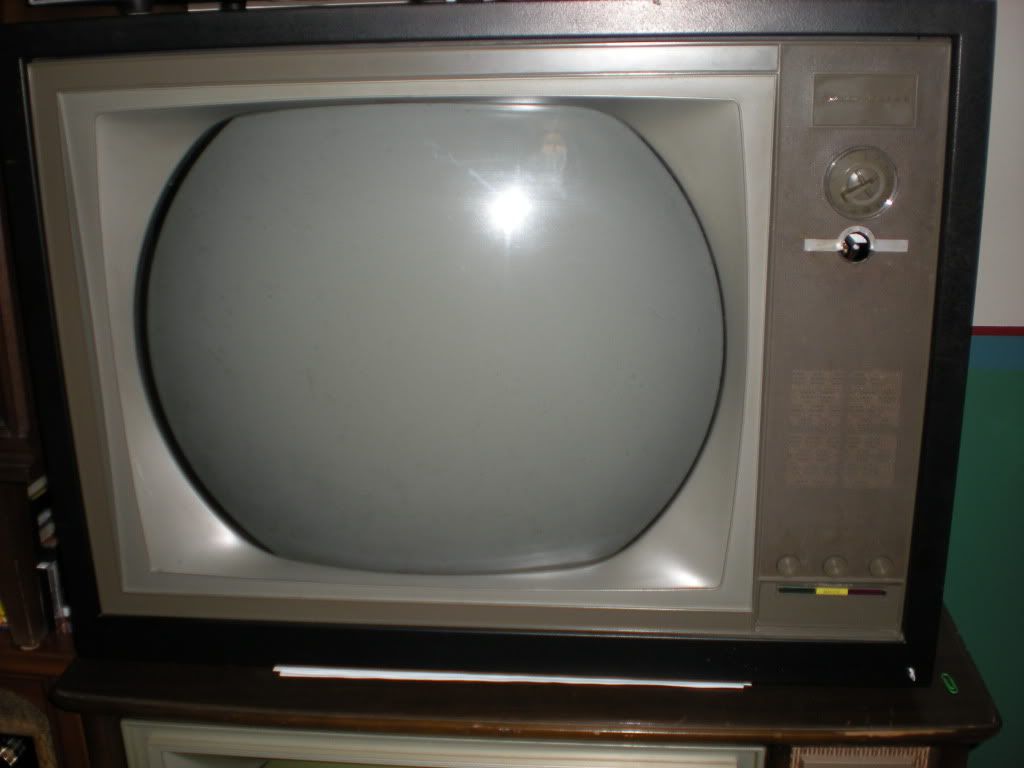 It is the (I believe) factory original CRT and is a type 21GUP22. 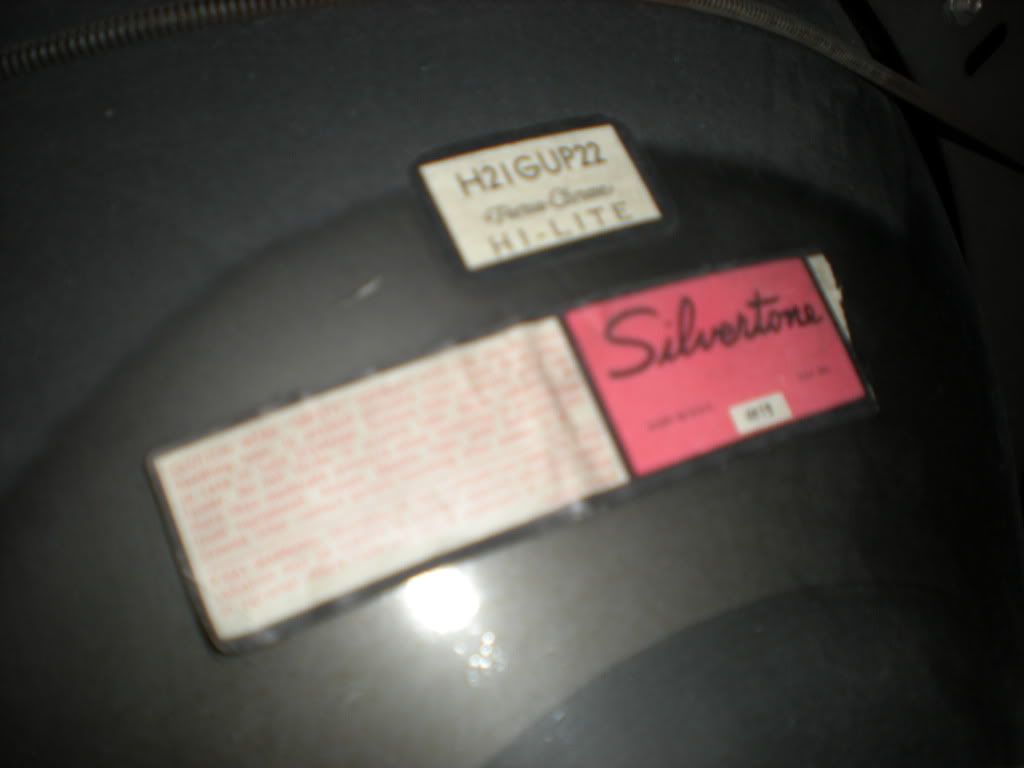 I believe that this is the color bar pic you mentioned. 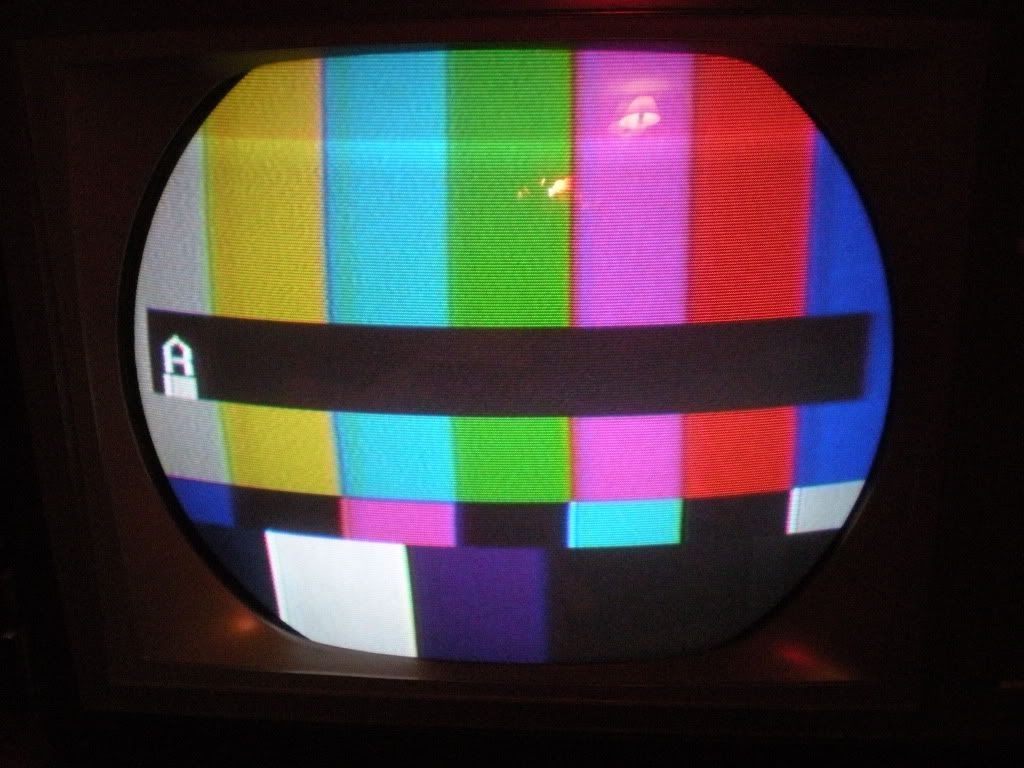 I believe that it may have been Mark who said to me at the 2010 ETF meet when I got it that he thought it may be a black matrix type. Which is quite possible. I did some cateracting this summer and was able to compare a genuine black matrix rectangular delta-gun CRT to a regular type of the same size, so if I take the tube out of the Silvertone during trouble shooting (I have to readjust the mountings anyway so why not take it a step farther) I'll get a shot of the phosphor and try to determine if it is a black matrix type. My set is a clone of an RCA CTC-15 or CTC-16 and lacks the benifit of an IQ demod scheme. I suspect that the alignment is lousy on mine. The colorimetry heretofore has been outstanding (ignoring that the screen adjustment balance tends to vary over the course of warmup and extended viewing), but the picture detail both color and mono can't hold a candle to my 71' Zenith Chromacolor hybrid (when the Zenith's focus and color circuits feel like warming up and doing their jobs that is).
__________________
Tom C. Zenith: The quality stays in EVEN after the name falls off! What I want. --> http://www.videokarma.org/showpost.p...62&postcount=4
|
|
#3
01-09-2012, 04:42 PM
|
||||
|
||||
|
21FBP22 Non Active Screen Color
Tom, sorry my innocent inquire broke your Silvertone! I must be more careful in my future posts. Thanks again for your interest in my inquiry and your great screen shot postings. Anyway, I now believe my 21FBP22 can't possibly be a 21GUP22 since I bought it in '64 and its " nonactive screen color" is definitely "paper-white" indicating rare-earth as miniman posted. Its most likely a "rare-earth" 21FBP22A as I always suspected and stated in my posts. So is that good or bad from a Picture Quality standpoint? Are the saturated reds of the rare-earth 21FBP22s more like the 15GP22s and 21AXP22s then the more numerous olive-green screen sulfide 21FBP22s? The last time I saw a 21AXP22 was my Dad's CTC4 when I replaced it with my present 21FBP22A 48 years ago. In fact, I haven't seen another roundy of any kind besides mine ever since. All I know is my 21FBP22A reds are obviously more "RED" then my 13in Sony Pro monitor which has SMPTE-C phosphor and my 27in Sony comb-filtered monitor. Both Sonys are orangeish-red in comparison. I was told the SMPTE-C reds make the reproduction of flesh-tones more natural? I would like to see a rare-earth, paper-white screen 21FBP22 included in any serious comparisons with other 21in roundy including Tom's 21GUP22 and the original 15GP22s.
Last edited by Tomcomm; 01-09-2012 at 06:23 PM.
|
|
#4
01-09-2012, 08:25 PM
|
||||
|
||||
|
Quote:
You may recall that in some cases when an earlier CRT was replaced with one with more efficient red, there was a change made to the cathode drive to reduce the red Y drive. But the R-Y gain was not reduced. The reason is that the new tube also had a yellower sulfide green. This was like adding some red into every green color, so the high R-Y amplitude tended to compensate by turning off red harder on greenish colors. This corrected the range of hues from red to orange to yellow to green, but also lit up reds too brightly. This compromise was subsequently built into all consumer NTSC sets to some degree, and a SMPTE-agreed amount was built into professional monitors, but with a matrix on/off switch. Some of the impression of "redder" reds with the older tube comes from the contrast with the P1 green but also is due to the not-overly bright reds (even if they are slightly orange) and/or due to not having a matrix that was fudged to reduce flesh tone variations. By the way, if you want an example of "how red" NTSC reds should be, note that red traffic signals are outside the NTSC gamut, but incandescent car taillights are not. Most rare-earth tubes are actually close to NTSC red - it's the greens that are way off.
|
 |
| Thread Tools | |
| Display Modes | |
|
|




 Hybrid Mode
