
|
|
|
|
|
#1
 11-24-2012, 03:59 PM
|
||||
|
||||
|
JVC-Delmonico AM/FM stereo tube radio
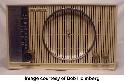
Here's a circa '63 JVC-Delmonico AM/FM stereo Japanese tube radio, model FMS-413U, that I bought for $10 at the flea market. The lady said she plugged it in and she heard a loud POP, followed by a wisp of smoke. Once I removed the back, it didn't take long to see what blew up - the capacitor that's wired across the AC line. This is yet another example why people shouldn't plug in a tube radio without first having it checked/gone over by an electronics technician.
As you can see, this is an AC/DC radio and looks to have a 35C5 output tube for each channel. It will be interesting to see how this performs when it's restored.   
__________________
http://www.youtube.com/user/radiotvphononut 
|
|
#3
11-24-2012, 07:31 PM
|
|||
|
|||
|
There's a simular model in the 1965 Beitman's.
Neat unrolled foil from the line cap.
|
|
#5
11-25-2012, 11:06 AM
|
||||
|
||||
|
Quote:
See Johnny (The Raster Master)'s post in the TV forums for an excellent example of what can and all too often does happen when a radio or TV is indiscriminately plugged into the AC line, without first replacing old filter caps. Does the radio operate normally with the line bypass capacitor out of the circuit? I would think the reason the capacitor exploded in the first place was that it was shorted; of course, when these capacitors short, they put a direct short circuit across the AC line and will smoke, pop and explode just as you described. However, I am surprised the line fuse (if present) or the shop's circuit breakers didn't open as soon as the radio was plugged in.
__________________
Jeff, WB8NHV Collecting, restoring and enjoying vintage Zenith radios since 2002 Zenith. Gone, but not forgotten.
|
| Audiokarma |
|
#6
11-25-2012, 04:25 PM
|
||||
|
||||
|
I read that post and, many times, I've seen first hand what shorted/leaky capacitors can do. I've also seen a few power transformers go up in somke due to bad capacitors.
The purpose of the AC line cap is to cut down on interference that may be present on the AC line. The radio should work without it, even though there may be some unwanted interference. However, I'm not plugging it in to find out until the other caps are changed.
__________________
http://www.youtube.com/user/radiotvphononut
|
|
#7
11-25-2012, 09:30 PM
|
||||
|
||||
|
I think it's cool how this model is FM stereo, but yet uses a 12AL5 as a detector, and looks like two parallel 35W4s. Does it do AM/FM stereo as well, with AM in one channel and FM in the other? it appears to have two separate tuning dials.
Last edited by maxhifi; 11-25-2012 at 09:42 PM.
|
|
#8
11-26-2012, 11:45 AM
|
|||
|
|||
|
Quote:
I see it has the parallel 35W4'a as well as two 12AV6's, instead of a 12AX7. It probably has two series strings for all those tubes. 
|
|
#9
11-26-2012, 02:07 PM
|
||||
|
||||
|
Quote:
Your JVC radio may appear to have two independent tuners, but I don't think it does. The dial drive may be arranged such that the AM and FM tuning capacitors are tuned at the same time when the front panel tuning knob is rotated -- and I'll bet it was a nightmare to repair if the dial cord broke and had to be restrung. BTW, I wonder why this radio was designed and built with two 35W4 rectifiers; most AC-DC sets use just one. The only reason I can see for using two rectifiers in this radio is that it may have unusually powerful amplifiers and/or preamplifiers, or was designed to drive (optionally) large external high-fidelity speakers such as are found in stereo hi-fi systems.
__________________
Jeff, WB8NHV Collecting, restoring and enjoying vintage Zenith radios since 2002 Zenith. Gone, but not forgotten. Last edited by Jeffhs; 11-26-2012 at 02:19 PM.
|
|
#10
11-26-2012, 11:20 AM
|
||||
|
||||
|
Is there any technical difficulty with detecting a stereo signal using a 12AL5?
|
| Audiokarma |
|
#11
11-26-2012, 12:01 PM
|
||||
|
||||
|
Quote:
|
|
#12
11-26-2012, 02:28 PM
|
||||
|
||||
|
I think a single 35W4 would be just at or possibly past maximum ratings, supplying B+ to two power amplifiers and all those other tubes. This being a stereo radio it'll need twice as much current as an ordinary radio, and the 35W4 isn't an extremely robust tube to begin with, so maybe it's reliability?
Last edited by maxhifi; 11-26-2012 at 02:37 PM.
|
|
#13
11-30-2012, 07:21 PM
|
||||
|
||||
|
Nice radio!
 One of my first posts on VK was regarding this very model. There are some of these still around just waiting to be discovered. One of my first posts on VK was regarding this very model. There are some of these still around just waiting to be discovered.http://www.videokarma.org/showthread.php?t=246047 BTW: These JVC-made Delmonico tube stereo radios were still being made as late as 1968, with cosmetic design changes of course. Later models saw the side speaker doors eliminated. Last edited by Kingfisher; 11-30-2012 at 07:33 PM.
|
 |
| Thread Tools | |
| Display Modes | |
|
|






 Hybrid Mode
