
|
|
|
#1
 11-26-2012, 11:36 AM
|
||||
|
||||
|
Crosley 9-403m Help Needed
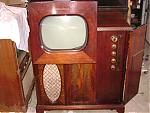
I've got a crosley 9-403M that I restored 2 years ago, unfortunately a mouse decided to take up residence in the chassis and did some minor damage. I've got the wires and any components that were chewed on replaced. My problem is this, I turn on the set and get no raster at all EXCEPT when the brightness is turned all the way bright and I turn it counterclockwise fast then a raster with retrace lines will appear for a second and then it goes dark. It will not flash if I turn the control clockwise or if I turn it ccw very slow. I will also see a flash when I turn the set off. I've checked all tube voltages in the vertical and horizontal circuit and all seems to be ok except pin 4 of the vert. osc-discharge tube V-14, Sams calls for -2--5vdc and I'm getting a -41vdc. Any Ideas where I need to start looking? Any help is greatly appreciated.

|
|
#2
11-26-2012, 12:34 PM
|
||||
|
||||
|
Quote:
If you had a minor problem in the horizontal, you would get reduced width and picture blooming as you advanced the brightness. If you had a major problem in the horizontal, you would get no HV and you seem to have that. If you had a problem in the vertical, you would get reduced height, or a single white horizontal line. These symptoms more or less eliminate Horiz, Vert and HV issues. OK, thinking the symptoms through, this problem can be caused by a wiring error or component failure in the vertical blanking circuit. 1) So, that one voltage error in the vertical may or may not be the result of that, so check carefully the wiring where the vertical pulse is fed to CRT to create the vertical blanking pulse. 2) Check the resistors on both sides of the brightness control. 3) Check the voltages on the video output tube. 4) Check the voltages on the CRT. 5) Depending on whether or not the video is fed to the CRT cathode or grid, you will have a relatively large cap on the other. That cap is suspect. 6) Although HV creation is not suspect, the resistance of that line is, so measure the resistance between the filament of the 1B3 and the CRT anode after carefully discharging it. 7) Mouse pee works wonders, so a corroded CRT socket not making electrical contact on a pin. (Less likely a defective CRT base solder joint, or the CRT itself.) Sorry for being so vague, but I don't have a schematic of this set available and this is from memory of the 1940's tuning-indication Crosley's. James Last edited by earlyfilm; 11-26-2012 at 12:39 PM.
|
|
#3
11-26-2012, 02:35 PM
|
|||
|
|||
|
these sets can be kinda odd, check to make sure you have both the contrast and the brightness adjusted (you may have to fiddle with them a bit), IIRC the contrast is really a gain control and you can cut off the CRT if not adj properly, it does not have the AGC like later sets. May sound silly but make sure you are not in the FM mode, lastly see if you can get a TV signal to it rather than relying on seeing a raster, the tuning of the inductor tuner is pretty critical to get a video signal.
aside from all of that, HV prob for HV check then CRT pin voltages for the correct grid and cathode voltages, if you have that it pretty much has to have a raster or at least a line.
|
|
#4
11-26-2012, 04:14 PM
|
||||
|
||||
|
Here's what I've got so far, I checked the crt pins and I'm definitely not getting what I should have, pin 11, cathode should be 400vdc and i'm reading max 191 with the contrast turned ccw and 76 turned cw. Also pin 2, grid should read 70vdc and i'm reading -87vdc. Ive also noticed that when i turn the bright control all the way up I lose my audio signal, I've got a DVD player hooked up so I can hear the sound of the dvd. I don't lose audio gradually, just in the last bit of turn of the control the audio will just shut off.
I haven't checked the HV with the HV probe but I can pull about a 1 inch arc, with a grounded screwdriver from the caps of the H-output and the HV rectifier tubes. I'm definitely on TV and not FM. I made that mistake earlier. I've checked the volatges at the 12au7 video amp and have pretty much 0 at tpin 6, plate, I should have 185vdc. I'll keep checking, thanks for you input guys.
|
|
#5
11-26-2012, 10:17 PM
|
||||
|
||||
|
Quote:
I would expect that the contrast control (actually an IF gain in some Crosleys) could muck up the audio, but not the brightness. Quote:
If you or someone has a schematic of the video, vertical and CRT sections and could post it, it would help. James
|
| Audiokarma |
|
#6
11-27-2012, 09:18 AM
|
||||
|
||||
|
Quote:
I will scan the schematic and post it shortly.
|
|
#7
11-27-2012, 09:31 AM
|
||||
|
||||
|
Quote:
|
|
#8
11-27-2012, 03:29 PM
|
||||
|
||||
|
I started checking resistance on the video amp tube pins and found pin 6 had no continuity so I traced back to the L23 peaking coil and it was open, so I replaced it with one out of an identical parts set and checked it again, it reads 17K and I'm supposed to have 8k but I figured it was better then the original. I turned the set on and now I get a wavy vertical line, see attached pic. It appears I've now lost my Horz sweep, so I disconnected one end of the coil, removed the 12au7 expecting to see a full raster as before but I still had the vertical line. I've got another bright / contrast pot from my parts set and will replace that tomorrow morning just to eliminate that as a probable cause.
|
|
#9
11-27-2012, 03:32 PM
|
||||
|
||||
|
I forgot to attach the pic.
|
|
#10
11-28-2012, 07:17 AM
|
||||
|
||||
|
Quote:
The good news is, now that I've seen your schematic, your set does not seem to have the high level FM switch some same period Crosley's used that can create difficult to pinpoint intermittent problems. When you unsolder the Brightness control BEFORE YOU REMOVE THE SHAFT NUT, check for a slider to case short. Also check for continuity between the outside terminals and check the slider for continuity between both ends while rotating it. (It probably would not hurt to perform the same test on the contrast, before removing it.) If no problem is found there, I'd suggest that before replacing any more parts, you take a couple of days off and then look at the set with new eyes, checking especially for correct wiring on items that you replaced after the mouse visit and using a bright light, for additional damage that was not noticed. Your symptoms do not seem to point to a single failure and this causes me to suspect either a newly introduced wiring error, or unnoticed rodent damage. If you have an oscilloscope, it might be a great help in this case as the design of this set causes many controls to interact unexpectedly. James
|
| Audiokarma |
|
#11
11-29-2012, 10:44 AM
|
||||
|
||||
|
Quote:
James, I really appreciate your advice, I wouldn't have gotten this far without your input.
|
|
#12
12-01-2012, 12:52 PM
|
||||
|
||||
|
Update 13-1-2012, So I took your advise James and tool a few days off, When I got back on it I decided to check resistance on the rest of the tubes in the video section. I found two resistors that were more than 50% out of spec and replaced them, fired up the set and with a few control adjustments had a good picture,. I've been watching the Burns and Allen show for nearly an hour now and it seems to be stable at this point. I'll run it for the rest of the day and if it's still good in the morning then I'll but it back in the cabinet.
Again thanks to everyone for your advice. James I appreciate your interest in this problem. I have to say I'd rather bring a TV back to life that hasn't worked in 40 years then to try and fix one with rodent damage. 
|
 |
| Thread Tools | |
| Display Modes | |
|
|




 Linear Mode

