
|
|
|
|
|
#1
 06-11-2015, 05:02 PM
|
||||
|
||||
|
Quote:

|
|
#2
06-11-2015, 06:05 PM
|
||||
|
||||
|
For any old PCB tube set BE GENTILE ! Things get very crispy.
It gets so bad at times neither the part or etch take solder. Socket savers a great idea where there has been a lot of heat. Also a muffin fan is nice to suck the heat out. When recapping or shotgunning do just a few at a time then run the set. Be sure its OK & make note of any major changes such as " C249 vert size much larger, adjusts normal". Disc caps almost never go bad. Dont change unless burned or cracked. Finally if you need to pull off the CRT socket slowly pry it off with a little screwdriver while holding the plastic part at the CRT end. I doubt many of these still have glue & you can kill the CRT. Good luck ! 73 Zeno 
|
|
#3
06-11-2015, 06:24 PM
|
||||
|
||||
|
Quote:
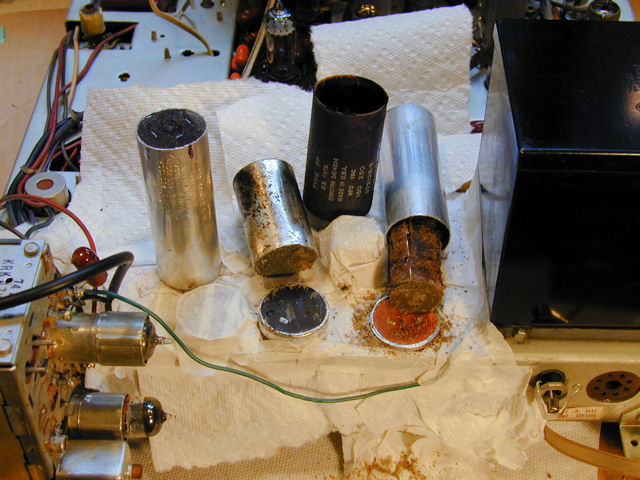 The two on the left might have worked. At least, the electrolytic paste inside them might still be somewhat operational. The one on the right is totally dried up, crumbling, and shrunken -- like a fossil. The insides are garbage. If I had powered up the set without monitoring the current draw, etc., and that cap was shorted, I might have burned up the power transformer. It's risky to leave them in place without at least doing some testing. For some people, testing means turning the TV on and holding your hand on the can to see if it burns you. A slightly more scientific way is to monitor the amount of current drawn by the TV and pull the plug if it spikes above what is normal. You can also disconnect those capacitors and test them individually under the right voltage, or even try to "re-form" them by gradually increasing the voltage and carefully monitoring current. In my experience, even electrolytics that appear to "re-form" after a while, may not be reliable for indefinite service. They may fail at any time without warning, and possibly cause damage when they go bye-bye. I often replace all of the electrolytics because then I am sure they'll be reliable, and I don't have to sit around wondering if my TV is going to go up in smoke. Other people like to re-use every old electrolytic if humanly possible; they understand the risk and don't mind taking it. Only you can decide how much risk you can tolerate and how you intend to use the TV. If it's going to be a "daily driver," you may want to err on the side of caution. If it's something you'll only play for a few minutes a couple of times a year, to show off to guests, maybe leaving the old electrolytics alone isn't such a big deal. Phil Nelson
|
|
#4
06-11-2015, 07:37 PM
|
||||
|
||||
|
Quote:
comes on and works, you have run it for a few hours and it's ok, then you may want to slowly replace parts. Replacing stuff that explodes, causes smoke, or burns out stuff that can't be replaced is a good idea..... Start with power supply capacitors, work your way to all electrolytics.... Eventually you can replace most of the caps, people here have lists of types of caps in specific sets that almost always will fail, do them. But keep in mind there are many many posts here that begin "I recapped my set and now......" Wiring mistakes, worse new parts choices than the originals, etc.... Best idea is to do the power supply, then make sure the set works. Do some other section, then make sure the set works.... etc.... And when yer done, remember there will be a buncha stuff you can't replace cause it just ain't available.... With a 1969ish kinda cutoff, most stuff earlier than that should have the electrolytics replaced, there are some safety caps in later sets that are known trouble, but earlier stuff, 1950's 1940's age is working against ya- There is too much of a chance of bad failure.... You should have fun, and be careful.
__________________
Yes you can call me "Squirrel boy"
|
 |
| Thread Tools | |
| Display Modes | |
|
|




 Hybrid Mode
