
|
|
|
#1
 06-12-2020, 01:55 PM
|
||||
|
||||
|
New-to-me Sony Trinitron KV-1710
Hello, everyone! I've generally shied away from TV collecting, but this showed up during a "ZoomFest" held in lieu of my antique radio club's usual spring swap meet, and I just couldn't help myself.
 It's a Sony KV-1710, circa 1972. Supposedly one of their last sets to use (mostly?) discrete transistors. The 17" Trinitron jug seems to give a good picture; the reds might be a bit weak as is typical, but the picture seems pretty well balanced from what I've seen with my NES 'toploader' game console connected to it as a makeshift source. Here are some photos of it, both off and being fed with the title screen of Super Mario Bros. 3: It's a Sony KV-1710, circa 1972. Supposedly one of their last sets to use (mostly?) discrete transistors. The 17" Trinitron jug seems to give a good picture; the reds might be a bit weak as is typical, but the picture seems pretty well balanced from what I've seen with my NES 'toploader' game console connected to it as a makeshift source. Here are some photos of it, both off and being fed with the title screen of Super Mario Bros. 3: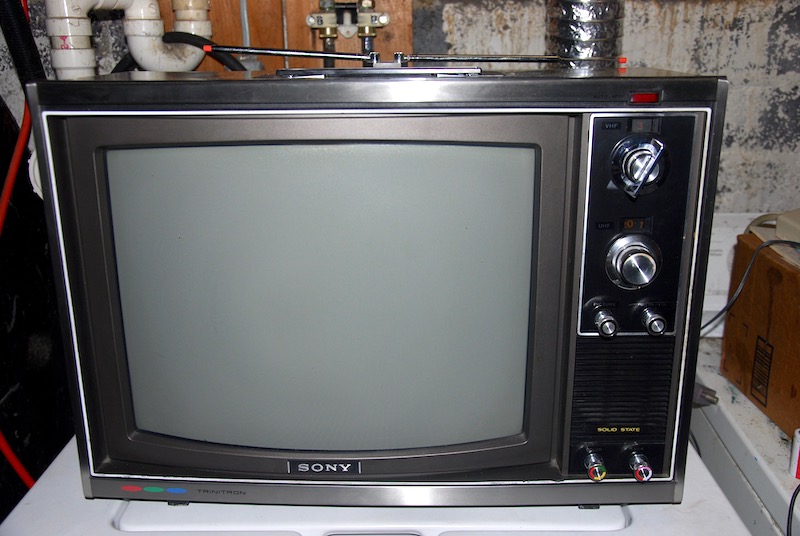 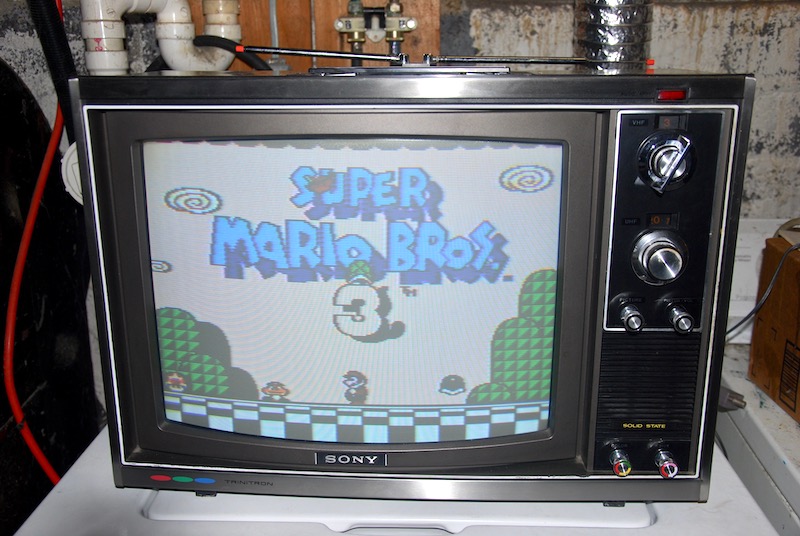 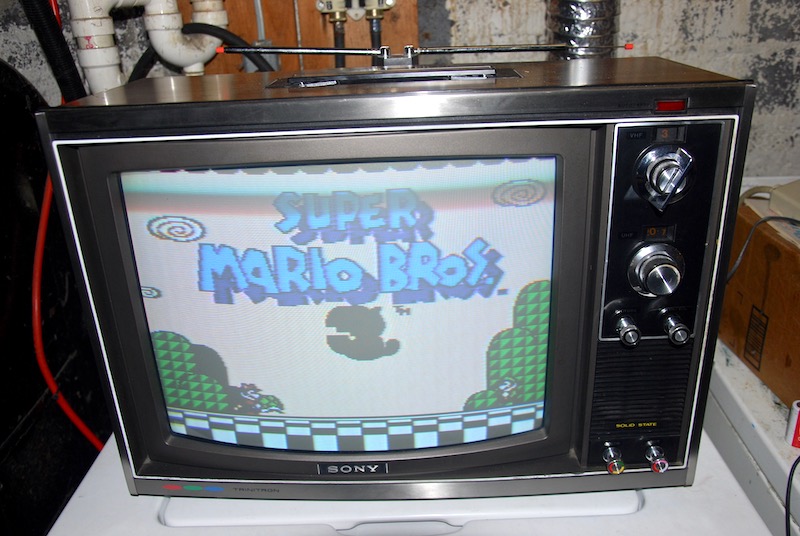 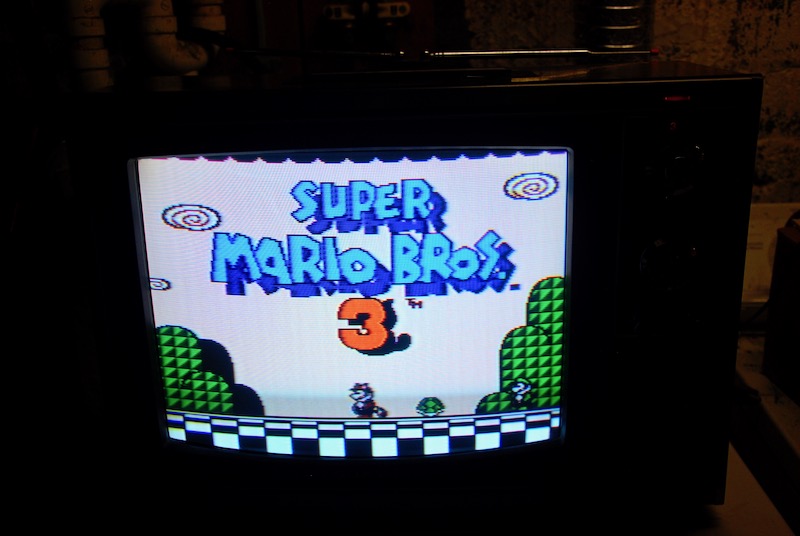 And for fun, a snippet from a Burdick's ad found in a 1972 edition of the Santa Cruz Sentinel, showing an ad for the KV-1710: 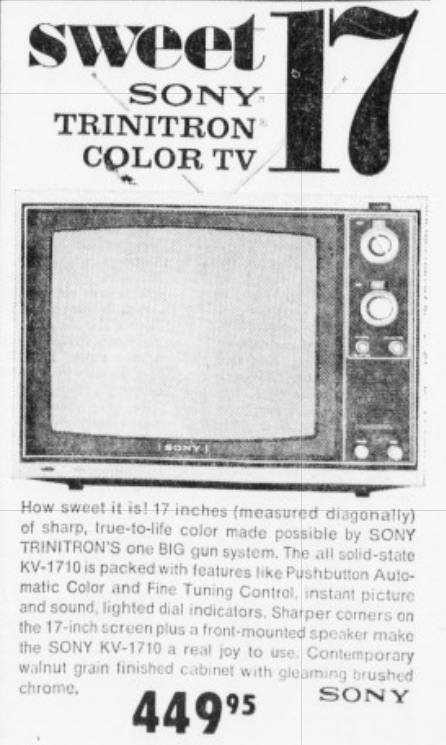 (click the image for a larger version)
__________________
Visit my site! Stereo: Pioneer SPEC-4, Pioneer SPEC-1, Kenwood KT-7500, Dual 1219, Nakamichi BX-100, Pioneer PD-M60, Paradigm Studio Monitors 
|
|
#3
06-12-2020, 03:02 PM
|
||||
|
||||
|
Oo nice set! I like the early trinitrons. I haven't been able to find one like this yet though
__________________
Rototwirbulation
|
|
#4
06-12-2020, 04:30 PM
|
||||
|
||||
|
Great find! This was Sony’s first venture into “large screen” sets with its 17inch diagonal measurement. The actual date of introduction was in Fall, 1970, not 1972. I know because I purchased a KV1720 with walnut cabinet about September, 1970. It replaced my RCA CTC-19 Bremanger.

__________________

|
|
#5
06-12-2020, 06:33 PM
|
||||
|
||||
|
Thanks for the replies!
Quote:
Quote:
-Adam
__________________
Visit my site! Stereo: Pioneer SPEC-4, Pioneer SPEC-1, Kenwood KT-7500, Dual 1219, Nakamichi BX-100, Pioneer PD-M60, Paradigm Studio Monitors
|
| Audiokarma |
|
#6
06-12-2020, 08:05 PM
|
|||
|
|||
|
Quote:
It sure is a nice example of a well-kept set. It was worth getting. 
|
|
#7
06-12-2020, 08:49 PM
|
||||
|
||||
|
Price of tv then was a bunch of money in ‘70 or ‘72. At least it was before the troubled SG613 gated switch design that most techs hated working on. Sony TVs are kind of like timex watches logo. “It takes a licking and keeps on ticking. Not sure if Sony’s logo was research makes the difference or if they were using Sony no baloney by then.
__________________
Sony Trinitron is my favorite brand. My wish list: Sony KV-7010U Sony KV-1220U
|
|
#8
06-12-2020, 08:54 PM
|
||||
|
||||
|
Upon closer look at the photos that cabinet is in really great shape as even the rabbit ears are all there with the orange tips and aren’t even bent.
__________________
Sony Trinitron is my favorite brand. My wish list: Sony KV-7010U Sony KV-1220U
|
|
#9
06-13-2020, 02:35 PM
|
||||
|
||||
|
Once again, thanks for the replies!
Quote:
 Quote:
 -Adam
__________________
Visit my site! Stereo: Pioneer SPEC-4, Pioneer SPEC-1, Kenwood KT-7500, Dual 1219, Nakamichi BX-100, Pioneer PD-M60, Paradigm Studio Monitors
|
|
#11
06-13-2020, 05:37 PM
|
||||
|
||||
|
Quote:
The thing with the Sonys was that you could NOT use anything but a Sony part for the SG613 horiz output, the 2SC867A regulator (God, I can't believe I still remember those numbers) and the damper diode (which I have forgotten, but it was huge and metal cased). When the horiz output shorted, it always shorted the regulator which was a series/pass arrangement. If you put in just a new SG613 without changing the regulator, it would blow immediately because the regulator pumped full B+ into it. These parts weren't cheap but if you changed all three at the same time using Sony parts, resoldered the horiz drive circuit, recapped the vertical circuit, you wouldn't see them back for at least three years. Lots of techs tried using HEPs, SKs, ECGs, etc. but it was a futile effort. Use Sony parts or *boom* and smoke would be the result. John
|
|
#14
06-14-2020, 01:15 PM
|
||||
|
||||
|
Quote:
Quote:
Quote:
-Adam
__________________
Visit my site! Stereo: Pioneer SPEC-4, Pioneer SPEC-1, Kenwood KT-7500, Dual 1219, Nakamichi BX-100, Pioneer PD-M60, Paradigm Studio Monitors Last edited by AdamAnt316; 06-14-2020 at 01:18 PM.
|
|
#15
06-14-2020, 04:01 PM
|
||||
|
||||
|
QUOTE I was aware of that, plus the fact that at least some of those 23" sets had originally been classified as 25" before an FTC(?) ruling regarding visible size. I was wondering more about smaller tabletop/portable sets like this one. When I was growing up in the '80s and '90s, most of the smaller tabletop color sets were available as 5", 13" and 19", and I don't recall seeing many sets in between, yet that ad shows 15", 16" and 17" sets as well. I'm wondering when the (relatively) odd portable sizes went away, and things became more homogenized. END QUOTE
Sony color started with a 12" then 8,15, 17, 19 over the 1970's. Tube built USA sets were 14", 16", 19" then bigger ones. When they went solid state 13", 15", 17" & 19" Almost all sizes up to 27" were built over the years after 27" a few sizes were skipped. Canada kept the old system so a 20" set was actually a 19" almost every where else. There was a class action suit over all this with computer monitors. IIRC you got $10 or something if you filled out the form. I did get a rebate. 73 Zeno  LFOD !
|
| Audiokarma |
 |
| Thread Tools | |
| Display Modes | |
|
|


 Linear Mode

