
|
|
|
#16
 02-13-2020, 06:46 AM
|
||||
|
||||
|
Quote:
The incidence of any RCA needing a flyback after they went to the Trans Vista and XL100 solid state TVs from the early 70s on was virtually nonexistent. According to our field rep, it had something to do with a bad batch of epoxy used to encapsulate the transformer. John 
|
|
#17
02-13-2020, 05:18 PM
|
|||
|
|||
|
I was determined to find this cap so I spent a little time finding the values on every electrolytic around the flyback. Picture 1 from left to right are 820@25v, 68@35v, 820@25v. Picture 2 330@35v, 30@250v. None of them are what I'm looking for except maybe the 30@250v but I don't want to assume anything.
Quote:
|
|
#18
02-13-2020, 07:02 PM
|
||||
|
||||
|
Where R1, R2 & R3 join follow that back to the main PCB. It may go through L1
first. The cap will be on that line. It will be on the cathode of a diode. If you have a schematic of almost any solid state set the circuit will be all but the same. 73 Zeno  LFOD !
|
|
#19
02-13-2020, 08:48 PM
|
|||
|
|||
|
Will do. Thanks Zeno.
Quote:
|
|
#20
02-14-2020, 02:53 PM
|
|||
|
|||
|
Well this is turning out to be difficult to find the cap.
Zeno, when you said follow where R1, 2 & 3 join - I am assuming you were referring to R10, 11 & 12 that go to Q1, 2 & 3. So if my assumption is correct (and if it's not, then I'm way off and please correct me), the resistors are fed by wire 13B, which on the main PCB goes to 13A. 13A connects to multiple traces on the PCB that lead to various resistors, one of which leads to the video transistor that I had to replace. Trying to make a mental schematic of all that is beyond me, but I can't see where any of it is connected to the cap I'm looking for. And the only solid state schematic I have is for that porta color (JA chassis), but on that one, the RGB transistors look to be fed off the power supply instead of the flyback, so that is no help for me with this set. That is my dilemma. Not the end of the world though, I just wanted to change the cap and see if the bars went away. If anyone can see that I'm missing something obvious and you want to smack me, feel free to point it out. 
|
| Audiokarma |
|
#21
02-14-2020, 09:45 PM
|
||||
|
||||
|
The Sams shows that 30 at 250 volt cap to be C117. From pin 9 of the flyback there is a diode CR112 with a small cap across it C116 that connects to a 4.7 ohm resistor R125, the resistor is probably raised above the printed board on 2 metal "stakes", then C117 is connected to the resistor and the wire run up to the CRT socket board. It then connects to the junction of R8 and R13 shown at the top of the picture you posted. Looks like it might say "9B" with L1 under it.( Sometimes the board call out numbers may be abbreviated. Example, C117 may just show C7, or CR112 may just be CR12)
|
|
#22
02-16-2020, 05:43 PM
|
|||
|
|||
|
Found it, thanks Damen. R1, 2 & 3 were right there but somehow I completely missed them till I followed the circuit from the flyback up. Zeno you were also right on, sorry I missed what you were trying to explain to me, I only saw R10, 11, 12 at first.
 I don't have that cap so will need to order it. In the meantime, the set has developed another issue. If I turn the brightness down to around half, the video just cuts out. It comes back abruptly if I turn the brightness almost all the way back up, then it can be lowered again, but if I turn the set off at the lower brightness level, there's no video next time I turn it on till I crank the brightness. I'm going to guess it's Q703 again since it is what killed the video the first time, and I installed a used one that I grabbed from a junk board, so maybe I damaged it with all the heat. If it loses video altogether, I will check that one first.
|
|
#23
02-18-2020, 06:40 PM
|
|||
|
|||
|
I think I'm done with this set! Q703 shorted again, causing the video to cut out like it did. I don't know why it happened, but rather than install the other used one that I harvested from the junk chassis, I checked with the electronic supply store in my city & they had the NTE159. They also had a 33mfd @ 250v so I grabbed that to replace the 30mfd@ 250v. They even had the SAMS for this set for $10 so I got that as well.
Video problem is fixed, bars in the picture are still there so that cap wasn't it, but they're really not noticeable enough to pursue it further IMO. It was cool finding this set and interesting working on it, and I hope it keeps working like it does. For anyone interested, Chester Electronics is in Kenosha, WI. Someone did a Youtube video recently in the store, if you want to check this place out, it's amazing. They even carry vacuum tubes and have a tube tester. https://www.youtube.com/watch?v=VAs7adDdcaQ Thanks to everyone who chimed in here.
|
|
#24
02-19-2020, 09:12 AM
|
||||
|
||||
|
I go to Chester electronics occasionally.
There is one thing they sell that I no longer buy: Electrolytic Capacitors. Most of their stock has been sitting longer than I have been alive. Lytics go bad from age and they fail faster when they spend significant periods of time without voltage on them. The first time I went to Chesters I bought some lytics and tested them for esr and leakage. Atleast half were marginal or bad. There's a fair chance the caps you swapped in are as bad or worse than what you pulled out. You would be better served going with an online supplier with fast turnover like mouser, digikey, Newark etc. and spacing out a good brand 105c rated cap. IIRC Chester also is more expensive than them. The stuff to go to Chester for is NTE semiconductors that have been out of production so long you can't find them online and stuff for 50s-70s sets that you can't believe NOS parts still exist for.
__________________
Tom C. Zenith: The quality stays in EVEN after the name falls off! What I want. --> http://www.videokarma.org/showpost.p...62&postcount=4 Last edited by Electronic M; 02-19-2020 at 09:19 AM.
|
|
#26
03-01-2020, 04:32 PM
|
|||
|
|||
|
Potential CRT donor found
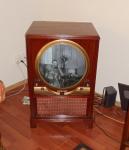
I found another RCA at an estate sale, this one is a 1984 with a CTC118 chassis. I powered it up, there was no signal to it but the snow appeared crisp with no dominant color, so I grabbed it. It was interesting to find this shortly after the 1981, because I never see 19" RCAs from the 80's and I've been going to estate sales for years.
It has cigarette burns on top, plus it stinks like cigarette residue, so it's not a keeper. But it makes a great picture, the crt tests great, and looking at the two RCAs side by side, I can see that this crt has better focus. I want to take the tube out of the cigarette set and put it in the keeper, since that one is only good because of the zap from the rejuvenator, and my understanding is that restoring a crt may only be a temporary fix. The yokes have different plugs which I can work out. The SAMS for the CTC108C shows yoke resistance to be 10 ohms on the vertical and 1.4 on the horiz. I measured it and that's what I got. I don't have a schematic for the CTC118. The vertical on that does measure 10 ohms, but the horiz has a cap in series with it so I can't measure it easily. I don't know the significance of that cap so I hesitate to do the swap & I don't want to disturb the convergence tape by trying to swap yokes. I really want to try this but don't want to ruin a good chassis or yoke. Any advice is appreciated! If it helps: CTC108C=19VLNP22 CTC118=A48ABE10X
|
|
#27
03-01-2020, 05:52 PM
|
||||
|
||||
|
Quote:
It's not just resistance of the windings, but also the inductance of the yoke windings that must be taken into consideration for a swap. I think I have the setups for both these chassis for an RCA test jig (or you may be able to find this on line). If the setup for the two chassis is the same, it would be safe to try. A lot of times the setups for different chassis might have too much width on one, less on another, vertical shrink etc. But if the switch settings are the same, it will work without creating an annoying mushroom cloud on your bench. Any slight differences between the yokes could likely be fudged at the chassis by changing some values. I'll check tomorrow at work. If you don't hear from me, ping me.. John
|
|
#30
03-01-2020, 09:06 PM
|
||||
|
||||
|
Sams shows the specifications of the two yokes to be very close. That cap on the yoke of the CTC118 set is already on the circuit board of the CTC108, just by-pass it, or wire in the yoke wires from the 108 yoke.
|
| Audiokarma |
 |
| Thread Tools | |
| Display Modes | |
|
|




 Linear Mode

