
|
|
|
#16
 02-20-2008, 01:00 PM
|
||||
|
||||
|
Aww...
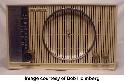
Well, since yer soooo nice to me, here's a photo of my onliest Arvin. The mirror in the centre of the dial is a bit pitted.
But then again, so am I, and I figger we're both about the same age...
__________________
Experience is what you get when you don't get what you wanted. 
|
|
#17
02-20-2008, 08:26 PM
|
||||
|
||||
|
I'm not so sure a goodly amount of that couldn't be "taken out" w/some judicious polishing w/a good chrome polish...Purty l'il feller...Arvins did pretty good for what they were...
__________________
Benevolent Despot
|
|
#18
02-21-2008, 11:34 AM
|
||||
|
||||
|
The antenna wire on your Arvin radio is much too short to do any good, Sandy. An inch and a half won't do on the broadcast band unless you're within spitting distance (or at least a few miles, not more than about five) of one or more stations; unless Rogersville has a local station you won't hear much of anything.
Splice about a foot or two more onto that stub and your set will work much better, even if it only has three tubes. Be careful with that hot chassis if you use an outside wire antenna, though. Your radio may have an external antenna connection on the back cover (many radios of '40s-'50s vintage did, since in those days not every town had local radio stations), but the blocking capacitor that's supposed to isolate the terminal from the chassis, if there is one (there should be), probably failed years ago and should be replaced, in the interest of safety. I once had a green metal-cabinet Arvin radio, model 540T, that had a wire antenna. I don't remember anymore how many tubes it had, but it worked well enough in the town where I lived at the time (late '60s-'70s) to get Cleveland stations. I never liked the idea of the radio having an all-metal cabinet, though, as it could pose a shock hazard, blow a fuse or throw sparks if it came in contact with any grounded metal object--depending entirely on how the AC plug was inserted in the wall socket. The chassis of these radios probably were not well insulated from the cabinet, either, although they did have plastic knobs on the control shafts. BTW: Arvin radios, and later televisions, were made, IIRC, by a division of the old Sparks-Withington Company of Columbus, Indiana. Where the company came up with the name "Arvin", however, is beyond me. Hmmm. 
__________________
Jeff, WB8NHV Collecting, restoring and enjoying vintage Zenith radios since 2002 Zenith. Gone, but not forgotten.
|
|
#19
02-21-2008, 12:10 PM
|
||||
|
||||
|
The little metal cabinet sets can be killers. In the "better" ones, the chassis was supposed to be isolated from the cabinet by grommets, but these may have deteriorated. A lot of the time you've got a live chassis connected to the case. Put one in the kitchen by the sink and reach over to tune the set while you've got your other hand in the dishwater and see what happens. You might want to check that any grommets (if it's got 'em) are OK. Other ways of isolating include using nylon screws to secure the chassis and back. Just depends on how the set was made. A polarized plug could make the hot lead be the switched lead. They are cute but dangerous little suckers, kinda like coral snakes.
Reece
__________________
Reece Perfection is hard to reach with a screwdriver.
|
|
#20
02-21-2008, 12:28 PM
|
||||
|
||||
|
I remember reading an article from an old radio / TV servicing magazine concerning the dangers of hot chassis radio & TV sets housed in metal cabinets. According to the article, part of the problem was failure of the service technician or DIY'er to place the insulating devices between the cabinet and the chassis when service was complete. The article also mentioned cases of electrocution from such sets. I've had several of those metal radios from the '40's and '50's. None of them had any sort of insulation between the chassis and cabinet. At best, the chassis was connected to one side of the line through a capacitor. I always install polarized cords on AC/DC sets that I service. Of course, it can still be dangerous if the outlet that it's plugged into is wired wrong. I've also run into a fair amount of early AC/DC radios with the "curtain burner" resistance line cord. Now, exposed hot chassis and resistance line cords would never fly with UL.
|
| Audiokarma |
|
#21
02-21-2008, 12:35 PM
|
||||
|
||||
|
I'd take a wild guess and say that the 3-tube models--given that there was likely a rectifier tube and an output tube--were probably "reflex" type, where the TRF stage was also an audio amp and detector. And the 4-tube ones had the converter's output IF transformered directly to the detector sans IF amp stage. Maybe someone can clarify....
|
|
#22
02-21-2008, 12:43 PM
|
||||
|
||||
|
Quote:
The other cute trick was to put the on-off switch on the ground side of the line, making any metal part of the set dangerous to touch in the off or on position, depending on how it was plugged into the outlet. When I was a wee tot we had an old Zenith table radio that was missing both volume and tuning knobs. Where we lived was in a house in FL with a concrete slab/tile floor. My older sisters (usually barefoot around the house) used to either stand on a pillow when changing stations, or would use a playing card in the slot of the splined shaft.
|
|
#23
02-21-2008, 01:59 PM
|
||||
|
||||
|
DX with simple radio
This past November, I was near Trois-Rivieres, and I spent an evening
playing with a small radio I have had for years. IIRC, it doesn't even have a nameplate, although I don't believe it is a homebrew. This is a 4-tube TRF design with 78 RF amp, 6C6 infinite impedance detector, 41 audio output and 80 rectifier. I tested the tubes (for the first time in about 30 years of ownership) and found all to be good except the 6C6 that barely wiggled the needle of my Heathkit TT-1. After a NOS replacement (wartime U.S. Navy surplus) was installed, I fired up the radio. With an antenna consisting of the telephone with its 25-foot cord, I managed to pull in CBC in Moncton with good volume for about an hour, a station about 400 miles away. You can have fun with a simple AM radio!
|
|
#24
02-21-2008, 02:19 PM
|
||||
|
||||
|
Resistance line cords; metal TV cabinets
I never cared much (or at all), either, for the "curtain burner" resistance line cords because they got so hot in operation. My grandmother had a 1936 Silvertone AC/DC radio that had a resistance line cord; for years it was in her summer cottage, left unplugged, of course, when she wasn't there or in the off-season. The cottage had curtains on the windows; I hate to think what would have happened had that resistance cord come in contact with them.
In the late '60s-early '70s, I had a 1955 transformerless Emerson portable TV in a metal case (which also wound up in my grandmother's cottage when I eventually got a new set). The TV worked well enough, but the metal case could well have posed a shock hazard (thank goodness mine never did; the AC switch was bad and had been jumpered, so the TV was always unplugged when not in use anyway). I don't know for the life of me why some TV manufacturers (even reputable, long-standing manufacturers such as Zenith) even put some models of their sets in metal cabinets in the first place when they knew (at least they were supposed to know) that transformerless televisions in metal cabinets were disasters waiting to happen under the right (or wrong[!]) circumstances. Deteriorated or missing insulation barriers (some do-it-yourselfers and even some technicians who should have known better sometimes left insulation schemes such as barriers off the cabinets of transformerless TVs and AC/DC radios, thinking they weren't needed--after all, the set worked without them), failed blocking capacitors, accidental contact with the chassis--anything could cause these sets eventually to become death traps. I also had a 1959 Zenith metal-cabinet TV which had a power transformer, but that set never was a concern to me as far as shock hazards went because the transformer effectively isolated the chassis from the cabinet. There is a way, however, a transformer-powered TV in a metal cabinet can become a death trap, aside from the high voltage on the CRT or a defective power cord: if the power transformer develops a short that, for whatever reason, does not trip the house circuit breakers. This will happen because the core of the power transformer is usually grounded; if the windings short to it, either the TV's own line fuse or the house fuses/breakers will open. If they do not open and kill the circuit, the entire case of the television will be charged with the full line voltage. What would happen to the rest of the house is a different story.
__________________
Jeff, WB8NHV Collecting, restoring and enjoying vintage Zenith radios since 2002 Zenith. Gone, but not forgotten.
|
|
#25
02-21-2008, 03:06 PM
|
||||
|
||||
|
Quote:
 
|
| Audiokarma |
|
#26
02-22-2008, 01:50 PM
|
||||
|
||||
|
Quote:
__________________
Jeff, WB8NHV Collecting, restoring and enjoying vintage Zenith radios since 2002 Zenith. Gone, but not forgotten.
|
|
#27
02-22-2008, 03:00 PM
|
||||
|
||||
|
About 20 years ago, my neighbor had a tube type console stereo in a yard sale. This was actually one of the better models with a power transformer. Their son was walking around barefoot on the driveway and touched a metal part of the record changer. It didn't shock him bad enough to cause damage; but, it got his attention. Since it was a power transformer set, it probably had leaky line bypass caps.
|
|
#28
02-22-2008, 03:44 PM
|
||||
|
||||
|
Well, this l'il feller hasn't bit me-yet-but other than hookin' it up to a decent antenna just to see what it CAN do, I prolly won't be playing it much.
__________________
Benevolent Despot
|
|
#29
02-22-2008, 06:34 PM
|
||||
|
||||
|
Quote:
Oh cripes!  
|
 |
|
|








 Linear Mode

