
|
|
|
#16
 10-13-2011, 02:48 PM
|
||||
|
||||
|
Not to be a wet blanket, but if you have zero or scanty experience restoring tube electronics, I recommend that you ignore the TV for the moment and try your hand at restoring the radio first.
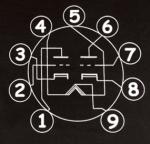
The radio is considerably simpler, so your chance of success is greater. It also does not have the very high voltage of a TV, although you can still kill yourself if you're very careless. Much of the restoration work (chiefly, replacing capacitors) is the same for radio or TV, so the experience gained in fixing the radio will translate directly. Same for reading the schematic diagram and translating that to what you see under the chassis, and so on. It's not critical to rush out and buy a variac or tube tester. What you need to get started is a decent soldering iron and a few small tools such as fine-tip pliers, wire cutter, etc. You also need a multimeter that can measure voltage, resistance, amps, and so on. If you don't have a tube tester, you can do a basic dud/not-dud test on any tube with an ohmmeter. Look up the tube diagram on http://www.nostalgiaair.org/Tubes/ and measure the resistance between the tube's heater pins. (Look up a 6SN7 tube, for instance, and you'll see that the heater pins are 7 and 8, each marked with H.) Infinite resistance means the heater wire is burned up and the tube is dead. Resistance of a few ohms means the heater is intact. That tube might still have weak emission, but at least it will light up. If you don't have a variac, you can use a dimbulb tester to power up a set with some protection in case of short circuits. The article at http://antiqueradio.org/dimbulb.htm has very basic information about this. Not really the same as using a variac, but still useful and you can make it with cheap parts from the hardware store. If you do buy a variac, get one with a meter, or else figure out how to meter current consumption with your multimeter while you are using an unmetered one. If your radio already works well, so much the better. Prove to yourself that you can follow a schematic and replace the old capacitors (especially electrolytics) without miswiring something or starting a fire. Once you have some confidence in your ability, and some practice, you'll be better equipped to tackle the TV. There are many other information sources, including forums like this and vintage TV repair books. If you skim a few of the restoration articles listed in this section, that will give you an idea what's basically involved, and how the quantity & difficulty of work differ between radio & TV restorations: http://antiqueradio.org/restoration.htm Regards, Phil Nelson Phil's Old Radios http://antiqueradio.org/index.html 
|
|
#17
10-18-2011, 05:15 PM
|
||||
|
||||
|
Fortunately, Magnavox console units were modular, so you can work on one segment at a time. Building on Phil's advice, I would start with the amplifier first, as it would be the most simplistic in terms of replacing capacitors (Mainly the electrolytic filter "cans" and the coupling capacitors). The turntable looks similar to the Collaro unit in my console.
It looks like you've joined the MagnavoxFriends group. They are a great resource for Maggie stuff. Good luck!
|
 |
|
|


 Linear Mode

