
|
|
|
#16
 08-17-2014, 08:54 AM
|
||||
|
||||
|
I haven't had much time to devote to restoration lately, things have been busy around here this summer. I did manage to find something interesting though. The pictures below are from an article in the NY Times which include a photo of a set almost identical to the one I have although with a tuner that is different than mine, Art's, and the factory Western tuner. The caption below the photograph reads "Courtesy Western Television Co." Why would that photo come from Western if it wasn't a factory set? If it is a factory set why would they use some one else's tuner? Could it be that this set was a transition between the Visionette and the later 41 and Empire State models? Perhaps their factory tuner was a later addition to the lineup which necessitated the use of some one else's tuner in this model? Any one have any thoughts?
 
__________________
John 
|
|
#17
08-17-2014, 07:41 PM
|
||||
|
||||
|
The set in the newspaper article does look similar to yours, though not identical. Note the ornaments on the side of the viewing lens on your set, but not on the one in the article. Also, the radio knobs are different, as is the base.
The ad I have for the Visionette (early 1931) show both the scanner and the radio. So, at that time, Western had its own receiver. I can't read the date on the newspaper you published. Can you let us know? I doubt if this was an interim design, since it doesn't bear any resemblance to the Empire State or 41. These sets were not manufactured until Early 1932.
|
|
#18
08-17-2014, 11:14 PM
|
|||
|
|||
|
Hi John,
Are you going to try and get the Visionette operational ? If so ,how many holes does yours have ? What is the motor speed and picture frame rate ? Disk Diameter ? I enjoy the mechanical television hobby. Ed
|
|
#19
08-17-2014, 11:35 PM
|
|||
|
|||
|
My Youtube channel.
http://www.youtube.com/watch?v=D0-KD-O2hhU
|
|
#20
08-18-2014, 12:16 AM
|
||||
|
||||
|
U.A. Sanabria's enduring claim to fame was the introduction of interlaced scanning to reduce flicker. Western Television sets have 45-line rasters divided into three 15-line interlaced spirals. The technique was not particularly effective at the scan rate of 15 fps, but when electronic TV took over in the mid 30s, interlaced scanning meant the difference between greatly perceptible flicker and near imperceptible flicker.
__________________
tvontheporch.com
|
| Audiokarma |
|
#21
08-18-2014, 09:27 AM
|
||||
|
||||
|
Quote:
One way or the other it's a mystery  . On the one hand my original theory is correct and my set was made by some enterprising company that was selling their "deluxe" version of the set in a fancier cabinet complete with a tuner, but if that's the case why would the Western Television Co. take credit for, and provide an illustration of a television they didn't manufacture themselves? On the other hand my set is a factory produced set, but if that's the case then why would Western use another company's tuner? . On the one hand my original theory is correct and my set was made by some enterprising company that was selling their "deluxe" version of the set in a fancier cabinet complete with a tuner, but if that's the case why would the Western Television Co. take credit for, and provide an illustration of a television they didn't manufacture themselves? On the other hand my set is a factory produced set, but if that's the case then why would Western use another company's tuner?
__________________
John Last edited by vts1134; 08-18-2014 at 10:27 AM.
|
|
#22
08-18-2014, 08:42 PM
|
||||
|
||||
|
Quote:
__________________
Tom C. Zenith: The quality stays in EVEN after the name falls off! What I want. --> http://www.videokarma.org/showpost.p...62&postcount=4
|
|
#23
08-18-2014, 09:15 PM
|
||||
|
||||
|
John, you may be right and it is a factory cabinet, though I'm fairly sure that Western had the radio for sale at the same time as the Visionette.
|
|
#24
08-22-2014, 04:59 PM
|
||||
|
||||
|
I received an email from a fellow who reads here often but chooses not to post. His thoughts:
"I think Western worked with whoever made the cabinet and they submitted the photo because it looks more console radio like and less like a novelty. Maybe they were going to produce them and the cost was too high compared to just the small wood box. The big question needs to be answered, why would they not have their radio in it and where is the Western Company tag, stickers, etc.?" Show the fancy cabinet and deluxe set produced by some other company (with some of your parts inside) but sell the plain version sans tuner yourself. Any one else have an opinion?
__________________
John
|
|
#25
08-25-2014, 01:22 PM
|
||||
|
||||
|
Another tidbit of circumstantial evidence to chew over. Below is a link to an article written by William N Parker who worked for Western Television Company. The article is a fantastic history of his recollections in the mechanical television field. On the third page he says the following:
"I arrived in Chicago about the middle of May with my first assignment; that of modifying Crosley three-dial, metal box, trf receivers for operation at 2100 kc. The 171 output tube passed sufficient current to operate a plate-type neon lamp." So it seems Western was using Crosley tuners at some point early on before they released their own version. Perhaps my set predates the Visionette entirely? http://www.antiquewireless.org/uploa...television.pdf
__________________
John
|
| Audiokarma |
|
#26
08-25-2014, 02:56 PM
|
||||
|
||||
|
John, here is my thinking.
This set didn't appear in any sales literature that I'm aware of. Western may have bought some console cabinets and installed Visionette assemblies (they were available as kits) for demonstration purposes, perhaps with the idea that they might sell a console model. I doubt if yours predates the Visionette since it uses the exact same mechanism. So, your set might be a Western prototype. Another possibility is that a cabinet company in Chicago made that cabinet and was selling it to the public for installation of a Visionette assembly.
|
|
#27
08-25-2014, 04:50 PM
|
||||
|
||||
|
Which style/model Visionette is shown in this picture of child adjusting Visionette.
http://www.richsamuels.com/nbcmm/wma...pnewsreel.html John, possibly your Visionette motor may also give a clue. Manufacturer, patent number/date etc From the article of your previous post: One of my early jobs was finding a supplier of 900 rpm synchronous motors. We received samples from GE, Holtzer Cabot, and Emerson, ... Finally, Barber Coleman was able to supply one for about a dollar!
|
|
#28
08-25-2014, 05:03 PM
|
||||
|
||||
|
rld-tv01, Parker was referring to the small motor that looks like a phonograph motor that is used in the Model 41 and Empire State.
http://www.earlytelevision.org/weste...storation.html The Visionette uses a large, relatively expensive motor. Last edited by Steve McVoy; 08-25-2014 at 05:06 PM.
|
|
#29
08-26-2014, 08:01 AM
|
||||
|
||||
|
Quote:
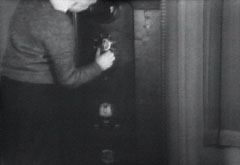 Very intriguing . That photograph clearly shows a set that is a combination of the two known survivors. It has the tall floor standing cabinet and dual chassis configuration of Art's set, but the vision tuner in that picture is a match to my set. I would love to watch the newsreel footage he has linked on his page but I cant' get it to play. Can any one else get that link to work and watch the footage? *Edit: never mind I got it to play with real player*
__________________
John Last edited by vts1134; 08-26-2014 at 08:22 AM.
|
|
#30
08-26-2014, 08:28 AM
|
||||
|
||||
|
Meanwhile deep in the heart of the man cave I've been busy with the cabinet and re-gluing the loose veneer. I've had to use basically a hypodermic needle in some spots to get the glue back under the veneer. It's a slow process, but things are coming along.

__________________
John
|
| Audiokarma |
 |
|
|






 Linear Mode

