
|
|
|
#406
 03-28-2012, 12:42 PM
|
||||
|
||||
|
Quote:
I am envisioning an issue with CPA and compatibility with the SCRF converters. Since these converters don't have frame memories they can't do frame rate conversion. This means the line and frame timing will match modern standards so there will not be a exact relationship between the line timing and sub-carrier frequency. We would need to either shift the sub-carrier frequency slightly, or accept a non-integer relationship. Not sure if the later would be a problem as I have not seen how the set determines which field phase it's in. The more expensive WC converter can do whatever we need but is overkill. Darryl 
|
|
#407
03-28-2012, 03:30 PM
|
||||
|
||||
|
I've documented a bunch more of the schematic. Note that I made some changes to the HV regulator I posted earlier. Another interesting find is a pot in the cathode of the hor. output tube, labeled "Phase".
Also, one half of one of the tubes we thought were for the CPA switching is actually in use as a sync cathode follower. Tomorrow I'll finish the vertical sweep section.
|
|
#408
03-28-2012, 04:01 PM
|
||||
|
||||
|
Quote:
The DOT sequential system is RCA. But the CPA test came under the auspices of the NTSC. I believe Bernard Loughlin refers to CPA in the context of NTSC. Can you explain your concern over compatibility with the SCRF? It would seem to me that the current NTSC frame rates are acceptible for CPA since the NTSC frame rates ensure proper chroma interleaving with the presence of the 4.5MHz sound carrier. Hence if the current scan rates are used, the standard NTSC subcarrier relationship (odd integer multiple of half the horizontal rate would suffice for the nominal 3.89MHz. But CPA means that with only a half line offset, the Y and R-Y spectra will align to form a vertical dot line up and resulting dot pattern. Hence I believe a quarter line offset is required. The nominal 3.89MHz results in: 3890000/fH/2 = 494.4622... The closest quarter line offset multiple is therefore 493.75 Therefore the CPA fsc = 493.75 x fH/2 = 3.884396MHz I believe this CPA subcarrier can be used with current NTSC scan rates and provide the best interleaving of the chroma. What do you think? Terry
|
|
#409
03-28-2012, 04:38 PM
|
||||
|
||||
|
Terry,
The CPA chroma frequency was defined as exactly 495/2 * Fh. Using the original Fh of 15,750.00Hz yields exactly 3,898,125Hz. This also means that there was an exact relationship between the phase of the chroma carrier and the line frequency (i.e. the phase and position of the chroma carrier will be exactly the same on every other line). From what I have read there was no half line offset. That's something that came later. Of course anything can be done now, but I would recommend putting the set back to as close to original as possible, warts and all, to verify what they saw during the original tests. This will result in a stationary, visible pattern but that's what they would have seen. So using the current NTSC line frequency of ~15,734.27Hz and the same 495/2 yields ~3,894,230.77Hz. This means that to maintain the same locked phase relationship between the chroma carrier and the line, we would have to use this new frequency. If we wanted to use the original 3,898,125Hz, we would loose the locked phase relationship between the chroma carrier and the line. This will change the visible dot pattern. The issue with the SCRF converter is there is no frame memory, so rate conversion cannot be performed. The line output timing would match the line input timing, or 15,734.27Hz. With the WC converter the output is complete independent of the input and anything can be done. So is there a design reason to have the chroma locked to the line, or does it even matter with this set? Do we want to observe the set exactly as it would have appeared during the tests? Since a crystal will need to be cut it could easily be cut for either frequency, or both could be cut and tried. To the converter it's just firmware so it doesn't matter. This will ultimately be Nik's/Steve's call assuming they take the set all the way to operation on CPA. Darryl
|
|
#410
03-28-2012, 09:24 PM
|
||||
|
||||
|
A 3.58Mhz crystal is simple, just take one from a CTC-2(B) chassis and plug it in- it's the same exact socket. For a 3.89Mhz one though, there would have to be some sort of miracle for an original to turn up. The simple solution there is just to have one made, I understand it's actually pretty cheap because RC car folks have it done all the time.
__________________
Evolution... 
|
| Audiokarma |
|
#411
03-28-2012, 10:59 PM
|
||||
|
||||
|
Quote:
The shift from the horizontal rate of 15,750Hz to 15750 x 1000/1001Hz was only to accommodate the 4.5MHz sound carrier. Hence shifting the subcarrier to accommodate the slightly lower scan rates should be inconsequential. I trust you agree the frame rate conversion is not necessary. The half line offset I referred to as an odd number multiple of half the line rate and is what is used for the current NTSC system. PAL uses a quarter line offset so that there is a quarter cycle less of subcarrier per line. This means that when the R-Y axis reverses line by line, there will not be the chance of vertical dot line up. I have not found any information that CPA used a quarter line offset but I included in my calculation anyway. My thoughts are this: a fixed relationship between CPA subcarrier and the scan rates is desirable but not essential. The frequency response of VHS tape is restricted so that there is no line locked relationship to fsc in VHS tape and it looks pretty good. If however wider luma bandwidth is desired (through comb filtering the source video) then maintaining a locked frequency relationship. The quarter line offset (as used with PAL) I believe applies to CPA. But is this correct? (It requires some thought) And would the visual field averaging require the quarter line offset? Perhaps it was not used or was not necessary? Perhaps the NTSC in 1952 was preoccupied with the edge flashing artifacts and so did not get around to thinking about CPA interleaving in greater detail? If that is the case, I would proceed with CPA fsc = 495 x 15750/2 x 1000/1001.
|
|
#412
03-29-2012, 08:35 AM
|
||||
|
||||
|
Hi Terry,
Quote:
Quote:
Quote:
From my point of view none of the specifics matter other than what the final target is. Since it's just VHDL coding and requires no physical hardware modifications to the converter, we can play with the specifics ad infinitum. (actually the FLASH memory is only rated for 100K write cycles  ) )Some impact would be imparted on the set as specific crystals would need to be cut for different trials. This is not expensive or difficult, but needs to be considered. Since the crystal is socketed it could be quickly replaced if you want original performance or "enhanced" performance. If you could work through the specifics of what the best enhanced format would be, I can get it coded and then we would have both available for testing. Darryl
|
|
#413
03-29-2012, 02:39 PM
|
||||
|
||||
|
I've just about finished the documentation of the schematic.
http://www.earlytelevision.org/rca_color_prototype.html There are a few pieces missing, but nothing important. Here are the significant things I found. 1. There are only 3 triode sections available for CPA switching (V24, V25A). I suspect that a sync cathode follower (V25B) was added after CPA was removed, so that would make 4 triodes. The Rauland switching took 5 triodes. How did RCA do it with 4? 2. The chassis has a pot in the cathode circuit of the horizontal output tube labeled "phase". How would that have been used in CPA? 3. Though there is a complete vertical dynamic convergence circuit (V27A), most of the horizontal circuit is missing. There is a triode (V28A) connected to the convergence transformer, but no sign of any controls, other than a remnant of fine wire connected to V28A plate. I can find no place that the controls could have been mounted. Next I'll fire up the reference oscillator/amp and see if I can find what frequency it is peaked to.
|
|
#414
03-29-2012, 03:46 PM
|
||||
|
||||
|
Steve,
I suspect the phase pot had nothing to do with CPA, but rather converngence. The CTC-5 did convergence with wave forms coming off the output tube cathode, perhaps it's the same here.
__________________
Evolution...
|
|
#415
03-30-2012, 06:16 AM
|
||||
|
||||
|
Nick, I'm sure you're right. I didn't think of that, but it makes sense.
|
| Audiokarma |
|
#416
04-06-2012, 01:02 AM
|
||||
|
||||
|
Important update:
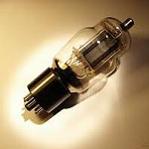
Steve has informed me that he found a fault in the deflection yoke- a broken wire. This is what was causing the low HV issue, and now the chassis is making a healthy 17kv! This is a very good sign that the flyback is indeed still good, and bodes well for a go at chassis restoration. Still left to figure out is the regulator tube, and how it functions. If the regulator can be made to work, it's looking like we may have a go at a working CPA receiver before the year is out. Naturally we still need to nail down the subcarrier frequency, as that will determine our course in the rest of this.
__________________
Evolution...
|
|
#417
04-06-2012, 03:14 AM
|
||||
|
||||
|
Nice to hear. Keep at it, and good luck with the project.
__________________
Chris Quote from another forum: "(Antique TV collecting) always seemed to me to be a fringe hobby that only weirdos did."
|
|
#418
04-06-2012, 06:32 AM
|
||||
|
||||
|
|
|
#419
05-08-2012, 03:14 PM
|
||||
|
||||
|
Here is the series of pictures from the convention, where we mounted the proto CRT into Bob D's CT-100 donor cabinet and attempted to run it with a CT-100 chassis.
Begin with a spare CT-100 cabinet.  Remove factory CRT mask.  Prefabbed proto CRT 'conversion' mask, plexiglass hasn't been installed yet.  Place conversion mask in cabinet.  Install plexiglass into front of conversion mask, secure with self tapping wood screws.  View from the rear of the cabinet. 
__________________
Evolution...
|
|
#420
05-08-2012, 03:25 PM
|
||||
|
||||
|
Install proto CRT into custom mask. This required the use of a CT-100 support ring, held in place by support rods that were fabbed on site because the factory ones were far too short. These were Bob Galanter's idea, made from threaded rod that we cut to size. We then heated the ends with Bob's mapp gas torch to bend J-hooks into the end so they would fit into the U-hooks in the CT-100 cabinet.
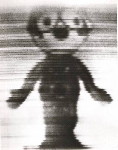
 Front view, with CRT in place.  Rear view, with CRT installed.  CRT being powered by the CT-100 at the ETF, which had unreasonably low HV (first attempt, on Friday).  Attempt #2 on Saturday, with CRT being powered by the Model 5 chassis. The Model 5 worked a lot better than the CT-100, but horizontal frequency tended to drift out of lock and we weren't able to get it back. Various things were tried in hopes of getting the Model 5 chassis repaired including replacement of caps and the horizontal frequency transformer, but were unsuccessful.  On Sunday we tried Bob's CT-100 chassis, but in the end we discovered that there is an issue with how much current the convergence electrode on the proto CRT is drawing out of the HV divider string in the chassis, which plays hell with the HV regulation. I will soon be modifying my CT-100 chassis so that the HV pot is no longer at the end of the divider string, but rather on the B+Boost line. This will ensure that HV remains steady, so convergence voltage is not chasing anode voltage anymore. Between this and some different value divider resistors (I bought a pair of 100 and 25 meg to try), I am confident I will at last be able to converge the proto CRT and get some decent screen shots. By the end of the day on Sunday we were all pretty tired... 
__________________
Evolution...
|
| Audiokarma |
 |
|
|








 Linear Mode

