
|
|
|
#32
 06-09-2009, 11:30 PM
|
||||
|
||||
|
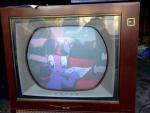
Like i told you over on ARF...all of my Admirals did just like yours where they worked as found when i got them. Yours is no exception. I recapped all of mine also just for a safety measure. I know some of the guys dont hold these in as much reguard compared to RCA's, Zenith's, ect but i love my Admirals. I have found them good in performance and reliability. I play my Admirals more than any of my other sets because of this. What a nice picture!
-Tony 
|
|
#33
06-10-2009, 12:02 AM
|
||||
|
||||
|
I love the Admirals too, they do generally hold up well. The picture is great on that set, excellent contrast and focus.
__________________
My TV page and YouTube channel Kyocera R-661, Yamaha RX-V2200 National Panasonic SA-5800 Sansui 1000a, 1000, SAX-200, 5050, 9090DB, 881, SR-636, SC-3000, AT-20 Pioneer SX-939, ER-420, SM-B201 Motorola SK77W-2Z tube console McIntosh MC2205, C26 
|
|
#34
06-10-2009, 01:09 PM
|
||||
|
||||
|
CBS Color connection to this Admiral...
I checked the flys of each Admiral and prepared this page since my 'space' for images is full on this forum.
http://ct-100.home.att.net/admiral1951early-late.html The page includes the following CBS Color info: In 1951, CBS defined two types of color add-on devices: adapters and converters. Color 'adapters' were the electronic add-on boxes and modifications to existing receivers that allowed those conventional black-and-white receivers to display 405-line, 144-field/s CBS Color Television programs in black-and-white. Color 'converters' were the color wheels, with driving electronics, that could be used in conjunction with 'adapted' receivers to show the CBS Color programs in color. They were meant to sit in front of an adapted receiver. Since my Admiral did not have the connector wired, I could not reverse engineer the circuit and so am not sure if the connectors under consideration were for adapters or converters. My first guess is that it is an adapter interface. Also, vintage CBS documentation calls for a dual-frequency flyback for use in converters. Little information is available on the dual freq flys, but one addition is an extra tap. It would be interesting to investigate the breakout of early- and late-set flybacks. Pete
|
 |
|
|


 Linear Mode

