
|
|
|
#31
 02-21-2007, 01:43 AM
|
||||
|
||||
|
Thats nice!
 You may find you don't need dual trace much. As you say, should be good for TV work. You may find you don't need dual trace much. As you say, should be good for TV work.John 
|
|
#33
02-21-2007, 10:28 PM
|
|||
|
|||
|
Tektronix
I've got an early 60s Tek RM-15 that I've had since 1980, when an instructor at my college gave it to me. Rack mounted, and the ratings are nothing special, but when my other scopes have let me down, the old TEK has been there to save my butt. It's only rated for 15 Mhz, but the waveforms seem pretty accurate to 25 Mhz, as long as you don't need to measure voltage. Single trace, single time base, but stable as a rock, and the focus is so sharp you could cut yourself on the trace. And like almost all of the Tektronix scopes of the day, it weighs more than my wifes car. Since I got this one, I've had 2 RCA scopes, and a Leader die, and my Sencore just isn't as nice to use. I also have a 100 Mhz Kenwood scope, but when it dies, I'm sure this old boatanchor will still be plugging along.
|
|
#34
02-22-2007, 12:15 AM
|
|||
|
|||
|
I also have an early 1980s dual trace Tek scope. It was sitting on top of a B&K TV analyst (which has several tubes and gets fairly warm) that was powered up. The heat from the analyst killed it and I have not tried to fix it.
The old TV scopes are tube type and much more rugged( but with less features and bandwidth).
|
|
#35
02-22-2007, 02:06 AM
|
||||
|
||||
|
I just noticed I never put up a picture of the old DuMont scope that I started this thread with. So, here it is along with the Tek 545A that I use.
Last edited by Adam; 09-13-2009 at 10:37 AM.
|
| Audiokarma |
|
#36
02-22-2007, 09:59 PM
|
||||
|
||||
|
Here's my HP H12-175A scope. It's a military surplus scope that I bought at a garage sale in Lincoln, NE about 10 years ago for $20. It's been a great instrument, and still works extremely well. It still has the "property of US Govt." tags on it, and was last officially calibrated in November 1970. It's CRT is also one that has an eerie glow in the dark.
|
|
#37
02-25-2007, 10:52 PM
|
||||
|
||||
|
One i got from CarlV (Thanks again Carl!), it's going to get new caps, and be used to provide a "Light show" in a tube amp setup. Might even try to find a second one and do one on each channel!
__________________
- Outlaw Main: 9090DB, Snell Type EIII's, Marantz 6100, TEAC PD-D2500 LR: Motorola tubes, EL84 outputs, , Dual 1019 TT, Sony CDP-CE105, Wharfedale Sapphire SP-89's and a 15" GV center in an infinite baffle Home Office: Sansui 6060, Sony CDP-C305, Original Advents
|
|
#38
02-25-2007, 11:36 PM
|
||||
|
||||
|
A couple of shots of it in action. Its really tough to get these pics we discovered...

__________________
- Outlaw Main: 9090DB, Snell Type EIII's, Marantz 6100, TEAC PD-D2500 LR: Motorola tubes, EL84 outputs, , Dual 1019 TT, Sony CDP-CE105, Wharfedale Sapphire SP-89's and a 15" GV center in an infinite baffle Home Office: Sansui 6060, Sony CDP-C305, Original Advents
|
|
#39
02-26-2007, 01:38 AM
|
||||
|
||||
|
I do it like this: Get it focused real nice, turn the lights off in the room, turn the intensity way down, a little too dim for good direct viewing, shoot.
|
|
#40
02-26-2007, 10:09 AM
|
||||
|
||||
|
Quote:
__________________
- Outlaw Main: 9090DB, Snell Type EIII's, Marantz 6100, TEAC PD-D2500 LR: Motorola tubes, EL84 outputs, , Dual 1019 TT, Sony CDP-CE105, Wharfedale Sapphire SP-89's and a 15" GV center in an infinite baffle Home Office: Sansui 6060, Sony CDP-C305, Original Advents
|
| Audiokarma |
|
#41
02-26-2007, 10:28 AM
|
||||
|
||||
|
Quote:
Seems to be completely operable, but gets that hot electronics smell when It warms up, and has several very old 'lytic caps that I'm sure need changing.
__________________
- Outlaw Main: 9090DB, Snell Type EIII's, Marantz 6100, TEAC PD-D2500 LR: Motorola tubes, EL84 outputs, , Dual 1019 TT, Sony CDP-CE105, Wharfedale Sapphire SP-89's and a 15" GV center in an infinite baffle Home Office: Sansui 6060, Sony CDP-C305, Original Advents
|
|
#42
03-02-2007, 10:44 PM
|
||||
|
||||
|
For general shop work, I use a Tek 547 with a 1A1 plug-in that I bought freshly serviced and calibrated from a vintage test gear restorer. I've had my 547 since '93 and periodically lift one side of and re-form each of the 'lytics with their rated working voltage and a 20K/5W series resistor just to make sure they're in good shape. My first scope as an experimenter and student was an old Jackson CRO-2. Just before I bought the 547, I was using a 531 that I bought from a TV repair shop. I started using Tek scopes exclusively in college. I learned from working as a lab tech for the university for 2 years that Tek scopes are virtually indestructible and will last practically forever with reasonable preventive maintenance.
For applications where I need more bandwidth or where the 547's size and weight might be an issue, I have a Tek 475A with the DM44 option. I prefer the extreme durability and ultra-sharp trace of the 547, but the 475A's portability is a plus at times. I've had very few problems with the 547, especially considering that the unit is older than I am. I've replaced one tube and one transistor in the time that I've owned it and those two breakdowns were preceded and followed by 4 or 5 years trouble-free. The tube and transistor failures were also both caused by rough handling by movers, as both problems popped up a few days after setting the scopes up in new locations after a move. If I don't re-form the 'lytics every 2 years, I've noticed that it will eventually start blowing the line fuse after an hour of run time until I re-form them again, then it can run for 8 or more hours at a time without blowing its fuse after the caps have each been re-formed to the point of drawing less 1/5(sqrt(C*V)) uA of DC leakage current. For a 125uF/350V, for example, that's 42uA or 837mV drop across a 20K series resistor. At that leakage current, the cap will dissipate 14.7mW due to leakage resistance at rated working voltage. Anyone know why Tek specifies a 6.25A slo-blo fuse for 115V operation and 3.0A slo-blo for 230V instead of 6.0A and 3.0A? It's hard to top the old Tek scopes for servicing and analyzing tube systems. With the 20V/div deflection factor available on most plug-in units and a 10x probe, waveforms up to 2kV p-p may be displayed, and slightly larger amplitude waveforms may be applied without risk of harming the scope. Large deflection factors are a must for viewing waveforms in the output stages of tube audio gear. Now, if I could just find a Tek 570 for under $1,200. For the newcomers, the Tek 570 is a Curve Tracer similar to the Tek 575 Transistor Curve Tracer, but designed for displaying vacuum tube characteristic curves. Included here are some 1950s-era pictures of two unusual scopes (from an old Howard W. Sams book on oscilloscopes). The Probescope PO-1 had its 1" CRT mounted inside the probe housing. The three pictures of it include a view of the semi-portable instrument showing the scope's front panel, close-up of the probe, and then the PO-1 in use on what appears to be one of Motorola's B/W chassis similar to the one which was used as the starting point in the evolution of the design which became their 19" color set. In my travels in the world of vintage TV, I've learned that Motorola modified a chassis design originally intended for a 24" B/W set, adding the chroma and convergence circuitry on a vertically-mounted subchassis attached to the rear of the main chassis and using a voltage-multiplier and regulated HV supply. An odd type of regulator tube called a Victoreen tube, which used controlled internal corona discharge to provide passive shunt regulation for the HV instead of the active shunt regulation provided by, for example, a 6BK4 high voltage triode, was used in early Motorola color sets. The next unusual scope pictured here was known as the Kingston Absorption Analyzer, which used a capacitive pickup device as its probe. A turret-type TV tuner inside the unit allowed for restricting the instrument's passband to selectable presets. Looks like a roundie color set is being serviced in the pic. If that's an RCA, then the horizontally-mounted chassis and "afterthought" appearance of the dynamic convergence subchassis suggests it might be a 21-CT-55 aka CTC2B, which was an update of the CT-100's CTC-2 chassis, modified to use the 21AXP22 CRT in place of the 15GP22. Let's hope that classic has survived and is safely stored away somewhere cool and dry, yet to be rediscovered. Just a reasonably-educated guess on the identification of the pictured roundie. Can anyone who actually owns a 21-CT-55 or has seen one recently confirm or correct my guess?
|
|
#43
06-14-2009, 12:05 AM
|
||||
|
||||
|
Quote:
Regarding old scopes, I'm still using that Tek 547 or the 475 depending upon the features needed for accomplishing a particular task, but I've also started using an 80s-era B&K scope (due to super-small size and weight and very sharp and bright trace) for projects requiring an ultra-portable unit and where a general-purpose recurrent-sweep scope of about 5 MHz bandwidth is adequate. It's especially handy for RF/IF alignments where its tiny size allows placing the scope in the most convenient position to allow viewing changes to a response curve while keeping the area of the chassis where I'm working well within my field of vision.
|
|
#44
06-14-2009, 08:20 AM
|
||||
|
||||
|
A couple of favorites from my scope collection:
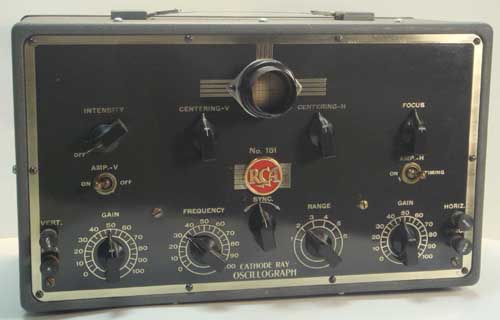 - RCA 151 1" CRT 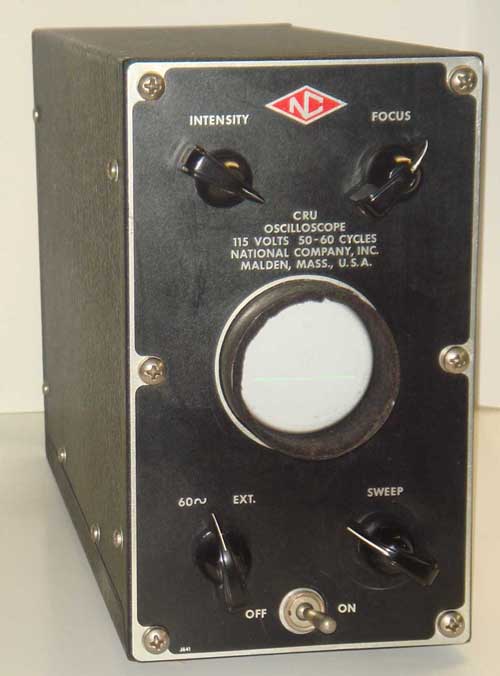 - National CRU 2" CRT Here's a link to some of my collection of early scopes, I only collect scopes with 1,2, or 3 inch tubes. http://www.myvintagetv.com/vintage_test_equipment.htm Still looking for one of these, General Radio Model 497: 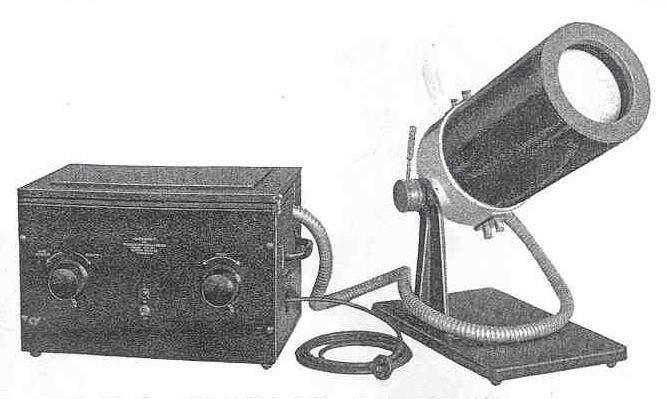 Chuck
__________________
www.myvintagetv.com Learn from the mistakes of others - You can't live long enough to make them all yourself.
|
|
#45
06-14-2009, 09:18 AM
|
||||
|
||||
|
That little National is one cute scope...didn't know they made 'em!
|
| Audiokarma |
 |
|
|




 Linear Mode

