
|
|
|
#46
 03-18-2014, 12:10 PM
|
||||
|
||||
|
Thanks for the ideas. My set does not have the .1 cap across L21. Maybe that's why they show the coil and cap inside dotted lines. I could try adding that to see what happens. The other caps are easy to reach except for C73 (47pf), which is crammed in the yoke.
Phil Nelson 
|
|
#47
03-18-2014, 02:15 PM
|
||||
|
||||
|
You may also want to try adding capacitance across the damper to increase the width if rrrhre2s' suggestions don't pan out...
__________________
Tom C. Zenith: The quality stays in EVEN after the name falls off! What I want. --> http://www.videokarma.org/showpost.p...62&postcount=4
|
|
#49
03-18-2014, 03:27 PM
|
||||
|
||||
|
Increasing capacitance across the damper made a difference. That cap (C72) is listed at 120pf/3KV, and I don't keep many high-voltage caps around, but I found a couple of 82pf/5KV ceramics and connected one across C72. That bumped out the width to nearly fill the mask. Wiring a second one in parallel increased the width to overscan the mask slightly.
The tradeoff is that with lower HV, the screen is less bright. With two 82-pf caps in parallel, the HV sinks to only 7.5KV and the screen is noticeably dimmer than before. Maybe I'll go with one cap and call it done. I'd rather have a bright screen with slivers of black on the edges than a dim one. There is still slight non-linearity, but not enough to be annoying when watching a program. For the record, I also tried adding a .1 cap across L21. It improved the linearity very slightly, but at the expense of width. Phil Nelson Phil's Old Radios http://antiqueradio.org/index.html
|
|
#50
03-18-2014, 03:48 PM
|
||||
|
||||
|
Phil did you try subbing the Horiz Output tube? Even if it checks good it might not work as well as another one.
As for the linearity I think some sets just aren't as good as others by design. If you've ever seen old copies of Consumer Reports they would test them for linearity and overscan and show test patterns, some models, especially low end models, had lousy linearity right out of the box.
|
| Audiokarma |
|
#51
03-18-2014, 03:59 PM
|
|||
|
|||
|
Phil,
Bear in mind that when you add C across the damper to gain width, the cathode current of the HO tube drops (along with HV). You can bump the G2 voltage up a tad to bring the current back up. But insert a milliameter in the K leg so you can see what's going on. For a 'quick & dirty' test of the HO tube, shut the set off for 7 seconds or so, and then back on. If the width is slow to come back to where it was, the tube is borderline weak. Last edited by old_coot88; 03-18-2014 at 04:06 PM.
|
|
#52
03-18-2014, 05:18 PM
|
||||
|
||||
|
This HO tube passes the 7-second test with flying colors. I tried subbing the other 6BQ6 that I have on hand, which seems slightly worse.
Maybe I have arrived at the land of tradeoffs with this issue. I can make things slightly different, but not significantly better. Phil Nelson
|
|
#53
03-18-2014, 05:27 PM
|
||||
|
||||
|
Here is a potentially dumb idea...Maybe you could get more HV by adding turn(s) to the HV rect. filament winding on the fly...If the fly filament winding was made assuming the higher HV condition then at reduced HV the filament may be starved for power and not emitting electrons as efficiently as it ought to, thus reducing HV.
__________________
Tom C. Zenith: The quality stays in EVEN after the name falls off! What I want. --> http://www.videokarma.org/showpost.p...62&postcount=4
|
|
#54
03-21-2014, 01:06 AM
|
||||
|
||||
|
Adding a 39pf cap across the damper (in addition to the added 82pf) did the trick. Now I can fill the screen horizontally and the brightness is just fine.
 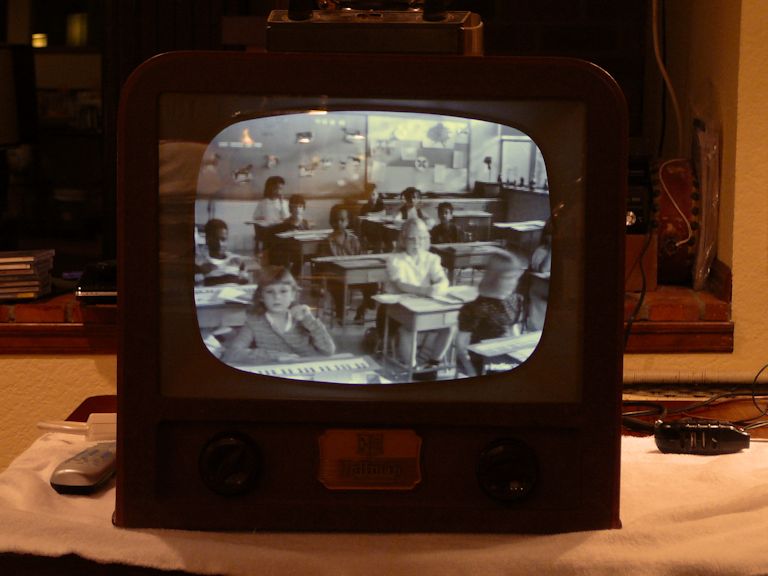 The second photo is a live broadcast received with rabbit ears. I suspect the screen geometry will never be perfect, but I'm calling this one good enough for now. Thanks again for the advice. Phil Nelson Phil's Old Radios http://antiqueradio.org/index.html Last edited by Phil Nelson; 03-23-2014 at 11:17 PM.
|
|
#55
03-21-2014, 11:52 AM
|
||||
|
||||
 I've come across a few sets with caps tacked in to increase the width. I've come across a few sets with caps tacked in to increase the width.
|
| Audiokarma |
|
#56
03-21-2014, 12:07 PM
|
|||
|
|||
|
Quote:
 With added C across the damper, the HO tube will run a little cooler, albeit with slightly reduced HV.. per the old sayin' "there is no free lunch". 
|
|
#57
03-21-2014, 12:31 PM
|
||||
|
||||
|
Quote:
Just curious,  jr
|
|
#58
03-21-2014, 12:47 PM
|
|||
|
|||
|
Quote:

|
|
#59
03-21-2014, 01:16 PM
|
||||
|
||||
|
Quote:
|
|
#60
03-21-2014, 03:44 PM
|
|||
|
|||
|
I think sometimes we forget that when this equipment was newer that people usually wanted the service man to repair the set in the home.
I had a book from RCA that an in home service call would have been about $15.00. So the guy doing the repairs had to get the set working as fast and as cheaply as possible to maximize his income. This meant that he could service more sets in one day. I will digress here getting off topic. rrrhre2s
|
| Audiokarma |
 |
|
|





 Linear Mode

