
|
|
|
#91
 12-02-2013, 07:28 PM
|
||||
|
||||
|
Quote:
I also noticed a note in Sams saying some models have L23,L24 reversed. Not sure how that would effect the alignment process. Did you ever figure out why the sound trap(A13) was not working in the tuner? That could account for some dependencies seen during alignment. 
|
|
#92
12-02-2013, 08:05 PM
|
||||
|
||||
|
No, but I've seen the same issue with traps in other sets and it was always a faulty mica cap. I'm not too keen on opening up that tuner and extracting the trap to find out.
I'll trace out the eye tube wiring as soon as I can. I'm way backed up at work right now from the holidays.
|
|
#93
12-03-2013, 02:59 AM
|
||||
|
||||
|
I stayed up late and gave the sound IF and good going over. Right away I noticed a 1K resistor with a crack that measured about 300 ohms. The one to the right of it measured 1,300. Both got replaced.
 Next came the mica caps. 3/5 were bad - a 10pF, 27 pF and 47pF. By 'bad' I mean they were showing leakage at less than 200 volts (all are rated for 500) and I couldn't get a capacitance reading. Hopefully, replacing these will have a positive impact on the sound tuning.  
|
|
#94
12-06-2013, 02:56 AM
|
||||
|
||||
|
I finished replacing the leaky mica caps and out of tolerance resistors including the one in the eye tube base then redid the audio alignment. Bingo!
 The eye tube now responds like it should, I only get good sound at one distinct point on the dial per station and it coincides with a sharp picture. Time to start putting this set back together 
|
|
#95
12-06-2013, 08:43 AM
|
||||
|
||||
|
Good show, Bob! Congratulations. After spending more time tuning around with mine, I notice that I also have the double peak issue with the audio. It's not as pronounced as yours was, but clearly I still have some work to do. I'll start by looking at those mica caps.
Are you going to do anything to the cabinet? I haven't done anything to mine except superficial cleaning. Again, congratulations. Your friend should be very pleased. -Clark
|
| Audiokarma |
|
#96
12-06-2013, 09:03 AM
|
||||
|
||||
|
Congratulations is right. I still don't understand how those bad components would cause the reveres action you were getting on the eye tube. Suppose it was a combination of the leaky caps which caused a false alignment indication at multiple resonances. Was the alignment off a lot when you went back through it? At any rate I think we're about to the point in time that we need to start shotgunning all mica caps. Although sometimes those types of caps make for a excellent learning experience.
Last edited by Kevin Kuehn; 12-06-2013 at 03:25 PM.
|
|
#97
12-06-2013, 09:51 AM
|
||||
|
||||
|
Congrats, Bob! I just watched your YouTube video last night on this set. Nice to see that you solved the audio issues and the tuning eye reverse issue. Cannot wait to see the next video of this set functioning!

__________________
-Al
|
|
#98
12-06-2013, 09:57 AM
|
||||
|
||||
|
Quote:
I would not advocate shotgunning micas in IF stages unless you are well equipped and well versed in alignment, since a slight change in lead dress may kick things out of whack. Ditto, even more so, for the tuner section. Service manuals often included warnings to keep your clumsy mitts out of the tuner. These days I look on mica caps as I do resistors. Generally more reliable than the hopeless paper caps, but not immortal. If a basic (paper + electrolytic) recap doesn't magically fix everything, then the next phase is to look at micas + resistors. One thing that I do during the basic recapping phase is test every component on the same terminal where I am connecting a new cap, the theory being that if I'm disturbing (unsoldering & resoldering) anything on that terminal, I may as well deal with everything at once to avoid trashing the connection with repeated monkey-wrenching. That way, I naturally uncover some other bad parts as I go, although it's not very systematic. Phil Nelson
|
|
#99
12-06-2013, 11:18 AM
|
||||
|
||||
|
Quote:
I'm not going to touch the cabinet but the owner asked for suggestions on preserving the finish. I'm no expert on blonde finishes but I figure a quality, non-silicone furniture polish found be fine. Quote:
I would call it a reverse action - more like the bias point was shifted over so that the left bar would never dip below the reference bar. Now, it swings to either side. I'll show that in detail in the next video up later today. Quote:
Quote:
I think the big culprits were the bad 10pF coupling mica cap between the 1st and 2nd audio IF stages and the two bad 1K resistors which threw the bias off the 2nd tube.
|
|
#100
12-06-2013, 11:39 AM
|
|||
|
|||
|
Yipee! Great going! Look forward to seeing the video.
I've wondered on some of these sets if the reason a bunch of components are bad is because of some kind of power surge or jolt to the system in the past? Something like lighting coming in the ac line or antenna lead. Maybe even running long time on low voltage or other abuses? Perhaps that doesn't explain it as much as plain old age and normal wear and tear. And, maybe that couldn't affect these mica caps. But, I see some people's restorations with a bunch of normally good components that have gone bad and think they all got zapped by something instead of just coincidence. Just wondering out loud here (or through a keyboard).
|
| Audiokarma |
|
#101
12-06-2013, 12:16 PM
|
||||
|
||||
|
I was thinking more along the lines of an issue with the materials or construction technique used. All the failed caps are "Micamold" - not exactly know for being high quality.
|
|
#102
12-06-2013, 12:57 PM
|
||||
|
||||
|
I have to agree that shotgunning the mica caps could be a bad idea. I keep forgetting that not everyone wants to get involved with alignment. Although in a few more years it may come down to that. Even so it would be best to replace them one at a time, testing as you go.
Last edited by Kevin Kuehn; 12-06-2013 at 03:30 PM.
|
|
#103
12-09-2013, 12:19 PM
|
||||
|
||||
|
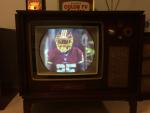
I reinstalled the yoke, speaker and chassis and fired it up. Well that's a little disappointing. Moving the ion trap magnet all around the neck has barely any effect. I brought it near a screwdriver and it seems plenty strong. I'll dig up some spares and give it another try.

|
|
#104
12-09-2013, 02:01 PM
|
||||
|
||||
|
I consulted the Rider service info and they mention this specific issue. It seems that he original 17AP4 required a stronger magnet than the 17BP4. They suggest sliding the original all the way back over the base.
 That did the trick I'll try to find an RCA to F connector at Radio Shack tonight so I can feed a cleaner signal into it. While working on this issue, I would occasionally hear a loud squeal from the HV area. Eventually, I tracked it down the the HOT plate lead. Moving that wire just slightly on the end going into the cage can eliminate or bring back that squeal. I suspect that's why there's tape wrapped around it - to keep it from moving. I guess I'll pull the chassis again and take a closer look. Probably a bad connection at the flyback or a break inside the wire. 
|
|
#105
12-09-2013, 03:53 PM
|
||||
|
||||
|
Congratulations on getting a picture on your set CRT! It is looking great, to me.
__________________
Bruce
|
| Audiokarma |
 |
|
|



 Linear Mode

