
|
|
|
#1
 02-13-2008, 03:54 AM
|
||||
|
||||
|
Pilot light connections on Zenith MJ-1035
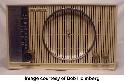
I have a Zenith MJ-1035 radio, chassis 11J01, that works very well, but the red pilot light on the front panel is disconnected (has been since I got the radio). I'd like to get it working again. Where does this lamp connect? There are two terminals on the chassis near the 19EA8 19kc/38kc amplifier tube (V8), marked "neon". The schematic does not show this lamp or the connection points I mentioned; however, the terminals are shown on the top view of the chassis in Sams (set 751, folder 9). The word "neon" is engraved on the chassis near the terminals in question.
Thanks in advance for any help with this; I don't want to indiscrimately connect the pilot light to those terminals without knowing what they are there for. I can't imagine them being for anything other than the neon on/off indicator, but I don't want to guess at it either. Also, I am somewhat baffled by the fact that the schematic shows a stereo-FM indicator lamp for this chassis, but mine does not seem to have such an indicator. Hmmm.  Did any model of the MJ-1035, say the MJ1035-W1, ever have a stereo indicator, or was this radio built without this feature, as some other early stereo receivers were? (I remember seeing a 1950s Magnavox radio/phonograph console about 20 years ago which supposedly had stereo FM capability [there was in fact a position on the function switch marked "stereo FM"], but I could not see an indicator anywhere on the front panel.) Did any model of the MJ-1035, say the MJ1035-W1, ever have a stereo indicator, or was this radio built without this feature, as some other early stereo receivers were? (I remember seeing a 1950s Magnavox radio/phonograph console about 20 years ago which supposedly had stereo FM capability [there was in fact a position on the function switch marked "stereo FM"], but I could not see an indicator anywhere on the front panel.) This also raises another question. If these early stereo-FM radios did not have a stereo indicator, how was the listener to know if he or she was listening to a stereo FM broadcast? The only way I can imagine a listener would know that without an indicator on the receiver would be to listen for the station break, in which the announcer very often stated that the radio station was broadcasting in stereo. Many stations' IDs would go something along the lines of "Stereo 96.9 W---" in multiplex FM's early years; there was one station in the Cleveland area in the late 1960s, for example, that used to identify itself as "WELW-FM Stereo 108, Cleveland." The station's assigned frequency was 107.9 MHz, but in those days, when all FM radios had analog slide-rule or circular tuning dials, FM stations rounded the frequency up or down to the nearest whole megacycle; if the station's frequency was 96.7 MHz or higher (to 96.9 in this case), for example, the station break would announce the station as "Stereo 97", and if the frequency were 96.5 or lower (to 96.1), the ID would be "Stereo 96." Of course, in this day and age of digital readouts on all modern FM receivers, many stations have gone to announcing their frequencies down to the tenths of megahertz; the oldies stations in this area (two that I can hear from my home in northeastern Ohio), for example, announce their frequencies as "Majic 105.7" and "Magic Oldies 102.5". Some stations in certain parts of the country leave off the tenths-of-MHz and simply announce their frequency as a round number; New York City's WQHT-FM (formerly WNBC-FM), for example, operates at 97.1 MHz, but its ID slogan is "Hot 97." The decision to have the air personalities announce the station's frequency in whole numbers or down to the tenths of MHz is left to the discretion of the station's program directors or management. The MJ-1035 is advertised as a stereo FM radio; in fact, the words "stereo FM radio" appear on the receiver's front panel. (The on/off pilot lamp is directly below the letters "fm", in lower-case italics.) However, I do not see a position on the function switch for FM stereo; I seriously doubt that this receiver had any kind of automatic stereo/mono switching, as the MJ1035 was not really a high-end piece of audio gear, its $199.95 price (in 1961 dollars) notwithstanding. Since not every FM station broadcast in stereo in the '60s, how did the listener switch the receiver to mono if the station he/she was listening to either was not equipped for FM multiplex or was not transmitting in this mode at the time? The only explanation I can come up with that makes any sense to me is that the radio's multiplex decoder operated full-time, whether or not the station to which the receiver was tuned was transmitting in stereo.
__________________
Jeff, WB8NHV Collecting, restoring and enjoying vintage Zenith radios since 2002 Zenith. Gone, but not forgotten. Last edited by Jeffhs; 02-13-2008 at 04:34 AM. Reason: Addition to post 
|
|
#2
02-13-2008, 02:28 PM
|
||||
|
||||
|
Sorry I can't help you with your questions regarding the Zenith, I trust
someone will come up with the info you need. I just want to make a small comment about that 1950s Magnavox unit with stereo capability. FM stereo broadcasting did not begin in the USA until 1961, but it was understood for several years prior to that date that the stereo info would be somehow transmitted in wideband FM, so manufacturers began to add 'multiplex output' jacks at the output of the FM demodulator, ahead of any low-pass filters. If the set you are remembering was truly from the fifties, it would use such a setup, and an outboard stereo decoder would be needed. The circuitry would then involve a pair of audio jacks to return the output of this decoder to the audio amplifiers in the console, and the switch position you are mentioning would correspond to this mode of operation. Some aftermarket stereo decoders were sold, but I understand their performance was nothing to write home about... Also, a number of tuners and hi-fi consoles were built with the capability of tuning in both an AM and an FM transmitter at the same time, for some experimental stereo broadcasts, but these do not seem to have ever been very popular. Actually, I know of at least one model of tuner that had both this 'AM/FM stereo capability' (not to be confused with later AM stereo systems!) and the MULTIPLEX jack. It was a Grommes unit from circa 1960, but I would have to look up the model number. Regards. (P. S.: Grommes 103GT) Last edited by electroking; 02-13-2008 at 03:00 PM. Reason: added model number
|
|
#3
02-13-2008, 03:31 PM
|
||||
|
||||
|
I gave you the wrong info
Hi Jeff,
The red lamp in the middle of your MJ's faceplate is in fact, the FM stereo indicator. I have the operating guide that I got with my second MJ...I'll burn you a copy and send it. That said, perhaps the lamp does connect near the "Matrix amp- Multiplex det" or "V8" tube placement section? Like you, I do not see the lamp on my schematic, but that is another concern. Your MJ has chassis # 11J01? That's news to me. The Photofact folder I ordered (Set 647 Folder 13) is for chassis numbers 12J01 and 12J01Z, dated Aug. 1963. I can say the MJ-1035 has twelve tubes -both early and late versions. I have the tube listing if you need it, but mine is getting hard to read. I have a stripped MJ that I can look at without pulling one of my working units apart. If it isn't traceable, I'll look at one of the others. Give me a bit of time-
__________________
Bedroom: Marantz 2015 / Pioneer CS-88 Living Room: Zenith Y928 / MJ 1035 vintage stereos Office: Zenith H845 Home desk: Zenith X338 / H272W Circle of Sound Truck: Kraco Dust-O-Matic, circa 1977
|
|
#4
02-13-2008, 04:17 PM
|
||||
|
||||
|
Jeff,
There are two male-female blade connectors (identical to the speaker connectors) that run from the lamp to a terminal directly behind the right edge of the speaker (looking at it from the rear, with the back off). The chassis has two holes, with one male portion of the connector sticking out of each. This is marked "71" on my chassis; 12J01Z. Again, these holes are located on the chassis' leading edge, just a couple inches from the tuner moving towards center. There is also a clear view in my SAMS in the photograph of the chassis-top. Let me know what you discover on yours. I can photograph, or fax my SAMS if you need it. Let me know-
__________________
Bedroom: Marantz 2015 / Pioneer CS-88 Living Room: Zenith Y928 / MJ 1035 vintage stereos Office: Zenith H845 Home desk: Zenith X338 / H272W Circle of Sound Truck: Kraco Dust-O-Matic, circa 1977
|
 |
|
|





 Linear Mode

