![]() |
|
#16
|
||||
|
||||
|
re: Removing petrified masking tape.
First thing is to determine what finish your wood cabinet has. By the 1940's all production lines were using lacquer, however a few small-run cabinet makers were still using shellac, so you gotta test the finish in a spot that won't show, which in your case looks like the cabinet bottom. Shellac can be re-amalgamated (remelted) with alcohol, so flip the empty cabinet on its top and test a finish spot on the base with rubbing alcohol which is 70% alcohol and 30% water. Put an old can lid over the test spot to keep it from drying out during the 5 minute soak test. If the finish on the test spot does not turn soft after a 5 minute soak or turn white after it drys, then assume that your finish is lacquer. If there is no change to the finish, to remove the tape, use either pure alcohol with a little Windex, or rubbing alcohol and add a trace of dishwashing soap and soak it until the tape can be rubbed off with a paper towel. Use plain Windex to remove the mess left behind. (Windex D or Windex with ammonia is the best product to use, but organic vapor rules are making this product almost impossible to find in some areas. If you have trouble, look for it at industrial suppliers.) If the test spot was softened or whitened by the rubbing alcohol test, you have the more rare shellac finish. Get some dry cleaning fluid (it is a known carcinogen) and test that on another spot on the base. If it does not harm the finish, then use the dry cleaning fluid in the same way as before, but wear protective gloves this time, and do it outside and avoid breathing the vapor. On a shellac finish, once the tape is removed, you can use pure alcohol to re-amalgamate the finish, and then top it off with a fresh coat of shellac. If there are bare areas of the cabinet, to even out the wood color, I'd suggest using alcohol as a shellac stripper, unless there are decals under the finish that you wish to preserve. James Last edited by earlyfilm; 07-14-2011 at 11:17 AM. Reason: typo |
|
#17
|
||||
|
||||
|
Thanks for the tips. I'll start with the least aggressive solvent and work my way up.
Quote:
![]() Quote:
![]() Quote:
Which Sears set do you have ? I picked up a Silvertone 8132 a while back and it's like nothing I've ever seen before inside - bunch of octals, dual push button tuner... Quote:
|
|
#18
|
||||
|
||||
|
Quote:
![]() I'll have to visit renovated radios as some of my knobs are missing, not to mention the back. Tom C. |
|
#19
|
||||
|
||||
|
Very nice find!
|
|
#20
|
||||
|
||||
|
Quote:
Thanks! I found the time today to pull the chassis. It looks like it's complete. ![]() Here's the HV coil. I like the primitive spot welded cover. Later versions were a single piece of stamped aluminum. ![]() As for the underside, it's somewhat different from later revisions. Here's a TS-4J for comparison. The two large metal HV caps are for the horizontal deflection plates. One thing I find odd is that this set has all plastic insulated wire. Every other TS-4 and TS-18 chassis I've worked on used cloth insulated wires ![]() ![]() All the non HV caps are Solar "sealdtite" branded as Motorola. They don't look to be very "sealed tite" anymore ![]()
Last edited by bandersen; 07-14-2011 at 05:41 PM. |
| Audiokarma |
|
#21
|
|||
|
|||
|
I noticed there aren't any "Do It Right" stickers on this one. You better be on the look out for factory mistakes!
__________________
The surefire way to make sure your CRT is dead, sell it to me! |
|
#22
|
|||
|
|||
|
Great set by the way!
__________________
The surefire way to make sure your CRT is dead, sell it to me! |
|
#23
|
||||
|
||||
|
That big orange doohickey is a selenium rectifier, ain't it ? They go out, too, usually makin' a very smelly mess when they do. Yeah, I'd say those caps have seen better days.
__________________
Benevolent Despot |
|
#24
|
||||
|
||||
|
This just gets more interesting, have you found a date stamped on it anywhere?
Most of these do have one either on the back apron or on top somewhere. |
|
#25
|
||||
|
||||
|
The first one sold was the TS-4B. The first one with fine tuning was the TS-4H. The last chassis in that run was the TS-4J, with an "early" and "late" version.
This comes from my Wallace's Telaides book. My set is a TS-4D.
__________________
"We improve things by making them worse" |
| Audiokarma |
|
#26
|
||||
|
||||
|
Quote:
![]() Quote:
I learned the hard way how bad these suckers smell when they let go. It's something you never forget! Quote:
I started putting together a little database form the sets I have seen. Here's all I have so far. It sure makes it seem likely that this set fits in nicely at the top of the list. Can anyone else supply some serial #s and dates ? TS-4 serial # 2425 (manufacture date: ??? ) TS-4D serial # 23149 (manufacture date: ???, 1948) TS-4H serial # 45354 (manufacture date: July 26, 1948) TS-4J serial # 52186 (manufacture date: Oct ??, ????) TS-4J serial # 61454 (manufacture date: January, 5 1949) TS-4J serial # 67607 (manufacture date: January 10, 1949) TS-4J serial # 86923 (manufacture date: April 23, 1949) Quote:
Yeah, I have that Telaides too. I found the TS-4 in Riders volume 1. There's an early and a late version. The late matches my chassis. |
|
#27
|
|||
|
|||
|
Interesting, I have a TS18A serial number 338581 built on 11/29/49. I wonder if Motorola made 250,000 sets between the last one Bob listed and my set or if they started a new numbering system for every chassis type?
__________________
The surefire way to make sure your CRT is dead, sell it to me! |
|
#28
|
||||
|
||||
|
From a Timeline of Motorola History.
Their first set was made in 1947, more than 100,000 units were sold the first year. If 2425 is the serial number it must be from the first week or two of production! |
|
#29
|
||||
|
||||
|
I just looked at my set with no fine tuning and channel 1 on the dial, it's chassis is Copper plated. It's serial# 23723 and it's a TS-4B or 4E can't quite make it out.
I have a bare chassis serial# 56000 something and it's a TS-4J, it has fine tuning. I'm thinking yours is just a plain TS-4 with no suffix, just like it says on the label? From your list above it looks like they were cranking out about 6000 of them a week in 1949! Last edited by Eric H; 07-14-2011 at 08:43 PM. |
|
#30
|
||||
|
||||
|
OK, now I'm even more confused. I studied the Riders schematic more closely and my set is a combination of the TS-4 early and TS-4 late.
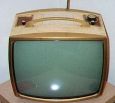
The TS-4 early has the big 0.03 mfd HV vertical caps and 6S8GT in the audio. The TS-4 late has 0.005 mfd HV vertical caps and 6AL5 + 6SQ7 in the audio. I have the big 0.03 mfd HV vertical caps and 6AL5 + 6SQ7 in the audio ! Also, thanks to your tips I was able to get the masking tape off ![]() Window cleaner with alcohol and ammonia did a good job on most of it. Then, alcohol on the residue. After that, Howard's RAF and Feed n' Wax. ![]() Not too shabby. Of course, all the dings, scratches and chips are still there, but it beats refinishing. ![]() Notice it doesn't have any side caps near the control panel ? That's another difference I just discovered. All the other VT71s I've seen had those caps that covers screws which hold on the front near the bottom like this. ![]() However, in the set, the control panel is held on from behind by screws. I think the earlier design is much nicer looking.
Last edited by bandersen; 07-14-2011 at 08:52 PM. |
| Audiokarma |
![]() |
|
|