
|
|
|
#1
 10-13-2011, 10:42 PM
|
||||
|
||||
|
Du Mont RA112-A3 and color?
I just acquired a Du Mont RA112-A3. It is a late run chassis according to the Rider's service manual which puts it manufacture probably at the end on 1950.
I noticed on the back cover "Video Out to Color Converter". The video output is via an RCA connector and this connection is not shown in the diagram from Riders Volume 6. Nor in Riders is the DPDT switch next to the connector which is not marked. (A standards switch?) I have yet to follow where the video is extracted but I expect it is somehere from the video amplifier stage. And as for the mystery switch, I will have to trace this out as well. This is interesting since the late 1950 coincides with the FCC acceptance of the CBS color system. My guess is that perhaps the switch alters the horizontal and vertical time bases and the video out may be to provide sync for an external sequential filter device? If a separate color wheel was considered for this set, it would have to be a monster diameter: the tube is a 19AP4 and therefore the disc would have to be about 40" in diameter!  (It make me chuckle to think how hazardous television servicing could be in those days: HV on metal cone CRTs and huge spinning discs could lead to horrendous accidents!)  Has anyone else seen such connectors and switches on 1950-51 vintage TVs? 
|
|
#2
10-13-2011, 10:56 PM
|
||||
|
||||
|
My majestic has a "color" switch that disconnects the video and sends it out an RCA jack when in the color position, but there are no other connections and no way to feed video back to the disconected output amp.
Makes for a better test point for testing the IF and detector, or a way to get a blank raster if you ask me. Could it be that majestic was planning to sell a color monitor less recieving circuits, and audio to connect to this jack? Naw, coulden't be.
__________________
Tom C. Zenith: The quality stays in EVEN after the name falls off! What I want. --> http://www.videokarma.org/showpost.p...62&postcount=4
|
|
#3
10-13-2011, 10:57 PM
|
||||
|
||||
|
Some DuMonts from that time frame have a local/distant switch which alters the response of the AGC.
|
|
#4
10-14-2011, 01:28 AM
|
||||
|
||||
|
I doubt it was for a color wheel, it's more likely to have been a provision for receiving color signals in B&W so that existing sets could get the CBS signal. See this link: http://www.earlytelevision.org/admiral_adapter.html
__________________
Evolution... 
|
|
#5
10-14-2011, 02:09 AM
|
||||
|
||||
|
Quote:
CBS showed an add-on "color converter" consisting of a video monitor set with a color wheel that took a video feed from an existing B&W set, so I'd think this was the intent of the jack on the RA 112. Another DuMont Set of the era, the 30 inch Royal Sovereign had this output connector marked the same way. It is a cathode follower output off the first video amp tube, a 6BA6, through a 0.1 uf cap to the output jack. This can be seen in Sams 156 for the RA-119-A on the ETF TV schematics pages. The output is about 2.0 volts P-P video with negative going sync. I would think the color output on the RA 112 would be from the same point, pin 7,the cathode of the 6AH6 video amp tube through a 0.1 uf cap to the jack. You'd have to trace out the switch wiring, but it probably disconnected the video from the video amp. This output could have also been used to drive a motor amplifier circuit for an external color wheel if such became available as an upgrade to this DuMont set. Modifications to the vertical and horizontal sweep sections would have been necessary as well. Cliff
|
| Audiokarma |
|
#7
10-14-2011, 09:18 PM
|
|||
|
|||
|
Either that guy is short, or the color wheel is taller than most living room ceilings.
|
|
#9
10-14-2011, 11:25 PM
|
|||
|
|||
|
Back in the late 1950s when I began servicing televisions, the general wisdom concerning those color adapter sockets on early 50s sets was that at one time television manufacturers couldn't sell a set unless it had such a plug. The presence of the plug was supposed to allay any fear that a potential buyer might have had of buying an obsolete product.
|
|
#10
10-15-2011, 09:53 AM
|
||||
|
||||
|
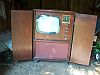
I love the style on that set that Allen is leaning on in the picture! It would look great in my man cave.
|
| Audiokarma |
|
#11
10-15-2011, 05:57 PM
|
||||
|
||||
|
I did a few calculations. The rotation of the 144 fields per second field sequential disc with six segments (2xR, 2XB, 2XG) would be:
(144/6) x 60 = 1440 RPM The linear velocity at the edge of a six foot diameter disc: V = 1440 x 6 x 3.14 V = 27130 feet per minute V = 4.7 miles per minute V = 283 mph.
|
|
#13
10-15-2011, 10:21 PM
|
||||
|
||||
|
Quote:
__________________
Tim
|
|
#14
10-16-2011, 01:07 AM
|
||||
|
||||
|
Quote:
DuMont actually did try to show how impractical a large color wheel set would be by bringing a Royal Sovereign with a real working 6 ft wheel [!!!] into a courtroom where hearings on the competing color TV systems were being held. When DuMont's turn came, the switch was thrown to start the FIVE HORSEPOWER wheel motor and the main breakers blew plunging the courtroom into total darkness. The judge stormed out accusing DuMont of trying to discredit CBS with this outrage. I wonder what ever happened to that set and the wheel? I'd love to find it in a warehouse somewhere and bring it all back to life. Cliff
|
|
#15
10-16-2011, 05:35 AM
|
|||
|
|||
|
Quote:
Seriously, great collection. I am envious... Oh and let us not forget the vintage 50s MoPar 
|
| Audiokarma |
 |
|
|





 Linear Mode

