
|
|
|
#16
 08-24-2012, 12:42 PM
|
||||
|
||||
|
The picture is pleasing, considering what a simple design this TV has. None of my 7-inch TVs seems as bright as an electromagnetic-focus set using a 10BP4, etc., but perhaps that's the nature of the beast.
The focus ain't bad, but I think I will take that focus pot back out and free it up, now that I have a stable image to work with. Phil Nelson Phil's Old Radios http://antiqueradio.org/index.html 
|
|
#17
08-24-2012, 01:06 PM
|
||||
|
||||
|
My RCA 730TV1 is the only 10" set I've restored so far but the 10BP4 in that has an absolutely amazing clear crisp image. I remember staring at it
 for hours after I had finished it and just being stunned at how good a 64 year old television looks. for hours after I had finished it and just being stunned at how good a 64 year old television looks.Here's hoping that being able to adjust the focus will give you an even better picture than you already have.
|
|
#18
08-25-2012, 08:26 AM
|
||||
|
||||
|
Quote:
__________________
Just look at those channels whiz on by. - Fred Sanford
|
|
#19
08-26-2012, 01:00 AM
|
||||
|
||||
|
Yes, that set looks good indeed.
The only two 7JP4 sets I have seen working were a Motorola that I did some repairs on in about 1980 when I had no idea I need to replace all of the capacitors (not surprisingly, it was still pretty bad even after a few new HV disc caps in the sweep circuits), and a Sentinel TV400 (or 400TV?) that worked well "as found" about the same time (before I knew not to power up old sets before replacing critical parts).
__________________
Chris Quote from another forum: "(Antique TV collecting) always seemed to me to be a fringe hobby that only weirdos did."
|
|
#20
08-31-2012, 12:24 AM
|
||||
|
||||
|
I have run out of significant things to fuss over, so I guess this project is nearly done.
Today, for fun I brought the Admiral out for a "Pepsi challenge" with my recently restored Philco 49-1240. I was expecting the 7JP4 to look dim and washed out next to the Philco's 12LP4, but it compares pretty well. These are unretouched daylight snapshots and both TVs are receiving OTA signal from my in-house transmitter on separate rabbit ears. 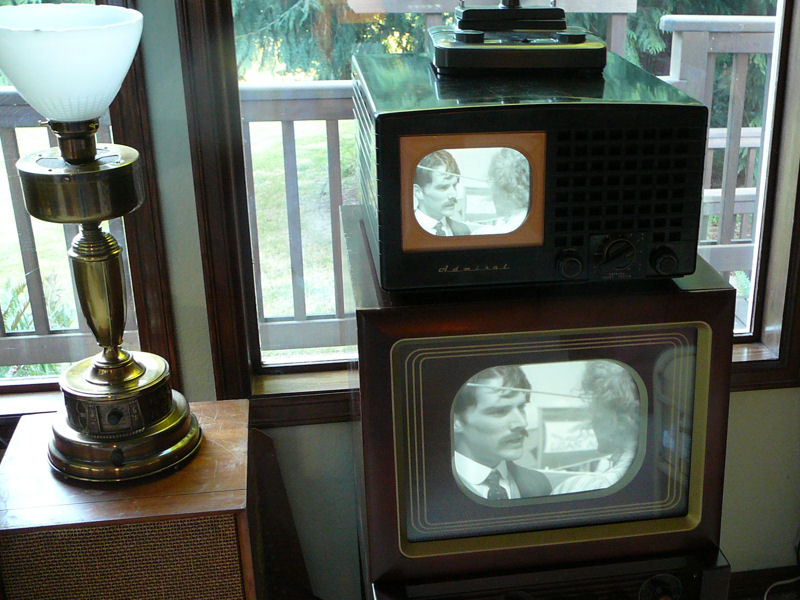 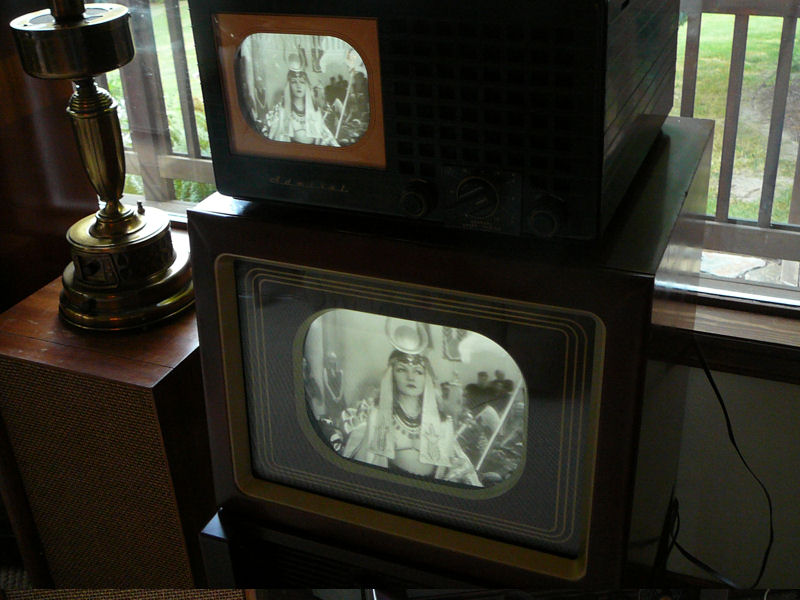 This TV had loads of retrace lines when I turned up the brightness to what seemed a desirable level, so I added this little blanking circuit that I read about a while ago. 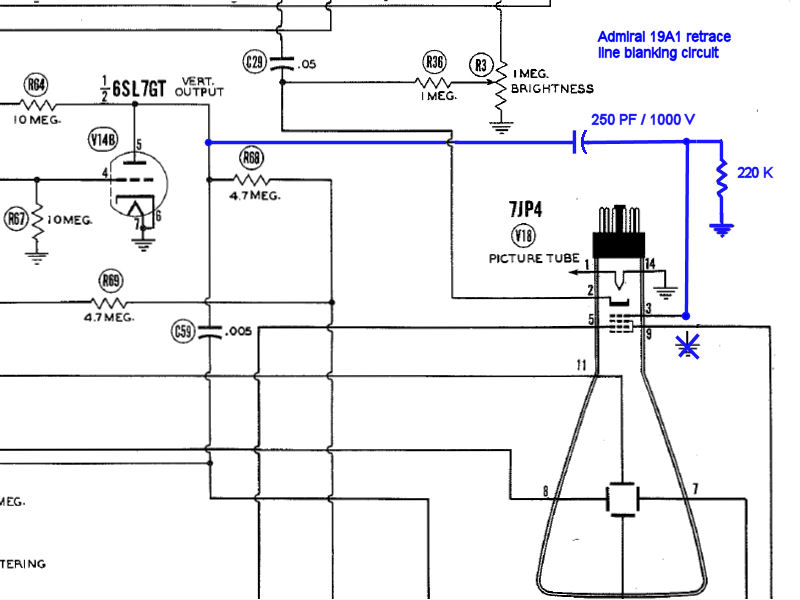 I don't know if this circuit is the optimum solution for this TV, but it made quite an improvement without noticeable side effects. Now, if it only had DC restoration . . .  Phil Nelson Phil's Old Radios http://antiqueradio.org/index.html Last edited by Phil Nelson; 09-02-2012 at 12:16 AM.
|
| Audiokarma |
|
#21
08-31-2012, 04:55 AM
|
||||
|
||||
|
Phil, just be happy you've got what seems to be a VERY nice example, which works very well indeed. I DON'T think these l'il guys were ever sposed to last anywhere nearly as long as they have...
__________________
Benevolent Despot
|
|
#22
09-02-2012, 02:17 PM
|
||||
|
||||
|
When I sat down to write an article about this set, I finally noticed that the label says 19A12, so I guess that's what I should call it:
http://antiqueradio.org/Admiral19A12Television.htm I assume there were magazine ads featuring this set, but I haven't run across any yet. Phil Nelson Phil's Old Radios http://antiqueradio.org/index.html
|
|
#23
09-02-2012, 03:09 PM
|
||||
|
||||
|
The 1934 "Cleopatra", starring Claudette Colbert & directed by Cecil B. DeMille, a Paramount release. Nice touch, Phil! Warren William was quite good as Julius Caesar in this one too. Add Joseph Schildkraut & Sir C. Aubrey Smith & you've got a high octane cast of leads to start with. Excellent images on both sets, may I add.
__________________
"Take time to deliberate. But when the moment for action arrives, stop thinking and go in!"-Andrew Jackson
|
|
#24
09-02-2012, 03:55 PM
|
||||
|
||||
|
Great restoration and writeup
 I haven't come cross any ads either, but it is shown in their 1949 catalog: http://www.shedradios.com/ADMIRALA.HTML http://www.shedradios.com/ADMIRAL4.HTML 19A11 = brown bakelite 19A12 = black bakelite 19A15 = maple wood
|
|
#25
09-02-2012, 04:13 PM
|
||||
|
||||
|
Thanks for the note on the model numbers. I modified the article to clarify that.
Cleopatra just happened to be playing on TCM when I snapped some photos. It has great visuals, but I was too busy taking photos and running back & forth to the computer to follow much of it. Perhaps they'll run it again when I have time to pay attention. Phil Nelson
|
| Audiokarma |
|
#26
09-04-2012, 11:58 PM
|
||||
|
||||
|
Phil, thanks for the superb article on the 19A12. When you get a chance, can you explain why the tubular HV caps are better than cheap ceramic disks?
-Winky
|
|
#27
09-05-2012, 02:01 AM
|
||||
|
||||
|
Using tubular caps in those HV coupling circuits seems to be the popular wisdom. I have never tried ceramic discs there to find out, but my understanding is that they may distort the scanning signals. What form that would take, I'm not sure. Perhaps anything from poor linearity to a scrambled picture.
As a rule, I don't use ceramic discs in any place where they were not originally used, especially in sweep circuits where high frequencies may beat them up. I have a couple of other 7-inch sets waiting for restoration. If I ever get around to them, maybe I'll try substituting a couple of ceramic discs once the TV is working, just out of curiosity. Phil Nelson
|
|
#28
09-05-2012, 08:37 AM
|
||||
|
||||
|
Years ago I used ceramic discs in my VT71 as that was all I could find. They worked fine for years and finally one went leaky. I used the ASC 6KV caps available today and they are fine too. The discs I used were damper circuit discs. My VT71 still has one in the high voltage filter circuit.
I recently was given some .002 12KV Potter brand tubular and will try them after I get my 9L1 Moto up and running. Has anyone heard of these Potter caps?
|
|
#29
09-05-2012, 09:15 AM
|
|||
|
|||
|
turned out really nice .
|
|
#30
09-05-2012, 02:24 PM
|
||||
|
||||
|
The capacitance of a ceramic cap varies with the applied voltage causing distortion in the sawtooth waveform. It's really not noticeable in the horizontal but may be in the vertical.
More info here: http://www.antiqueradios.com/forums/...c.php?t=119878
|
| Audiokarma |
 |
|
|







 Linear Mode

