
|
|
|
#1
 08-29-2012, 05:43 PM
|
||||
|
||||
|
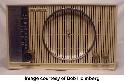
Zenith C845L. Needs a knob...
Cleaning up a bit around here and found this forgotten freebie out in the garage. A farily grimy Zenith C845L. At first, based on the style I thought it might be a solid state radio but the label on the bottom tells a different story.
Are these decent radios? Worth fixing? ( the PO claimed it worked, I haven't verified) It says 'high fidelity'.  This one needs a knob. Anyone out there have a spare? Looks like this (inner knob) Here's my radio....
__________________
. . . Console, chairside and table top radios. Test equipment , tubes, and a couple TV's. Oh, and tube/SS audio equipment.... lots and lots of audio equipment..... Last edited by Ohighway; 08-31-2012 at 02:23 PM. 
|
|
#2
08-29-2012, 06:58 PM
|
||||
|
||||
|
Well in just over an hour I've discovered the following. The radio works on both AM and FM, though it probably needs a better antenna and/or some attention. FM-AFC actually sounds worse than just FM. The quality of sound it puts out is impressive. I guess they weren't lying about the 'high fidelity' part. Another thing, the knob that's currently being used for the FM/FM-AFC/AM selector is actually supposed to be over on the bass-treble control. Some other larger and different style knob is supposed to live on that FM/AM selector. The wood case is in pretty decent shape, no missing veneer. The grubby stuff on the front is coming off slowly. It seems like dried on Coca Cola or ??? The only fatal flaw is a chip out of the plastic face along the horizontal piece that juts out (right below the 7 o'clock position on the round chrome area) Oh well... beggars can't be choosers...
__________________
. . . Console, chairside and table top radios. Test equipment , tubes, and a couple TV's. Oh, and tube/SS audio equipment.... lots and lots of audio equipment..... Last edited by Ohighway; 08-29-2012 at 07:13 PM.
|
|
#3
08-30-2012, 02:31 PM
|
||||
|
||||
|
Great radio. You need a band switch knob which is pretty easy to find at swap meets.
I changed the selenium rectifier to a 1N4005, replaced wax/paper caps and tested the 2 electrolytic caps. I added a CL-90 thermistor (from allied radio) to limit inrush current to tube filaments and rectifier. Band switch is touchy even though I cleaned it with DeOxit. So bad I had to jump out (hardwire across) two oscillator switch wafers. Its a daily driver and oddly, it works quite well and is selective with the built-in "cord loop" FM antenna Related thread on a second unit that I found on the FREE table at a swap meet. http://www.videokarma.org/showthread.php?t=254601 Last edited by DavGoodlin; 08-30-2012 at 02:35 PM.
|
|
#4
08-30-2012, 05:53 PM
|
||||
|
||||
|
Dave, funny I just pulled the chassis out today and saw that selenium rectifier staring at me. Definitely want to replace that! I let it run for about an hour or so. Fairly quiet at first, then started getting noisy. Then a little later it 'snapped' into being quiet again. Hmm. The thing does pull in stations pretty well using that internal antenna. And it's a nice sounding set. I'm not seeing this as a candidate for a full blown restoration (as the front is damaged and I'm missing an original knob) however with a light cleanup and attending to a few parts I'm seeing the 'daily driver' scenario as it's best possibility.
EDIT: Are the two screws on the back a provision for an external speaker? It says "stereo speakers input" but that doesn't make sense to me in the context of this radio....
__________________
. . . Console, chairside and table top radios. Test equipment , tubes, and a couple TV's. Oh, and tube/SS audio equipment.... lots and lots of audio equipment..... Last edited by Ohighway; 08-31-2012 at 02:26 PM.
|
|
#5
08-31-2012, 01:34 AM
|
||||
|
||||
|
Those screws are probably for an antenna.
__________________
Tom C. Zenith: The quality stays in EVEN after the name falls off! What I want. --> http://www.videokarma.org/showpost.p...62&postcount=4
|
| Audiokarma |
|
#6
08-31-2012, 08:01 AM
|
||||
|
||||
|
Quote:
 and has a decent front end, unlike some of my other AM/FM table radios. and has a decent front end, unlike some of my other AM/FM table radios.
|
|
#7
08-31-2012, 08:14 AM
|
||||
|
||||
|
Whoops, sorry Dave, not those two screws. I knew the "F" screw was hooked to the antenna. (Could "G" be ground?)
The two screws I'm talking about are on the lower left back recessed area, right next to the phono-radio slider switch and RCA input jack.
__________________
. . . Console, chairside and table top radios. Test equipment , tubes, and a couple TV's. Oh, and tube/SS audio equipment.... lots and lots of audio equipment.....
|
|
#8
08-31-2012, 01:28 PM
|
||||
|
||||
|
I Googled the model number and found a number of pictures of the missing knob.
http://www.google.com/search?num=10&...ac.0s7wNm9sYn4 If you email RadioPup with a reference to pictures of this missing knob they may have one. [email protected]
__________________
Reece Perfection is hard to reach with a screwdriver.
|
|
#9
09-28-2012, 12:03 AM
|
||||
|
||||
|
Quote:
No, I'm afraid not. My own Zenith C845 has those screws as well, and they are marked for an external speaker; they are near the radio-phono selector switch at the rear of the radio, and are in fact marked "External SPK'S input". However, when I connected a speaker to them, I heard nothing. I read somewhere awhile ago, don't remember where, however, that those "external speaker input" terminals are only active when the radio is used with Zenith's "Stereo Multiplexer", model MH-902, IIRC. This was an add-on (which may show up on eBay every once in a while) for certain models of Zenith radios that would supposedly convert these older sets to stereo FM. The "Multiplexer" had an FM tuner, multiplex decoder circuitry complete with stereo indicator light, and an amplifier and speaker, which could be used by itself as an FM radio -- that is, if you didn't mind listening to just one half of a stereo FM broadcast. However, the Stereo Multiplexer was designed to work with the C-845, and probably others in that series (H- and L-845); the latter would provide the other stereo channel. The FM antenna connections are marked "F" and "G", and are located on the radio's back cover. "F" stands for FM, and is the terminal to which an external single wire antenna would be connected. "G" is ground. It is normally used only in cases where two-wire feedline is being used from the antenna back to the radio. One of those leads goes to the "F" terminal, the other to G. There is no polarity involved, so the 2-wire antenna can be connected either way; however, when a single wire is used as an antenna, it must be connected to the "F" terminal. Leave the "G" terminal alone in this case. If the FM antenna is mistakenly connected to the "G" terminal, you will get no reception, as you will be literally grounding out the external wire -- leaving the radio with no antenna. This connection might work if you have one or more extremely strong FM stations in your area (the radio would actually be picking up the extremely strong signal on its own tuner wiring), but in most cases and in most signal areas an antenna lead connected to "G" will result in no reception at all. BTW, whatever you do, don't touch the grounded antenna terminal when the radio is in operation. The 800 series Zeniths, including the C/H/L-845, et al., are AC-DC sets which have one side of the chassis connected to the AC line. Should the AC plug be inserted in the wall socket such that the chassis is hot with the line voltage, contacting the grounded antenna terminal and the chassis simultaneously (or the chassis and a grounded object) could be lethal. This warning also applies to very old AC-DC radios with external AM antenna connections, and goes at least double for such radios housed in metal cabinets; the Arvin model 540T comes to mind as I write this, as I had one many years ago. The problem occurs because the insulation material, usually rubber grommets, between the radio chassis and the metal cabinet will deteriorate over time, becoming hard and possibly even conductive. Again, depending entirely on which way the AC plug is inserted in the wall socket, the chassis could be hot with the full line voltage, and any contact with same, say via the external AM antenna terminal, will result in a very possibly lethal electrical shock. Always remember to unplug the set before connecting or disconnecting the external antenna, if one is used.
__________________
Jeff, WB8NHV Collecting, restoring and enjoying vintage Zenith radios since 2002 Zenith. Gone, but not forgotten. Last edited by Jeffhs; 09-28-2012 at 12:51 AM.
|
 |
|
|





 Linear Mode

