
|
|
|
#91
 10-03-2012, 06:49 PM
|
||||
|
||||
|
Hi Bob,
those LEDs are a great find. If you're concerned about the bluish colour, you could perhaps try some transparent paint. Craft and hobby shops usually sell this stuff designed for glass to achieve the fake leadlight look. Too much paint and the thing will go yellow, but a few carefully and evenly placed stripes on the LED with an artists brush should do the trick, especially if there is a light diffuser in front. If not, you could always paint the back of the channel selector knob with a frosted paint, but I'm sure there are better options. That should give you that nice, warm look. Cheers, Adam
__________________
Four Predictas down, now to score a Continental. 
|
|
#93
10-04-2012, 08:24 PM
|
||||
|
||||
|
No more 'saltine cracker' K networks
 First some epoxy.  Then some paint.  The satin was a bit too shiny so I switched to Rusty metal Primer. Much better  
Last edited by bandersen; 10-19-2012 at 01:55 PM.
|
|
#94
10-04-2012, 09:35 PM
|
||||
|
||||
|
OOOOOOOhhh caramels
SR
|
|
#96
10-05-2012, 01:14 AM
|
||||
|
||||
|
Very nice. Those will blend in much better than the bareback kind I have made before.
Phil Nelson Phil's Old Radios http://antiqueradio.org/index.html
|
|
#97
10-05-2012, 02:02 AM
|
||||
|
||||
|
Thanks! I was half expecting you guys to say I was wasting my time on details no one would ever see

|
|
#98
10-05-2012, 08:56 AM
|
|||
|
|||
|
Bob, that's what made the difference! That is a great idea. Now, you need to ink-stamp them with some numbers etc.
. Seriously, that did make the difference. Just like cleaning wires so that the original color jumps out at you!
|
|
#99
10-05-2012, 02:40 PM
|
||||
|
||||
|
NAAAHHH
Invent you own logo and stamp those works of ART  SR
|
|
#100
10-05-2012, 03:42 PM
|
||||
|
||||
|
LOL - maybe I will
My earlier dissection showed the resistors in the original networks were carbon comp, but what about the capacitors? Here's a closeup of a network without the opaque coating. This side shows the values.  While this side shows the components. I looks to me like the caps are made from ceramic cylinders dipped in a conductive coating. The more coating it has, the larger the value. That's what led me to try using NP0/C0G ceramic caps which seem to work just fine 
|
| Audiokarma |
|
#101
10-07-2012, 10:28 PM
|
||||
|
||||
|
I coated the flyback with some RTV133. It comes out of the tube as a thin paste and is easy to spread on.
Not exactly a thing of beauty, but should do the trick. 
|
|
#102
10-08-2012, 08:42 AM
|
|||
|
|||
|
Nice job on the networks. Thoughts on flybacks
a member here did an interesting video on boiling out a flyback in molten wax, with a vacuum pulled to get all the air out. Based on the video it would seem that moisture is part of the problem, getting into the insulting strips of paper in the HV doughnut. My concern would be if there was excessive humidity and then the RTV seals it in. I have often though of boiling in hot medium (oil or wax) under a vacuum, then building a dam around the flyback and sealing in a compatible potting compound. this would of course require removing the fly from the mount, removing the core, blocking the core hole to prevent the compound from fouling that. A lot of work for sure, but seems like the ultimate fix.
|
|
#103
10-08-2012, 01:53 PM
|
||||
|
||||
|
Quote:
__________________
Tom C. Zenith: The quality stays in EVEN after the name falls off! What I want. --> http://www.videokarma.org/showpost.p...62&postcount=4
|
|
#104
10-08-2012, 04:24 PM
|
||||
|
||||
|
Yes, I've seen that cool video. This flyback wasn't that bad though. Just some shallow surface cracks. It's also been rather dry lately and I've have the set running a while so I'm hoping moisture won't be an issue.
Here it is before the RTV. 
|
|
#105
10-10-2012, 09:23 PM
|
||||
|
||||
|
I've been having fun with the dead power switch tonight. I was able to get it apart and clean it up so it makes good contact, but the latching mechanism just isn't working right.
After a couple clicks, it stops working  The contacts are also pretty worn down so even if I did get it working I don't think it would last long. The contacts are also pretty worn down so even if I did get it working I don't think it would last long.I've read that replacements are impossible to find. It's label "CTS Type J" on the bottom. Any ideas ? I'll go looking through my old junk control box and see what I can find. 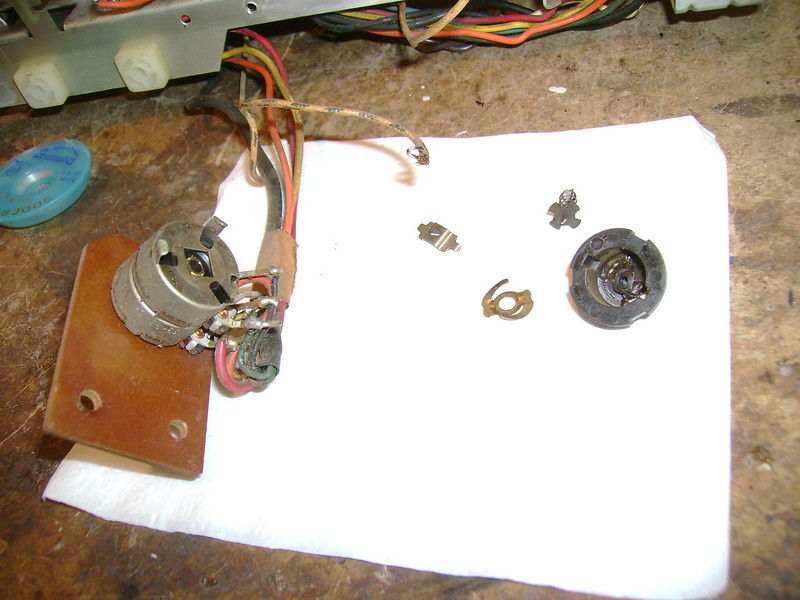
|
| Audiokarma |
 |
|
|








 Linear Mode

