
|
|
|
#16
 12-31-2012, 07:07 AM
|
|||
|
|||
|
Double Yikes!!
  I read it too, and dunno what to say. So I guess just don't say nuthin'. I read it too, and dunno what to say. So I guess just don't say nuthin'.

|
|
#17
12-31-2012, 09:07 AM
|
||||
|
||||
|
I'm gonna go through and replace them. That was my intention from the beginning. Leaving them alone is okay if you want to just off the set as "working", but if you want to actually USE the set, you might as well just leave the chassis sitting on the bench, because chances are they're gonna fail anyway.
Parts are on order 
__________________
"Restoring a tube TV is like going to war. A color one is like a land war in Asia."
|
|
#18
12-31-2012, 09:44 AM
|
||||
|
||||
|
Quote:
The cause is misadjustment of the multiple controls in horizontal sync. I don't have a factory schematic on this set, so take look at the Sams 74, fol 8: http://www.earlytelevision.org/pdf/R...-Sams-74-8.pdf If the .01 Mfd cap on the exposed end of T3 Horizontal Oscillator coil under the chassis is original, you can bet that this set was taken out of service before it was 10 years old. But, you say, this cap is paralleled by a 22K resistor, how could a little leakage hurt? Well it can cause some well-intended person to mess up the other horizontal sync adjustments! After you have finished recapping the set, follow the alignment procedure on page 18 of that Sams. If you are lucky, you won't have to use a scope. But if you have (or can borrow) a scope with a low cap probe, and you make the final adjustment and then repeat the full page 18 procedure to even things up, you will find that these early RCA sets were some of the most stable sweep sets made during that era. Today we take for granted that the TV signal will be stable. Remember when this set was made, when ever the station switched from network to local, there was a slight time-shift in the sync. On the smaller stations, often the film chain would also be slightly off with the studio cameras, and location footage would be even more off. These circuits kept the RCA sets from rolling on scene changes, unlike the sets from many of their competitors. Re: Mica caps Try to avoid bending the leads of the old ones. This seems to start problems. Re: Electrolytic caps If you decide to keep the original electrolytics, add fuses ahead of them to kill the power when they fail. I won't join the argument on replacing electrolytics, but I am more inclined to leave a pre-1960 one in for set testing (only after disconnecting it and reforming) than a post-1970 one in any circuit. Either way, restuff or replace, carries a definite risk unless you can find relatively new industrial or military grade electrolytics. I am unimpressed by the quality of currently available electrolytics for tube-era voltages. They seem to be made to last the length of the warranty. James
|
|
#19
12-31-2012, 10:10 AM
|
||||
|
||||
|
James, thanks a TON for that useful information. The project will resume as soon as the parts arrive
.For the capacitors, this is what I plan to do. I did this work on a '52 Motorola as seen in this picture. While it won't be popular to the purist, I intend to use the snot out of this set when I'm done, and to me, serviceability is the key. I have no intention of restuffing them, and letting loose caps dangle on the underside isn't really appealing......there's no real room to do an under-chassis mount in these areas. 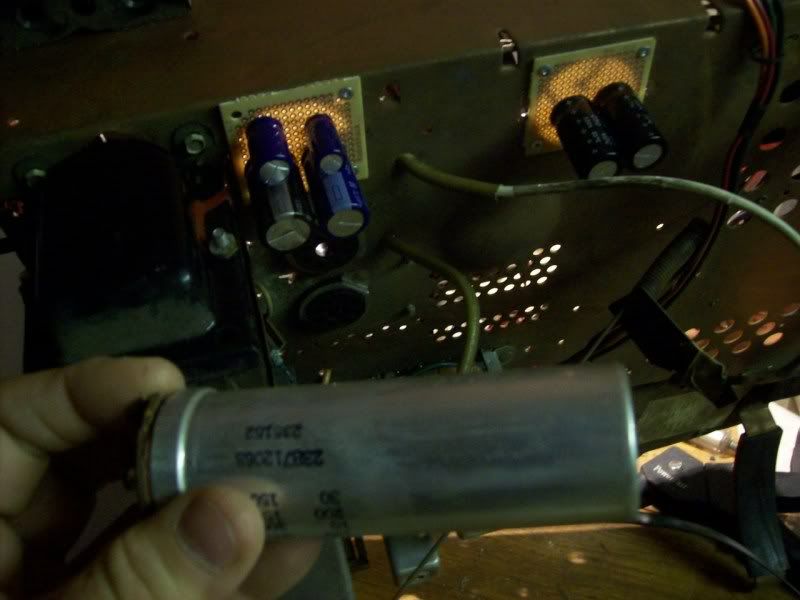
__________________
"Restoring a tube TV is like going to war. A color one is like a land war in Asia."
|
|
#20
12-31-2012, 10:12 AM
|
||||
|
||||
|
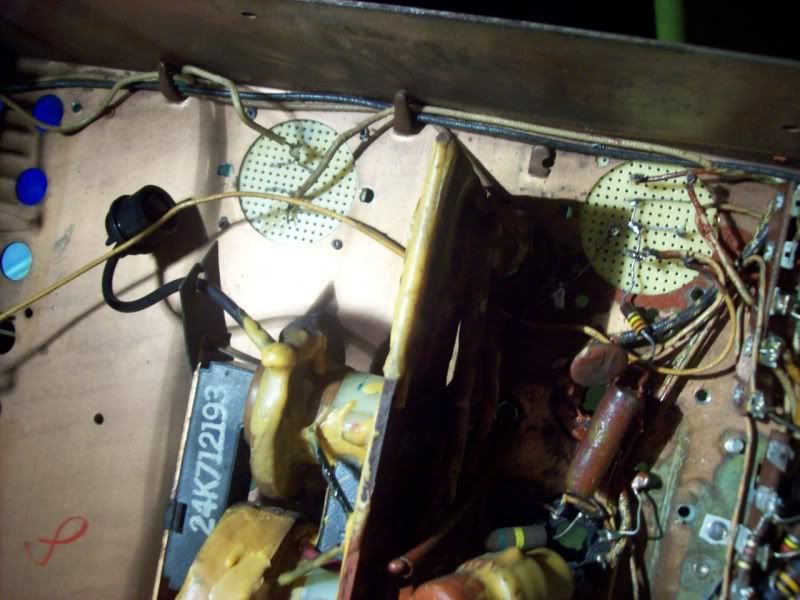
Another shot of the '52 Motorola. See how it cleaned things up under the chassis?
__________________
"Restoring a tube TV is like going to war. A color one is like a land war in Asia."
|
| Audiokarma |
|
#21
12-31-2012, 10:52 AM
|
||||
|
||||
|
Thank you for the replies! I respect your disagreements. The philosophy of simply replacing a component because everyone does it seems odd to me. I have seen my share of bad electrolytics. I just want to point out you can easily test and measure whether an electrolytic will hold up and whether it is good or bad.
The test is simple: reform the dielectric and measure the leakage current and capacitance. The reforming of a capacitor takes a few hours and I will put the full rated DC across it for a few days. If the leakage is more than 200uA, then it must be replaced. 200uA is far below the point of creating any heat dissapation from the capacitor. If you detect a 450v capacitor getting warm, then the leakage will more like 10000uA or above. The RCA set capacitors used from the KCS28 chassis upwards are extremely good. Of the six sets of the late forties and early fifties vintage I have restored over the last 40 years, I have replaced two electrolytics. And the ones replaced never shorted, they became open. I have never had an old electrolytic explode as a result of the precautions I have taken. I have however seen newer capacitors explode. The measure of pulling one apart and it looking crumbly and bad is no judge of its condition. Dry electrolytics use a dry paste and even a good one will crumble upon taking it apart. Then again if you feel uncomfortable about this, by all means pull the old capacitor apart and stick in newer replacements. Also, if someone has been foolhardy to plug in the set after it has remained doment for 40 years, then you should expect explosions and fireworks. By my monitoring procedure I will find if a capacitor has been stressed. I would just like to reitterate that I find it unfortunate that the assumption is that a component must be replaced without even testing the component to see if it is bad. Last edited by Penthode; 12-31-2012 at 10:55 AM.
|
|
#22
12-31-2012, 11:08 AM
|
||||
|
||||
|
Quote:
I like overbuilding these TVs when I restore them. The last thing I want to do is open them up again when I'm finished tweaking them. 
|
|
#24
12-31-2012, 01:48 PM
|
||||
|
||||
|
Well that seems weird, for me, the opening of them up is the fun part.
 It's at least way more interesting than changing the oil on the daily driver. It's at least way more interesting than changing the oil on the daily driver.
Last edited by Kevin Kuehn; 12-31-2012 at 01:51 PM.
|
|
#25
12-31-2012, 01:59 PM
|
||||
|
||||
|
You guys might find this webpage from Illinois Capacitors interesting. It has capacitor Life Calculators for electrolytic, film and ceramic capacitors.
It quantifies the advice we've seen nicely. Voltage derating does indeed increase the life span. Using 105C rate caps extends them considerably more though. Typical general purpose caps have a 1,000-2,000 hour life at maximum temp and voltage. Nichicon has a new line out of high ripple, long life caps rated for 450 volts, 105C and 10,000 hours. They also have a very small diameter and great for restuffing cans.  Use one of those at 300 volts, keep the temp down to 50C (122 F) and it should last about 675,000 hours or 77 years of continuous operation Using a cap with the same ratings except 85C should last about 169,706 hours or 19 years of continuous operation. Last edited by bandersen; 12-31-2012 at 02:31 PM.
|
| Audiokarma |
|
#26
12-31-2012, 03:42 PM
|
||||
|
||||
|
Quote:
To each his own. I prefer to keep the sets as original as possible and I can assure you that I do not have to pull the chassis because of electrolytics. I suggest you prove it for yourself. Take an old electroltyic from a 40's or 50's era RCA TV, reform the dielectric as I suggest and measure the leakage current. You will find that rarely do these capacitors go bad. And consider this: if after 50 years the above test shows that a capacitor is still good, would this not suggest that the new capacitors that are currently used for replacement, may not last as long?
|
|
#27
12-31-2012, 04:16 PM
|
||||
|
||||
|
I have tried it myself on sets from the 40s - many times. Easily 75% are open due to a deteriorated electrolyte and cannot be reformed. I also find many original electrolytics have already been replaced back in the 50s.
|
|
#28
12-31-2012, 04:22 PM
|
||||
|
||||
|
But one would have to assume the odds would have been much better had you gotten into the hobby back in 1969. I think the longer they sit idle, the less likely they are to recover.
|
|
#29
12-31-2012, 07:34 PM
|
||||
|
||||
|
I've hacksawed off old can electrolytics near the base, the location just above the fat part at the base. That fat part holds a rubber gasket, which holds the terminals down below the chassis, and has wires passing thru to go to the actual cap guts. Clean off the top of this rubber gasket, and then either mount new caps to the terminals below the chassis, or drill small holes to pass new cap leads so you can mount the new caps topside and have the leads connect to the appropriate terminals below. If you're lucky you can slip the empty can over the new caps on the topside. Put one or more caps down below if they don't all fit. One advantage is that you don't have to undo the wiring on the terminals.
__________________

|
|
#30
12-31-2012, 07:50 PM
|
|||
|
|||
|
since we are talking about caps, I decided to test out reforming a NOS 3 section.
150 @450v 100@400v 100@50v I started out at 25v, the eye quickly opened, I jumped up to 150 pretty quick and again it opened pretty fast. I have it sitting at 250v now and its about .2ma of leakage (have a DMM in series with the cap eye tester). I will leave it there overnite and jump up to 350v tomorrow and the 450v later in the day. I will check for leakage between terminals later, and then will leave it alone for a couple of weeks and see how well it performs. I have a big box full of these NOS caps, I had orig planned on using them as base donors but I like to experiment. I personally do not replace a can cap automatically, like Pentode, I try to reform them out of circuit 1st, if they compare to like new caps I just reconnect them and then fuse the B+ I did a recent project where I did this on a 8t241 chassis, replaced all the wax paper caps and a few of the horz mica (after having some horz issues). All the cans were reformed and tested fine, some had been replaced some were original. I am not trying to say its wrong to replace them, but I prefer to do what it takes to get the set running and then trouble shoot issues as required. different strokes for different folks.
|
| Audiokarma |
 |
|
|








 Linear Mode

