
|
|
|
#1
 09-25-2013, 10:45 AM
|
||||
|
||||
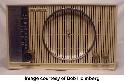
 New Find: 1956 Motorola 56A Table top radio
Hello,
recently, I walked into a vintage audio shop looking for some old plastic radios. I collect small inexpensive tabletop AM radios, without the clock. I managed to find this little Motorola 56A in red. It is not in perfect shape, has a small chip on the top and a stress crack ontop. Anyways, I thought it would be a nice addition to my collection. The internals have been gone through inside and works perfect. cheers Video : http://youtu.be/tpgy7kQsJn8  
__________________
flickr Last edited by Robb; 07-03-2014 at 12:56 PM. 
|
|
#2
09-25-2013, 02:23 PM
|
||||
|
||||
|
Nice color! The first year for the batwing logo also.
That is one of the first models to use the PlaCir pcb, having printed wiring on top as well as bottom of the pcb. I have a cousin model, 56H and found that if I put a minimum 220mfd @16v cap from cathode pin 1 to chassis ground on the 50C5, the sound improves greatly.
__________________
"When resistors increase in value, they're worthless" -Dave G
|
|
#3
09-25-2013, 04:47 PM
|
||||
|
||||
|
I find the sound to be really really good already !
The fact is, the radio exists. Most have cracked or been disposed of loooong ago. These cheaper hard plastic radios werent built to last, hence the original cheap price.
__________________
flickr
|
|
#4
09-26-2013, 01:48 PM
|
||||
|
||||
|
The 4" speaker and 5 tubes make that sound good. You could not make them any cheaper in those days, yet they sounded soooo much better than the transistorized stuff with import speakers made in the 1970s.
I bet you get 740 CFZM real well . LOL . We usually pull it in clear at night but not always. CFZM is the only night-reception AM station we have that PLAYS MUSIC in SE PA.
__________________
"When resistors increase in value, they're worthless" -Dave G
|
|
#5
09-26-2013, 06:34 PM
|
|||
|
|||
|
Quote:
Also, the Motorola radios were more highly styled than some of the others. With a few exceptions, the styles changed from year to year, unlike GE, where they kept the same tired styling for ages. 
|
| Audiokarma |
|
#8
06-21-2014, 03:36 PM
|
||||
|
||||
|
Zenith's H511 series of "racetrack" radios are well-made and sound great too. I have one, an eBay score from about ten years ago, that sounds very good for its age (63 years, made in 1951). The speaker in mine is shot (cone is torn badly), but since most AM stations these days are talk, that doesn't make much of a difference. The dial cord is gone as well, but I can tune the radio by simply moving the tuning pointer with a finger. I've only replaced one tube and the pilot light in the set since I got it, and freshened the worn red paint on the pointer with a red Sharpie marker.
The tube I replaced, if I remember right, was a 12AU6. The 50L6 audio output tube has a very loose base; that doesn't surprise me, as I think it is the original (it has the old-style Zenith logo). However, the tube still works, although the radio doesn't put out a lot of volume with the control at maximum. This is probably due to bad or failing capacitors; one of these days I'll go into the set and replace them. Shouldn't take too long, as there isn't much under the chassis. Zenith did not call this series of table radios "Consol-Tone" for nothing; when they are working as they should, they produce excellent sound, thanks in large part to tone-compensation circuitry not found in most AA5s. While the H511 series does not sound as good as, for example, the K731 or the C845, it sounds very good for what it is. Good for background music or news, but I wouldn't listen to a station on it the likes of New York's WQXR-AM (now WQEW Radio Disney) and expect high fidelity. I had relatives (now long deceased) who owned an H511, and they liked it, a lot (it may have been the radio they had before they got TV, as their first television was also a 1950s model). However, when they did some remodeling in their house I inherited the radio, and used it for several years until I moved to another city. The set got lost in a move back to my home town three years later, and I missed it. That's why I was so glad to find my present H511 on eBay back in 2002 or so. I made the mistake, however, of plugging the set in as soon as it arrived at my door via UPS. The pilot light burned out with a bright white flash as soon as I turned the radio on; it worked after a fashion, but I noticed the 35W4 rectifier tube was glowing much brighter than it should. The reason the 35W4 was glowing red-hot, I found out after asking around on a couple of antique radio forums, was that the pilot light in these radios is an integral part of the power supply. If it burns out or is otherwise taken out of the circuit, the voltages on the series filament string are thrown off balance, causing all other tubes to get more filament voltage than they should. Replacing the pilot light cured the problem. The radio has been working ever since, albeit not as well as it could be because of the capacitors. Some years later (!), I also replaced the line cord, which was shot (crumbling insulation with bare spots) with a new, safer cord salvaged from a junked RF modulator. One interesting thing about my H511, to me anyway, is that the radio still works with little noticeable hum. The original 3-section electrolytic filter capacitor is still there. I noticed the capacitor is covered by a black paper tube, probably to prevent electric shock; the metal casing is probably live with the line voltage when the radio is on, as are the external antenna terminals on the back cover. I browse eBay every now and then, and sometimes see reproduction backs for Zenith radios, including the H511 series; one of these days I just might order one to replace the back on my set, which is battered and torn up badly. The loop antenna still works, but the back looks awful, which is why I have mounted what's left of it to a black sheet of paper and taped the latter to the radio cabinet. As I said, it works, but I wouldn't want to have the radio on display in my apartment in that condition (it is presently in my bedroom on my dresser, atop a Zenith H480W clock radio). I don't know, however, if these reproduction backs come with the loop antenna and external antenna terminals, or if they are just the basic back cover, requiring the use of the radio's original fasteners and loop. I'll look one up later today and find out. My H511 is in decent shape otherwise (except, as I said, for the capacitors), so I think it will be well worth it to replace the cover. After 63 years, this set, IMHO, darn well deserves it.
__________________
Jeff, WB8NHV Collecting, restoring and enjoying vintage Zenith radios since 2002 Zenith. Gone, but not forgotten.
|
|
#9
06-22-2014, 12:59 AM
|
|||
|
|||
|
Quote:
 Why didn't you just start a new thread if you wanted to tell a long rambling story about your Zenith H511 radio? At least that way you wouldn't be hijacking someone else's thread, and your Zenith H511 mini-novel would be findable by it's own thread title, not archived here under Motorola. .
|
|
#10
06-22-2014, 10:41 PM
|
||||
|
||||
|
A thread on Zenith radios is always welcome here, despite my obvious interest being all things Motorola. There can never be too many threads.
Keeping the subjects separate is important to us middle-age types that can remember a tube diagram but not where we saw some helpful information. Type of set (TV-Phono-Tape deck, etc) AND brand is a good way to categorize, since the unit's age is not always known well.
__________________
"When resistors increase in value, they're worthless" -Dave G
|
| Audiokarma |
 |
|
|





 Linear Mode

