
|
|
|
#1
 08-31-2014, 06:31 PM
|
||||
|
||||
|
Motorola VT-71 TS-4D Horizontal Jittering Image
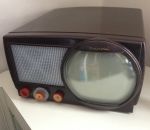
Hi, I have a VT-71, recapped, including some micas. All tubes tested good. Problem is the image is jittery. I have dialed in the tuning pot for Ch3 the best I can, but still have the issue. See attached image, and video linked below.
What do you think? https://www.youtube.com/watch?v=uVxP...ature=youtu.be 
|
|
#2
09-03-2014, 01:46 AM
|
||||
|
||||
|
Jon-
That is absolutely, exactly the same problem I have with my VT-71 as well, which is also a TS-4D chassis. I started a discussion (with a similar title) on the Antique Radio Forums TV section a month or so ago, and got a number of helpful ideas and suggestions, but nothing has fixed mine yet. Since I have been busy with several other non-antique-TV projects and events, I have not got back into my set for a while, but my next step was to put an oscilloscope into the horizontal, video, and AGC circuits to see what I could find. Starting the the TS-4E chassis, Motorola added a horizontal AFC circuit (and that version is what is in the Sams Photofact manual, more or less), so I suspect that this problem is common in the TS-4D and earlier chassis to one extent or another. The one trick/clue I have found is that when I played with the horizontal hold control, I got the set into some mode where the picture was split horizontally but seemed to be in sync; the "horizontal phase" was way off, I think it can be called, and the vertical sync bar was visible in the picture. I forgot if it was in or near the center, or off to one side. The big kick, though, is that the (out of phase) horizontal sync seemed very steady! So, if anyone has ideas of what that means, I would like to know, and maybe it will help both of our sets. My intent was to connect my scope if/when I can get the set into that out-of-phase mode again, as well.
__________________
Chris Quote from another forum: "(Antique TV collecting) always seemed to me to be a fringe hobby that only weirdos did."
|
|
#3
09-03-2014, 08:36 PM
|
||||
|
||||
|
I wouldn't call that hor jitters, looks more like noise to me. Try looking for sources of stray HV, or adding additional shielding to the IF strip. Can also be caused be signal interference, so make sure you run a cable signal right into it using a balun.
__________________
Evolution... 
|
|
#4
09-03-2014, 09:04 PM
|
||||
|
||||
|
Quote:
|
|
#5
09-04-2014, 08:18 AM
|
|||
|
|||
|
Quote:
That is the direction that I would be heading also. It does appear to be noise to me. But I am NO expert, only a hobbyist.
|
| Audiokarma |
|
#7
09-06-2014, 02:00 AM
|
||||
|
||||
|
Jon-
Yes, it should be possible to directly connect a composite-video signal, BUT: Of course, an isolation transformer MUST be used to power the set during such a test (and, in fact, during all service of these sets!). The logical place to connect video is to the control grid (pin 1) of the video amplifier tube, a 6AU6. Knowing that your set can do that same "out of phase but jitter-free" trick is good to know; that means it is not a unique quirk to my set. One of these days, I need to get back into troubleshooting my TS-4D, and not just reading and posting. 
__________________
Chris Quote from another forum: "(Antique TV collecting) always seemed to me to be a fringe hobby that only weirdos did."
|
|
#8
09-07-2014, 06:47 PM
|
||||
|
||||
|
I replaced all mica caps except for the ones in the IF chain and for the heck of it rebuilt the network for the audio, no change in the behavior of the set.
Next I will try to inject the composite signal to see if it goes away.
|
|
#9
09-07-2014, 07:56 PM
|
||||
|
||||
|
Quote:
|
|
#10
09-07-2014, 08:07 PM
|
||||
|
||||
|
|
| Audiokarma |
|
#11
09-07-2014, 08:18 PM
|
||||
|
||||
|
Quote:
|
|
#12
09-07-2014, 08:34 PM
|
|||
|
|||
|
Hello Jon,
First off, I am not experienced or qualified enough to give anyone advise on fixing thier tv, but I do like to try to learn from these forums. So, for what its worth, my thought is could it be the crystal diode in the 2nd detector getting leaky?
|
|
#13
09-07-2014, 08:48 PM
|
||||
|
||||
|
Quote:
In general, you expect a direct triggered circuit to be much more noise sensitive compared to an AFC circuit. If L42/R38 through R39 and C44 is the source of sync, then L42 may be rolling off some high frequency noise depending on its size. Probably they experimented with the roll-off but couldn't get reliable triggering with it rolled off more. Since there is more than one example in existence, I'd guess this is a design limitation that won't be fixed reliably without changing the circuit somehow. Meanwhile, my guess is to try to eliminate possible sources of noise, as others have suggested.
|
|
#14
09-08-2014, 10:33 PM
|
||||
|
||||
|
Quote:
There may be more to it than I made it sound like, as I just looked at the schematic diagram again. Yes, disconnecting the signal from the IF/detector circuit is likely needed, especially to eliminate those circuits (and the earlier tuner/IF stages) as a possible source of noise. However, I am not an engineer enough to know for sure if it will be that simple. At the least, I would recommend using an oscilloscope to look at the video signal that is there from the tuner/IF now; it could be more than the one volt that is standard from DVD players and so on, and it could even be inverted polarity. I will do such tests when I try that type of connection, and also, I have a couple of video test-signal devices (Sencore VA62, B&K 1077) that can output variable-voltage video signals as needed. Oh, and thanks for quickly posting the TS-4D schematic link for old_tv_nut. I have a question for you, as well: When you replaced the mica capacitors, does that include the two 900pF ones (c137 and C138 on that schematic, I think) that connect between the horizontal sweep signal outputs and ground? I think they are rated at 1000 or 2000 volts, large "domino"-type capacitors in my chassis. That is on my list of suggested possible fixes, but if you already tried them without success, they would likely not fix my set either.
__________________
Chris Quote from another forum: "(Antique TV collecting) always seemed to me to be a fringe hobby that only weirdos did."
|
|
#15
09-09-2014, 07:12 PM
|
||||
|
||||
|
Quote:
Thanks
|
| Audiokarma |
 |
|
|






 Linear Mode

