
|
|
|
#1
 05-20-2016, 11:10 PM
|
||||
|
||||
|
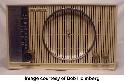
Zenith C725 AM/FM radio
A 1959 model (there was even a date stamped on the top of the chassis 04 16 59), this radio actually worked fine when I got it. But I like to recap something this old, so I recapped it and replaced the selenium rectifier with a 1N4007. I like the unusual light green color of the cabinet...

|
|
#3
05-21-2016, 07:32 AM
|
||||
|
||||
|
It is an oval speaker, but it I think it was only a 4x6… And I don't think Fluffy would fit on top of that radio! The smallest of my 3 cats, Moppet, might…
Strangely, I have a similar AM-only Zenith (a 1957 model), and I think I remember it using a bigger speaker, like a 6x9. The real king of Zenith table radios from this era is the AM/FM C845, with it's separate woofer and tweeter. The C725 is equally as sensitive C845 on both bands, and I think better looking, but the C845 has the nicer sound.
|
|
#4
05-21-2016, 08:30 AM
|
||||
|
||||
|
I have this exact radio, and I like it a lot. I remember one time, I was listening to it, and all of a sudden, it quit. Thankfully, it was only a tube filament.
__________________
Quality vintage television service by Alabama's original Animegao Kigurumi performer. Last edited by TUD1; 01-30-2017 at 05:06 PM.
|
|
#5
05-21-2016, 11:05 AM
|
|||
|
|||
 Quote:
|
| Audiokarma |
|
#6
05-21-2016, 01:49 PM
|
||||
|
||||
|
I agree with Adam. I have a Zenith C-845,identical to the one in my avatar, in the "toasted mahogany" (blonde) cabinet and like it; great sound, sensitive as anything (mine will get stations from southwestern Ontario, Canada, Detroit, Toledo, Youngstown, Ohio and Erie, Pennsylvania, as well as the locals from Cleveland, simply using the line cord antenna and under favorable band conditions; the set still has its original tubes and everything else--I haven't done a thing to it since I got it seven or eight years ago, and it still sounds great). Today's gutless-wonder one-chip "stereo" radios cannot possibly match the C-845 for the qualities I mentioned. That is almost certainly why the C-845 is, as Adam put it, the king of AM-FM table radios of the late '50s and early sixties. The same goes for this radio's variants, the C-845M, -L, and the H845 series; the only differences between any of those radios are in the cabinet style, as they all use the same basic chassis (8C01 or 8C02).
BTW, I put the word "stereo" in the last paragraph in quotes because today's portable radios claiming to have stereo FM give the medium a very bad name. The stereo separation, for one thing, is a joke in most stereo portables. I have a Panasonic AM/FM/stereo-FM boombox that is perhaps a foot long; it sounds good, but the speakers are still far too close to each other for the best stereo effect. I don't use that radio much, but if I do from now on, it will be with headphones. My Zenith H-480 AM/FM/FM-stereo clock radio has the same problem, but that radio hasn't worked very well on FM in perhaps ten years or more since I tried to clean the slide pots for volume, tone and balance. The cleaning spray must have shorted something out (I'm darned if I know what shorted), as the radio does work after a fashion (in mono) on FM, but the volume must be at maximum to hear anything; even then, the sound is extremely weak. AM works perfectly, with more sound volume than I know what to do with.
__________________
Jeff, WB8NHV Collecting, restoring and enjoying vintage Zenith radios since 2002 Zenith. Gone, but not forgotten. Last edited by Jeffhs; 05-21-2016 at 07:14 PM.
|
|
#7
05-21-2016, 07:22 PM
|
||||
|
||||
|
Quote:
http://www.universal-radio.com/catal...alty/0068.html By the way, it is a HOT radio for FM dx, that far outperforms (in sensitivity and selectivity) every vintage Zenith that I have ever owned, including a TO 3000 and Y-832  jr Last edited by jr_tech; 05-21-2016 at 08:07 PM. Reason: clarification of performance criteria
|
|
#8
05-22-2016, 01:01 PM
|
||||
|
||||
|
Quote:
As to FM DX, you are probably surrounded by mountains. The only "FM DX" you probably get is within the state you live in, unless you have an FM antenna mounted ridiculously high. Here in northeastern Ohio, I have yet to hear any FM stations from California or anywhere hundreds of miles away. The best "FM DX" I have ever had was in the summer of 1970, when a local FM station was knocked off the air in a thunderstorm. The station I heard while the local one was silent was in West Palm Beach, Florida on 107.9 MHz. I had a cheap stereo FM portable radio at the time with a telescoping antenna, nothing more. Once the local station was back on the air I never again heard that station, or any other FM stations from Florida--or anyplace else hundreds of miles south, east or west of where I live. The only FM DX I get here, as a rule, is from Detroit, southwestern Ontario, Canada, Erie, Pennsylvania and Youngstown, Ohio. I am within one mile of the south shore of Lake Erie, so I can get the Detroit stations, as well as the others I mentioned, quite well in the summer on any of my Zenith radios. How can a radio such as your "Sangean" portable be better from an FM selectivity and sensitivity standpoint than any 50+-year-old Zenith radio?  Your set must have an FM section hotter than a firecracker if it can outperform most older tube-powered radios. Your set must have an FM section hotter than a firecracker if it can outperform most older tube-powered radios. Most of today's FM radios are nowhere near that sensitive or selective. The digital FM tuner in my bookshelf stereo system, for example, is almost useless in my area, which is about 40 miles from Cleveland's FM stations. I am sure it would work well in the Cleveland suburb I moved here from 16 years ago, but in a semi-fringe area such as the small east-central Lake County, Ohio town I live in today, it doesn't work well at all. I cannot listen to the local NPR station, for example, when my computer is on due to the CPU hash, and stereo FM reception is iffy at best on some stations; therefore, I listen mostly to my own CDs, cassettes and audio files stored on my computer for music, having almost completely abandoned FM radio. I realize a better antenna would solve the reception problems I have here, but since I live in an apartment building with lease restrictions forbidding outdoor television or FM antennas (every tenant in this building, including myself, has cable or satellite for TV and probably uses short indoor antennas for FM, no antennas), such antennas are out of the question.
__________________
Jeff, WB8NHV Collecting, restoring and enjoying vintage Zenith radios since 2002 Zenith. Gone, but not forgotten. Last edited by Jeffhs; 05-22-2016 at 01:14 PM.
|
|
#9
05-22-2016, 03:30 PM
|
||||
|
||||
|
Quote:
Don't get me wrong... I love and collect vintage tube devices and really admire them for what they were, but the arrow of time keeps moving forward. Indeed, many radios sold today are designed to a low price point and are poor performers, but there are also a large number of great performing radios, if you know were to look. jr
|
|
#10
05-23-2016, 01:52 PM
|
||||
|
||||
|
When I replaced the selenium in mine, I used a bridge rectifier.
 Full wave rectification, less power supply hum (120Hz vs 60Hz). The heater string runs directly off the powerline (via power switch). The mid point of the heater string will look to have minimal AC waveform in reference to the B- line of the bridge rectifier. But will have a DC bias of about half the B+ voltage. This is fine, cathodes like their heaters to have a positive bias. One end of the audio output tube (for example a 50C5) (#8 in the diagram) heater is probably already connected to one of the AC lines. Disconnect the heater line of the other audio output heater pin. This line, now disconnected (feeding to tube #7), now will be connected to the other AC line. See diagram. And at the old ground end of the heater string, usually the AM or FM detector/ audio driver tube (#1) (19T8 for example) disconnect from ground and connect to the now loose end of the audio output tube heater. This should minimize hum pickup from the heater line. A small cap of around 0.1uF 400V or more tied close to the heater string midpoint should help reduce the AC waveform some more by holding a bias charge between the heater string and the B- ground of the radio during the time the bridge rectifier isn't conducting. The bridge diodes only conduct at the peaks of the AC powerline waveform. Pay special attention to the AC line lead dress around the volume control power switch for hum pickup. Hot chassis radios usually switched the local ground feed line to avoid hum pickup from 120VAC to local ground wires. This could ruin the advantage of full wave rectification (less hum, 120Hz vs 60Hz) if not taken care of. Look for trouble by listening to silent passages in radio programming with the volume control at half setting (hum pickup can be more severe at this position). Shielding may be needed.
__________________

|
| Audiokarma |
 |
|
|






 Linear Mode

