
|
|
|
#76
 04-03-2020, 11:41 PM
|
||||
|
||||
|
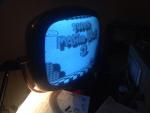
This is how my TV was modified for the above measurements. And I just realized I didn't have the bleeder resistor across the diode when I did this. Not sure what if any effect that will have on the measurements. I had one in there early and didn't see much difference and then forgot to put it back.
 

|
|
#77
04-04-2020, 12:07 AM
|
||||
|
||||
|
Quote:
The indication of the effectiveness of the DC restoration is the DC voltage measurement at the cathode. With no DC restoration, the change from bright scene to black scene will be minimal - it will just be set by the brightness pot. But with the DC restorer, the DC voltage will be high on the black scene and lower on the bright scene. Looking with the scope, set to DC coupling, the dark parts of a bright picture will be the same voltage as the black of a black screen (or almost the same, depending on how complete the DC restoration is). Looking at your screen pics, you can see plainly that with the test pattern, the blacks are properly black, and with the black image they are still properly black, not gray, so the DC restoration is doing its thing. If you get an old movie that has spooky night scenes where nearly everything is dark, the picture will actually be dark like it should be, instead of foggy medium gray. This will not be visually subtle! Your measurements at the wiper would indicate that the black level probably shifts about 8 volts when going from bright test pattern to full black. This is small compared to the full 50 v p-p video signal, so is much better than the non-DC- restored original. If you look with a DC-coupled scope at the cathode, you will be able to see how little the black level shifts compared to the huge changes without DC restoration. Last edited by old_tv_nut; 04-04-2020 at 12:10 AM.
|
|
#78
04-04-2020, 12:47 AM
|
||||
|
||||
|
Quote:
Last edited by Kevin Kuehn; 04-04-2020 at 12:53 AM.
|
|
#79
04-04-2020, 08:23 AM
|
||||
|
||||
|
I believe a portion of this lack of black level comes from some sets having lower B+ headroom. The B+ on this TV I'm experimenting with has close to 250v vs Max's set at 150v. My contrast control has a range that allows high black level's even without the dc restoration circuit present. I find that most video I watched growing up was fairly consistent within a given program. I suspect there was some type of video compression used during the production process back in the 60's though 70's. I can basically set it and forget it. I'm not sure if modern day video content would be worse in that respect. Honestly I don't have much desire to watch new programing on my vintage sets. I do find the audio processing on today's movies quite poor in comparison to older material. Or possibly there's a trend back towards less processing? With my ageing ears I struggle to hear the quieter passages, and soon after being blown away. IMO too much dynamics. Similarly I don't see the range of video dynamics in nature that we expect to see from from our television sets. When ambient lighting is low the human eye tends to see less contrast.
Last edited by Kevin Kuehn; 04-04-2020 at 08:26 AM.
|
|
#80
04-04-2020, 11:05 AM
|
||||
|
||||
|
I think the human eye sees a far greater range of contrast than vintage TV sets can display. In old TV shows, it seemed common to light up night scenes quite brightly by today's standards in order to get any image on the film, but the more modern trend seems to be a huge range between the brightest and darkest scenes. I would say it is almost analogous to the difference between the noise floor and the loudest possible recording on a 78RPM record versus a digital recording.
This large contrast range really asks a lot of old TVs, and that's why I wanted to try and do something to improve the Marconi, if only slightly. Better yet it seems to me would be some kind of signal processing to dynamically compress the contrast range, like say using a variable mu tube as the video amplifier, to have the effect of turning the contrast down in dark scenes, but I'm afraid I'm not smart enough to design that.
|
| Audiokarma |
|
#81
04-04-2020, 11:33 AM
|
||||
|
||||
|
Well of course the contrast on old sets was/is limited to whatever the CRT face reflects in any given ambient lighting. That's the main reason modern flat screens can produce such apparent contrast. But in IMO it's pushed over the edge, to the point of now being an effect more so than anything you'd see inside or outdoors in natural lighting. Keeping in mind that everyone's eyes aren't calibrated the same, not anymore that our ears are. I've met a few folks that don't see color, or so they say.

|
|
#82
04-04-2020, 11:44 AM
|
||||
|
||||
|
Quote:
I agree though, it is kind of pushing things too far, but unfortunately I have no influence over what sort of signal the TV gets. I actually use my vintage sets for 100% of TV watching, simply because I like them. I can't convince the family to live in black and white though, so the main living room set is a CTC38.
|
|
#83
04-04-2020, 12:04 PM
|
||||
|
||||
|
Don't get me wrong, I'm not suggesting the DC restorer isn't helping out on your Marconi. I was simply pointing out that there's a multitude of things than can compound the situation. I've watched modern over the air TV from the S video luminance output, through my Blonder Tongue agile modulator, which even then the contrast can seem very washed out, and this on a set with DC coupling from detector to CRT. It's not solely a mater of DC component. [edit] well it might be a matter of DC component gone missing from some point in the signal chain, but not necessarily within the vintage TV.
Last edited by Kevin Kuehn; 04-04-2020 at 12:11 PM.
|
|
#84
04-04-2020, 12:10 PM
|
||||
|
||||
|
Quote:
|
 |
|
|


 Linear Mode

