
|
|
|
#467
 01-19-2021, 04:54 PM
|
||||
|
||||
|
Quote:
The problem is that that color is one phase of Q, green is the other. Thus, one gets bad color blur . 
|
|
#468
01-19-2021, 06:00 PM
|
||||
|
||||
|
Quote:
Actually, the minimum visual color acuity should be on a blue/yellow axis, but the NTSC choice of the I axis (orange/cyan) worked out well because skin tone is on the I axis and therefore you don't get any Q channel color distortion on the edges of faces. Making Q at 90 degrees to I then puts a mixture of blue and red (purple) variation in the Q channel, and the eye can see the loss of detail in that. It would be interesting to figure out how well things would have worked if NTSC had abandoned the 90 degree relationship of R-Y and B-Y, and put I and B-Y at 90 degrees instead. It would have other implications for the sensitivity of hue to burst phase errors, so not a straight-forward issue.
|
|
#469
01-26-2021, 01:18 PM
|
||||
|
||||
|
UPDATE, JANUARY 26, 2021
In our quest to extract more color information from 1954 NTSC color television and continued experimentation with the 1954 Westinghouse H840CK15 with RCA 15GP22 CRT, we realized the need for a pro or semi-pro photo editor. The obvious choice was Photoshop, but I don’t own a PC or laptop, just my friendly iPad Pro 2 with P3 color gamut. Photoshop requires a $10 monthly rental, so we looked elsewhere and found the Affinity Photo app. A one time purchase of $30 and boom, we were in business. I have never used a pro editor, so a learning curve was in order. We can choose from 7 color spaces and 7 color profiles, color channels, transitions, A/V editing and much more. Just what we were looking for. Much has been said about the 15GP22 extended color gamut phosphors, can we see the extended reds and Kelly greens? We used five favorite screenshots on this test from the movie, Meet Me In St.Lois, broadcast television and the movie, Wizard of Oz. The movies used three strip Technicolor process and the broadcast images were from PBS. The first image below is a low resolution sample of the images to fit this forum page. This down sized image introduced terrible moire artifacts wich are not present in the originals. The left column images were shot straight out of my Sony A6300, set on s/RGB color space. Should I have chosen a different color space on the camera? The right column show edited images using the Affinity editor. For color management, we used auto channels, auto contrast and auto white balance and chose RGB/16 color space with P3 color profile since my display covers P3 extended color gamut. Three strip Technicolor, P3 color gamut display, will the editor extract the extended color from the NTSC correct color phosphors and can we see extended color? 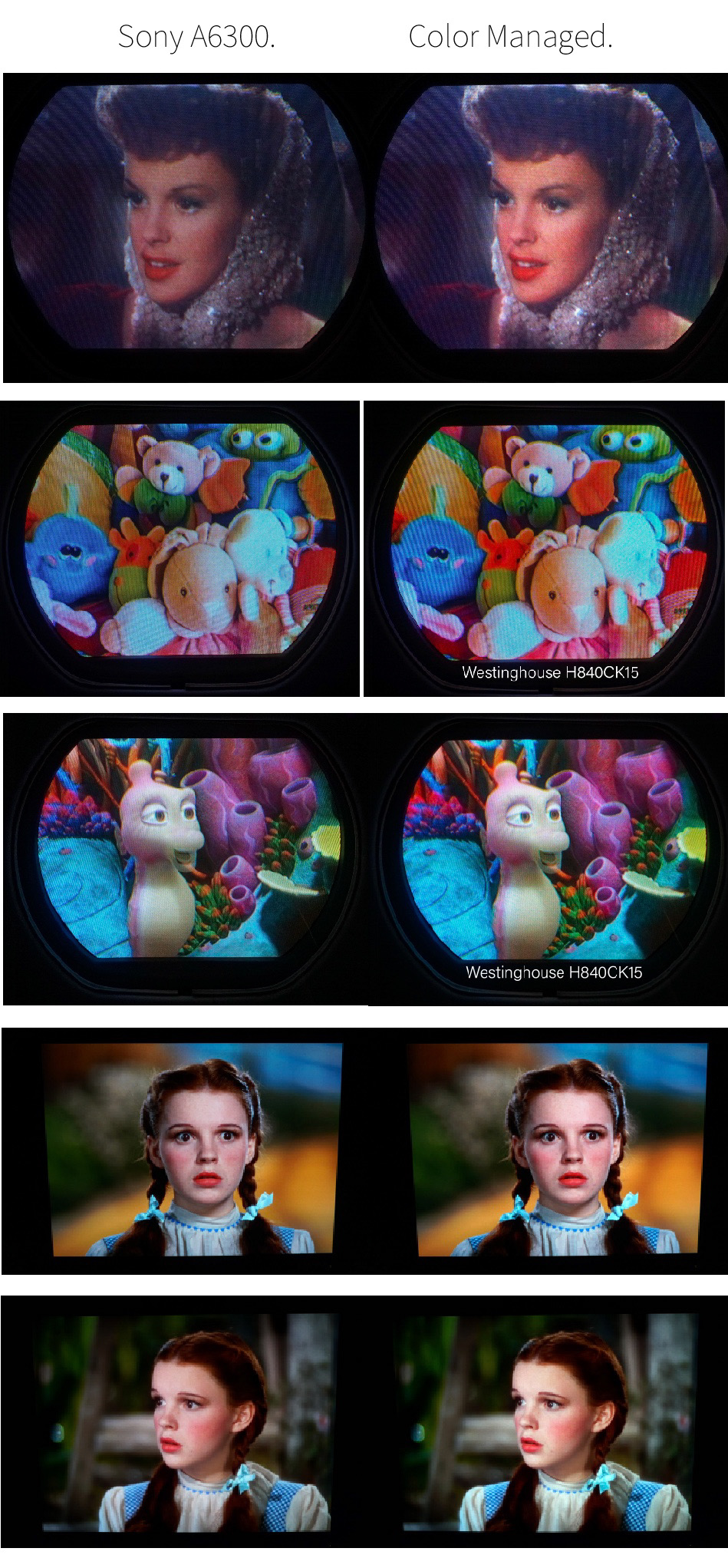 https://visions4netjournal.com/wp-co...3473A2660.jpeg If you want to see the full resolution shots of each image, I’ve provided the photos below with commentary. These images are best viewed on an extended color gamut monitor. First edited image: One of my favorite facial shots because of the color depth and shading and a night shot. The moire is gone. I see more yellow in Dorthy’s face as opposed to the pink tones. The colors are more saturated. The color managed image removed artifacts and noise from the original. Note. Using the A6300, I’m relying on manual settings viewed on a 3 inch LCD monitor screen attached to the camera body. Not exactly ideal to see color accuracy. We can adjust aperture, shutter speed, focal length, ISO, or white balance, but never get the shot perfect as we see it on the television screen. A tripod and darkened room helps together with filling the camera viewfinder with the television image is best for accurate sensor rendering Second edited image: This image was rather flat with nice pastels when photographed. The edited version shows extended color depth and saturation. The moire is gone. Third edited image: Edited version has deeper saturated colors, wider color gamut. Forth edited image: Source, 4K HDR BLURay on LG OLED. Edited version slightly warmer with deeper color. LG’s OLED out the box preset color profile appears very accurate using ISF PRO DARK ROOM. Fifth edited image: Same source as forth image. Very close to original with whiter whites. As a novice in photo editing, we just set the mods on auto and let it do the work. The last image is to show the pixel structure. Yes, low resolution, but not as bad as the first generation GE Portacolor. Did we learn anything? Yes. Did we see extended colors? Maybe. Deeper saturated colors, improved shading with brighter images in all cases to improve on the 15GP22 low light output. About 86% of the tri-color light energy is blocked by the shadow mask. This specification is from RCA’s own technical paper. My question is, did the engineers that developed 1954 NTSC color, actually see the full color gamut on an advanced display, or is the specification just mathematical? The phosphors must have been stimulated in some fashion to output light. https://visions4netjournal.com/wp-co...CDDC5CFB6.jpeg https://visions4netjournal.com/wp-co...5F671CF708.png https://visions4netjournal.com/wp-co...0DD760B60.jpeg https://visions4netjournal.com/wp-co...AECF90E43.jpeg https://visions4netjournal.com/wp-co...A16502729.jpeg https://visions4netjournal.com/wp-co...045989779.jpeg https://visions4netjournal.com/wp-co...C2512D62D.jpeg https://visions4netjournal.com/wp-co...9082EA07E.jpeg https://visions4netjournal.com/wp-co...11F960FE3.jpeg https://visions4netjournal.com/wp-co...0AA928B78.jpeg https://visions4netjournal.com/wp-co...2E45E1D71.jpeg
__________________

Last edited by etype2; 01-26-2021 at 02:03 PM.
|
|
#470
01-26-2021, 04:07 PM
|
||||
|
||||
|
I'm afraid you are making a mistake in what you are attempting.
The color range that you can demonstrate in a posted image is dependent on the narrowest colorspace bottleneck that the image passes through. In the past this has often been the viewer's display, but these days most monitors are sRGB (or close), so sRGB wil be the limiting factor. In addition, sRGB is the usual space for jpg images, and the assumed space for most web browsers. In fact, if you simply copy the digital values of a wider space (such as P3 or Adobe RGB) into an sRGB jpg file for the web, the colors usually will be reproduced with distorted, lower saturation, because most browsers ignore any auxiliary color gamut info in a jpg file that would tell them to convert to the monitor profile. Properly color managed software like Photoshop or Lightroom converts the colors to sRGB before exporting a jpg file. A correctly color managed program like photoshop takes the image data from your camera, and knowing the color space it is in, translates it to a very wide working space (e.g., Lab), and then translates it from the working space to your monitor profile for viewing, or to the proper output space for your printer or for export to jpg (in that case sRGB). There is NO possibility to make the NTSC colors show up on anyone else's sRGB monitor. The only thing color management can guarantee is that colors that are within sRGB in the original camera file will be reproduced correctly on a correctly profiled monitor. Colors beyond the sRGB gamut must be moved to fit inside sRGB, as those are the only ones that can be reproduced by an sRGB monitor. So, no, we cannot see the Kelly greens, but we should be able to see the less saturated colors better. If you want to share the Kelly greens with someone, they need to have a color managed wider-gamut monitor and viewing software that recognizes the color profile embedded in the file you share (which usually would need to be some other format than jpg).
|
| Audiokarma |
|
#471
01-26-2021, 04:28 PM
|
||||
|
||||
|
"My question is, did the engineers that developed 1954 NTSC color, actually see the full color gamut on an advanced display, or is the specification just mathematical? The phosphors must have been stimulated in some fashion to output light."
I'm not sure what you mean by "advanced display." In 1954, the 15GP22 CRTs did display the full NTSC color gamut, and the cameras did produce it. Your set can also produce the full gamut, but the new catch is that all current sources other than specific wide color gamut (WCG) ones limit the gamut to sRGB in the first place. To get things really proper for viewing on your set, you need a WCG source of the program material, and a digital to NTSC converter that does the math to convert color space properly. A way to approach this would be to hook up your set to your computer and treat it as a monitor, profiling it with a colorimeter or spectrophotometer just as you would any monitor, then play a WCG source through the computer using software that does the same sort of color management as Photoshop does for stills, converting accurately from WCG source to your set. (I am not familiar with PC movie/video editing software, maybe Adobe Prmier Pro can do this, but I have not used it and don't know.)
|
|
#472
01-26-2021, 04:44 PM
|
||||
|
||||
|
Quote:
__________________
Last edited by etype2; 01-26-2021 at 05:04 PM.
|
|
#473
01-26-2021, 04:56 PM
|
||||
|
||||
|
Quote:
The thing is my, my iPad can display WCG P3 and our OLED TV has P3 color space with a Chrome web browser so we can view my website photos on a large screen. The photos look overly saturated on the (OLED) web front interface, (RGB) but when opened to full resolution, they are displayed in a different color space. (P3)
__________________
Last edited by etype2; 01-26-2021 at 05:01 PM.
|
|
#474
01-26-2021, 05:25 PM
|
||||
|
||||
|
If you want to display full gamut to just everyone on VK, I suggest you give up. But if you want to offer a full gamut file to those who have color managed systems and know how to use them, then linking to a TIFF file could work. Unfortunately, TIFF files are big, even with (lossless) compression. A more dangerous idea is to export the files [Edit: I mean as jpg] with Adobe RGB profile embedded, with the warning that those who don't know how to view them in a color managed system will see bad desaturated colors. From what I read, PNG files use embedded profiles properly, but I don't know if common web browsers pay any attention. PNG files will be smaller than TIFF but not as small as jpg, which uses a lossy compression algorithm.
I think it would be a worthwhile experiment to post jpg, TIFF and PNG, all three with wide gamut embedded profiles, plus a normal jpg sRGB, to VideoKarma (don't know if the site will allow all types) and see what the results are with different browsers. The only guaranteed way to get wide color gamut to a viewer is to send a file to someone who knows what they're doing; others may be tripped up by defaults and limitations of their software and hardware. This page explains (to some extent) the messy situation with web browsers. https://www.benq.com/en-us/knowledge...0color%20space. Note that some default to sRGB, some do not, some adjust to the monitor profile, some do not. This is why settling on sRGB is the way to ensure everyone sees the same thing, although that thing then cannot include wide gamut colors. Last edited by old_tv_nut; 01-26-2021 at 05:39 PM.
|
|
#475
01-26-2021, 05:36 PM
|
||||
|
||||
|
"The thing is my, my iPad can display WCG P3 and our OLED TV has P3 color space with a Chrome web browser so we can view my website photos on a large screen. The photos look overly saturated on the front interface, (RGB) but when opened to full resolution, they are displayed in a different color space. (P3)"
I think a correct statement is that your OLED is always displaying in P3 space. When going in RGB, it is just taking the RGB values of the sRGB input and applying them to the P3 primary colors, thus increasing the saturation. But when you expand to full screen, it is converting the sRGB values to P3. This means decreasing the saturation in the signal the right amount to compensate for the increase due to the P3 primary colors. This is similar to what happens on my computer monitors, one sRGB and the other wide gamut. Viewing an sRGB jpg in Chrome on the sRGB monitor gives natural colors, but if I move the Chrome window to the wide gamut monitor, the colors are oversaturated, because Chrome does not do anything to take account of the monitor profile. But, if I open that same sRGB jpg in Photoshop, it shows the correct colors whether the Photoshop window is on either monitor. In fact, if you slowly move the Photoshop window from one monitor to the other, as soon as it passes the 50% split, the rendition changes to be correct on whichever monitor has the majority of the image area.
|
| Audiokarma |
|
#476
01-26-2021, 06:23 PM
|
||||
|
||||
|
So the colors of the images in post #469 look distorted to folks with sRGB monitors even though they look good on my P3 display.
Thank you for the information, appreciate it. Working on it .... :-)
__________________
|
|
#477
01-26-2021, 07:56 PM
|
||||
|
||||
|
Quote:
|
|
#478
01-26-2021, 08:33 PM
|
||||
|
||||
|
I opened the composite image in Photoshop on my wide-gamut monitor, and it looked oversaturated. Photoshop did not find a color space specification and opened it in non-color managed mode. Then I assigned sRGB profile, and the saturation reduced to normal, that is, the same as viewing in Chrome on my sRGB monitor.
Conclusion seems confirmed that the jpg files were converted and saved as sRGB when you exported them. So again, people with default monitors and browsers are seeing them the same as you. Question: are the originals from your camera jpg or raw files? If jpg, they are probably sRGB to start with. To see the full gamut of colors, the input files must be raw format, your processing software has to know your monitor is P3, and your working space has to be set to wide gamut, not sRGB. Again, it's a bottleneck issue. If any step in the process is sRGB, then the image is restricted to sRGB from that point on. It's just like if you converted the image to black and white at any step, the color would be lost from that point onward.
|
|
#479
01-26-2021, 08:39 PM
|
||||
|
||||
|
Side note: if your monitor is narrow gamut, your working space can still be wide gamut and your processing software will convert and confine the colors only for the monitor display if it knows what that is. The wide gamut colors are still maintained in the file and can be saved in a TIFF, or other color managed format. But if your working space is sRGB, the bottleneck will be applied even to output files that could carry a wider color space.
Last edited by old_tv_nut; 01-26-2021 at 08:43 PM.
|
|
#480
01-26-2021, 09:57 PM
|
||||
|
||||
|
The originals were Jpeg, s/RGB. I’m going to take everything you have said and try to apply to my next post. Thank you for the good read.
__________________
|
| Audiokarma |
 |
|
|



 Linear Mode

