
|
|
|
#1
 11-07-2025, 09:54 AM
|
||||
|
||||
|
Italian Simple-PAL TV sets
Dear Collectors,
as known, in Europe during the early days of PAL color TV introduction in the second half of the 1960's, there have been sold SIMPLE PAL TV sets on the market. SIMPLE PAL means, that there was no expensive glass delay line installed to cut the costs. • Most known is the for european standards adopted and modified GE Porta Color as German KUBA CK211P with different tube and circuit setup. • Further in Italy the CGE TPC279/11 • and just mentioned at RM.org a TELEFUNKEN Italy TELECOLOR T479 with the same chassis but with a slightly different housing. And where you could see a model number "747" at the rear side? Question: Did any collector know more about any real TELEFUNKEN (Italy) SIMPLE PAL TV set? Was it just a prototype? Are there more labeled GE PAL versions sold? Please: Just SIMPLE PAL TV sets were requested. Not PAL TV sets with delay line in general. Thanks for your support. Wolfgang 
|
|
#2
11-21-2025, 08:41 PM
|
||||
|
||||
|
In 1982 I remember visiting a friend in Croydon Surrey UK who had in the kitchen a very early Sony Trinitron 26cm screen PAL portable TV. I recall it had a tint control on it. Sadly I never adjusted it!
Whilst working for the BBC, I recall the Melford studio monitors had a simple PAL switch. When adjusting the PAL demod phase (otherwise known as tint on an NTSC monitor) you could adjust for minimum visibility of the "Hanover Bars". I would assume the simple PAL receivers hue adjustment would display the Hanover Bars if misadjusted. Last edited by Penthode; 11-22-2025 at 08:19 PM.
|
|
#3
11-21-2025, 09:06 PM
|
||||
|
||||
|
Quote:
|
|
#4
11-22-2025, 02:55 AM
|
||||
|
||||
|
Sony were using Delay Lines too
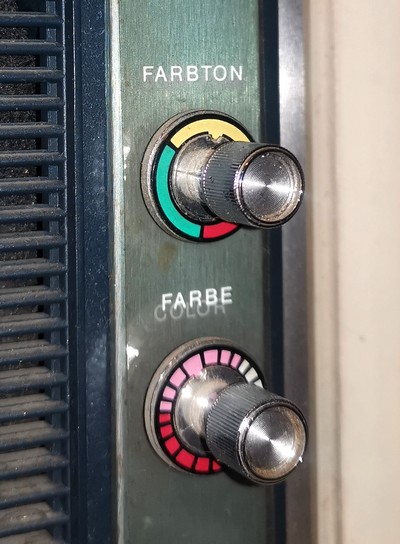 Dear Penthode, thanks for your reply. But years ago, I was thinking the same way and found out Iam wrong. The Sony KV-1300- 1310E and their UK versions were using the tint control just to avoid the PAL Telefunken license fees by modifiying the PAL decoding circuit. At least, they also using Delay Lines as of "real" PAL devices. See circuit extract and photo of the device in the 1310E with Tint control. Last edited by WellInformed; 11-22-2025 at 12:49 PM. Reason: Pic add
|
|
#6
11-23-2025, 01:41 AM
|
||||
|
||||
|
The early PAL Sony Trinitrons were designed to avoid infringing the PAL patents. These were owned by Telefunken and in the UK were assigned to EMI. They were also used to prevent import of Japanese TVs to Europe.
The Sony design converted PAL to sort of NTSC (this is a very simplistic explanation) which was then demodulated as though it was NTSC. Hence a hue control was needed. Simple PAL was different. You could demodulate PAL without using a delay line to average adjacent lines. Any phase errors then gave Hanover bars. When PAL was invented by Bruch at Telefunken a one-line delay was a difficult and expensive item. Hence the idea of a simple PAL decoder. Then Philips designed the original DL1 ultrasonic delay line which was cheap enough. AFAIK, no simple PAL sets were marketed in the UK. Strictly speaking, in NTSC, if both the coding and decoding are done accurately then no hue control is needed. Even into the late 1960s and early 1970s the required accuracy and stability was not feasible.
|
|
#7
11-23-2025, 10:08 AM
|
||||
|
||||
|
A further complication was that although the burst included in the signal followed any phase or amplitude distortion of the chroma, it had to be replaced by a clean burst meeting FCC signal specs before broadcast or distribution on an analog cable system. If the re-inserted burst phase didn't match the incoming (which happened often), the error was baked into the signal receivers saw.
|
|
#8
11-23-2025, 06:33 PM
|
||||
|
||||
|
Quote:
__________________
Tom C. Zenith: The quality stays in EVEN after the name falls off! What I want. --> http://www.videokarma.org/showpost.p...62&postcount=4
|
|
#9
06-28-2026, 07:49 AM
|
||||
|
||||
|
Dragging this thread up from the past to add some anecdotal info. Zenith sets were sold in Spain during the 70s that were PAL compatible obviously and had no hue control on them. Mine is similar to the 12A13C52 American chassis but has a couple of missing tubes in the color section (just holes in the chassis) and the audio output was changed to a 6BQ5. I've got the Spanish service manual for it someplace.
They sold the some of the vertical chassis sets here too, none with a hue control.
|
|
#10
06-28-2026, 01:29 PM
|
||||
|
||||
|
As a kid growing up in the 80s, they must have had the broadcaster accuracy issues figured out well enough, because I don't recall much issue with needing to readjust... And I was the kind of kid who would have noticed. All of that said, I don't know how much I'd like the idea of a tv where I COULDN'T make some color phase adjustments. The flesh tones that one person likes might be a shade different than another. Then add recoding home movies on consumer grade video cameras where I KNOW the colors aren't correct. At least I can compensate for that with a tint knob.
__________________
From Captain Video, 1/4/2007 "It seems that Italian people are very prone to preserve antique stuff."
|
| Audiokarma |
|
#11
06-29-2026, 08:36 AM
|
||||
|
||||
|
Quote:
I'm guessing they converted the audio detector to a more standard circuit (like a ratio detector). The audio output compactron US Zeniths used in the late 60s-early 70s was basically a a 6BN6 (buzzomatic) detector and a 6BQ5 sharing an envelope.
__________________
Tom C. Zenith: The quality stays in EVEN after the name falls off! What I want. --> http://www.videokarma.org/showpost.p...62&postcount=4
|
 |
|
|


 Linear Mode

