
|
|
|
#706
 12-16-2006, 05:38 PM
|
||||
|
||||
|
Crt
I contacted Eric H months ago. He has this CRT. Shipping from the USA is expensive for me right now, so, I am considering other options. I am trying to find out if there's still someone near me who rebuilds those old tubes. One thing that I find amazing is that the guy who sold this said that the TV belonged to his grandfather, and that his grandfather carried the TV around all the time. And he treated something that was part of his family History like that, with no care at all. Oh well...

|
|
#707
12-17-2006, 02:36 AM
|
||||
|
||||
|
Hey Captain Video, sorry, you asked me a question about that a while back and it completely slipped my feeble mind!
The tube is an 8DP4 in that set, I never did figure out the exact cost of shipping on that tube, if you'll PM me your address I will check and see if there isn't some way to send it that won't break the bank.
|
|
#708
12-17-2006, 04:46 PM
|
||||
|
||||
|
Crt
Eric, I sent you a PM.
|
|
#709
12-19-2006, 07:34 AM
|
|||
|
|||
|
Quote:
John
|
|
#710
12-19-2006, 09:21 AM
|
||||
|
||||
|
I was young and foolish once.
Welcome on Board John. I wish I had kept my first set that I got when in High School back in 1964. It was a CTC4 that I recaped. It had a great picture. I sold it to a friend in 1971 for $25 after I bought a new Zenith. I have been trying to acquire a CTC4 for about 3 years now with no luck.
Anybody know where I can buy a CTC4?
__________________
Vacuum tubes are used in Wisconsin to help heat your house. New Web Site under developement ME http://AntiqueTvGuy.com
|
| Audiokarma |
|
#711
01-06-2007, 12:02 AM
|
||||
|
||||
|
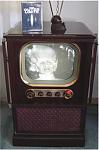
My 2nd restoration
Well here is number 2. A 12 inch Zenith Porthole as you can well see. When I got her the 12up4 had an open filiment. Took a while to find a good crt, but I got a real good one and she shows real bright.
Full recap a few marginal tubes replaced and a lot of TLC to refinish the cabinette with many coats of clear lacquer. Stripped the solid brass control door and re-polished it, then re-lacquered it. Same done to the brass trim rings aorund the On/Off/volume and chanel knobs. Took the Die cast picture tube safety glass frame and cleaned it real good and gave it a couple coats of lacquer so it looks like new. Runs real nice and gets a nice picture except for a horizontal linearity problem that has me stumped. As per John Marinello's suggestion I may try to fiddle with some capacitor values in between the Horizontal discharge tube and the grid of the horizontal output to see if I can get the trace to be more linear. Right now the picture is streched on the left and compressed tightly on the right. Question... does the scan start on the left and end on the right or vise versa? Also have another question. The filiment winding that feeds the 1B3 which wraps around the core of the flyback, dosent do a complete loop all the way around the flyback core. It just does a 180 sort of like a u-turn. Is this the way it is supposed to be? I have always seen 1 complete turn, a full 360 around the flyback core on all the sets I am familiar with. Can someone who has a set like this verify if the winding is to be a horse shoe sort of 'U' turn or is it supposed to be 1 full complete 360 loop around the flyback core? So here are the photos... Enjoy!
__________________
Vacuum tubes are used in Wisconsin to help heat your house. New Web Site under developement ME http://AntiqueTvGuy.com Last edited by ohohyodafarted; 03-08-2009 at 10:44 PM.
|
|
#712
01-27-2007, 12:51 AM
|
||||
|
||||
|
I wonder what Zenith and Raytheon did to expand the raster to fill the entire viewing area without it being out of proportion. The other round crt sets with double d border show the vertical blanking signal just outside the viewing area.
I would think that just expanding the picture with the linearity and size controls would cause way too much height.
|
|
#713
01-27-2007, 08:45 AM
|
||||
|
||||
|
I don't know what was done in the old porthole sets, but in the ZOOM feature in some later Zenith color sets, they increased the retrace time. So, the scan started just beyond the edge of the faceplate, but it started late and ended early. I imagine the porthole sets may do the same thing. If you can put a scope on the deflection coils, you could measure this easily. Watch out, thouhg, the retrace pulse voltage may be quite high (several times as big as B+)
|
|
#714
01-27-2007, 10:09 AM
|
||||
|
||||
|
On my porthole, the switch simply causes an increase in the verticle voltage to the deflection yoke. It does not alter the horizontal width at all. IN essence what happens is that you get a stretching of the verticle and as a result the picture IS distorted. If you watch the picture in normal position you get a 1 inch black area at the top and bottom of the crt and you can see all the digital data in the top 3 or so traces.
__________________
Vacuum tubes are used in Wisconsin to help heat your house. New Web Site under developement ME http://AntiqueTvGuy.com
|
|
#715
01-27-2007, 11:34 AM
|
||||
|
||||
|
This gets at something I've been wondering about, on all b/w sets (atleast those using the same standard) I thought the frequency at the yoke coils for both horiz. and vert. and the number of lines on the screen always stay the same. So inorder to have a larger picture, something has to give, so is there more space between each line on a larger screen, are the lines thicker?
Secondly, inorder to increase the deflection angle, is the voltage at the yoke increased over what it would be on a set with a lesser deflection angle while maintaining the same frequency, or does it have more to do with the size/ shape of the yoke? Thirdly, in the case of longer and shorter tubes, would not different distances between the gun and the front of the tube cause problems due to different amount of times it takes the beam to travel from one to the other? I know if you increase the vert size, you're increasing the voltage at the vertical half of the yoke, but the frequency remains the same, now the picture covers a greater area and the deflection angle increased, but the number of lines is the same, so there must be more space between the lines. Also in some sense the vert. has to oscillate faster, because it now has to go between 2 higher voltages in the same time it used go between two lower voltages, this is why when you increase the vert. size alot the vert. goes out of sync? And if I have absolutely no idea what I'm talking about, let me know.
|
| Audiokarma |
|
#716
01-27-2007, 01:13 PM
|
||||
|
||||
|
Another use for those vertical-interval network test signals
In the early '70s I had a Majestic 16" round-screen b&w set whose picture did not fill the screen when the chassis was outside the cabinet. However, with the chassis in its normal position inside the cabinet, the top and bottom of the CRT were covered by the mask, so the picture looked round. (Round-screen b&w RCA and other sets also used this dodge to create a round picture from the original rectangular scan.) The raster only covered about the middle third or so of the CRT (again with the set out of the cabinet), so one could see the vertical blanking interval and its test signals (which also gave an indication as to when the station went from network to local programs--the test signals would disappear from the vertical interval during local broadcast time and return, of course, when the station rejoined the network). I don't know if TV stations and/or networks still use these signals in this age of microwave studio/transmitter links and network-to-affiliate satellite feeds but, IMHO, the test signals were fun to watch while they lasted (if you knew what they were and what you were looking at--most non-technical viewers didn't, and may have found them the devil of an annoyance if the picture shrunk due to weak tubes or other problems in the vertical sweep system).
BTW, the picture-size switch in the Zenith Porthole (a.k.a. Great Circle) TVs worked well when it worked, but the switch often caused problems with vertical sweep when the contacts tarnished or oxidized as the set aged. Many technicians simply bypassed or cut the switch out of the circuit when it acted up; my best guess is it wasn't missed that much by viewers, as it was just a frill anyway (another selling point for Zenith Great Circle TVs of the period). I doubt that most set owners even knew it was there. However, the TV worked just as well without the switch as with it.
__________________
Jeff, WB8NHV Collecting, restoring and enjoying vintage Zenith radios since 2002 Zenith. Gone, but not forgotten.
|
|
#718
01-27-2007, 01:55 PM
|
||||
|
||||
|
Basically your understanding is correct. What is essentially being done is increasing the verticle height adjustment.
Actually the lines stay the same thickness, but the space between the lines gets wider. The thickness of the line is determined by the diameter of the electron beam from the gun, and the divergence of the beam which is related to the distance from the gun to the screen. As for the Yoke issue. We are talking about only increasing the height about 1 inch on top and 1 inch on bottom. So an increase in voltage causes a stronger magnetic field and thus a stronger deflection upward and downward. I am not sure if the Yoke has any special charastics over a yoke in a conventional set. My guess is that it's nothing special. If there is any relationship in the length of the tube and timing it would be so small as to not be significent. Electrons travel at the speed of light. Verticle oscilator frequency does not vary. It must stay at 30 frames per second to sync with the broadcast from the network. What varies is not the duration of the ramp waveform that drives the verticle section, but rather the peak positive and negative values of the voltage comming out of the verticle output transformer, (which is driven by the verticle output amplifier tube) which drives the verticle coils of the yoke. A simple analogy would be when you turn up the volume of your stereo, you don't change the waveforms of the sound or the durations of those waveforms. You only change the verticle amplitude of the waveforms and thus the loudness of the sound. The verticle output section of the tv set is very much like a vacuum tube audio amplifier. A ramp waveform (the input signal) drives an output tube which in turn drives an output transformer (to obtain an AC positive and negative voltage) which drives the verticle coils of the deflection yoke (just like you drive the voice coil of a speaker to make it move forward and backwards). Look at it this way. The verticle voltage driving the verticle coils of the deflection yoke is driven by a sawtooth ramp waveform. When the ramp voltage is at it's positive peak, the verticle voltage at the yoke is at it's max and the electron beam scans the top most line of the picture. When the ramp wave drops and crosses the zero axis, the voltage at the yoke is zero and the electron beam scans across the middle of the tube. When the ramp wave reaches the bottom of the cycle it is at the most negative value and the voltage at the Yoke is at it's most negative value and the scan line is at the bottom line of the picture. By varying the peek voltage of the ramp waveform comming out of the verticle amplifier tube, you vary the maximum positive and negative voltages applied to the yoke via the verticle output transformer. The the verticle waveform driving the verticle output amplifier tube, is a ramp because at the end of each frame of the picture, the voltage needs to instantaneously return to the beginning of the cycle and start scanning a new frame at the top of the picture with virtually no time delay. As the value of the voltage on the ramp waveform drops from highest to lowest value, the electron beam scan lines move from the top to the bottom of the screen in a corresponding fashion. Hope I haven't confused you too much, but basically you had the right idea.
__________________
Vacuum tubes are used in Wisconsin to help heat your house. New Web Site under developement ME http://AntiqueTvGuy.com
|
|
#719
01-27-2007, 04:13 PM
|
||||
|
||||
|
Electronic magnification
There were several late 1940s TVs which featured some form of magnification or zoom. Most designs simply increased the vertical height, as discussed earlier in this thread.
But Westinghouse took the concept to its logical extreme in the Model H-605T12. This 12 inch table set has a front panel control labeled electronic magnification. When in the normal position, the CRT was masked off in the conventional "double D" format; that is a round CRT with the top and bottom masked off and the sides left rounded, to approximate the 4:3 aspect ration of the trnasmitted image. When the control was moved to the magnification position, two things happened. First, two mechanical shutters at the top and bottom of the CRT moved outware to reveal the full round CRT. Second, both the vertical sweep height and horizontal sweep width were increased to completely fill the round CRT, while maintaining the 4:3 aspect ration of the inage. The magnification was accomplished by switching in two separate vertical height controls to set the vertical height, and the B+ voltage to the horizontal output stage was switched between 2 values to cause the width to change. In a conventional flyback type horizontal deflection system, changing the B+ voltage would have drematic effects on the high voltage as well as the width. Westinghouse avoided this complication by implementing a RF type high voltage power supply, which operates independently of the horizontal deflection circuitry. This HV supply is a souped-up version of the RF high voltage supply commonly used in 7" sets of the period. It was relatively uncommon to use RF high voltage supplies in sets employing CRTs bigger than 7 inches. The horizontal deflection circuitry of this set used 3 7A3's in parallel to drive a conventional transformer coupled deflection yoke. This set can be found in Sams #97-19.
__________________
John Folsom
|
|
#720
01-27-2007, 04:59 PM
|
||||
|
||||
|
WOW John,
I just acquired a Westy like the one in the photograph. I did not do anything to it yet except test the crt. I had no idea that there was a shutter attached to the magnification control or any of the other very interesting features of this set you mentioned. I will have to look more closely at it as soon as I have a chance. I already have the Sams for it. The cabinette is in pretty bad condition but I think it can be restored. Chassis looks unmolested from what I can see. Thanks for this most interesting information ont he Westy.
__________________
Vacuum tubes are used in Wisconsin to help heat your house. New Web Site under developement ME http://AntiqueTvGuy.com
|
| Audiokarma |
 |
|
|








 Linear Mode

