
|
|
|
#16
 12-18-2008, 09:56 AM
|
||||
|
||||
|
As for the art work, I would place the old part on a large flat bed scanner at Kinkos. Then i would have it printed in full color on a color printer onto clear acetate film and sandwich it between two pieces of thin glass cut to the exact shape and dimensions as the original glass.
The other alternative if you are willing to spend the moeny, is to take the newly cut glass to a silk screener along with the old part. A silk screener can photo the old art work on the old glass and print it on the new glass in multiple colors. This would cost about $75 per color, so I would vote for the Kinkos method because the value of the set is not that great. Good Luck!
__________________
Vacuum tubes are used in Wisconsin to help heat your house. New Web Site under developement ME http://AntiqueTvGuy.com 
|
|
#17
12-18-2008, 01:44 PM
|
||||
|
||||
|
Once, I took a radio panel into Kinko's for scanning. They refused to let me put it on their scanner bed. Nothing allowed there but paper or equivalent. Risk of scratching the glass, I suppose.
Phil
|
|
#18
12-19-2008, 02:37 AM
|
||||
|
||||
|
Hi folks,
I will probably have somebody who is willing to make a replica of the front glass. The tv set is General Electric model 806. Is somebody here interested in getting a replica, too? It might be cheaper for us all to produce some more front glasses than only a unique replica. Kind regards, Eckhard
|
|
#19
12-20-2008, 01:36 AM
|
||||
|
||||
|
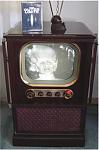
Does this look like the same cabinet and glass as your 806 set? The tube diagram inside is marked model C2505 or C2506. The CRT was a 10BP4.
If so, you can have both pieces or just the glass for postage from zip 19390. They are from a parted out set. The green back paint is chipped away near the top as shown but the glass is not broken. Cliff
|
|
#20
12-20-2008, 09:36 AM
|
||||
|
||||
|
I think once you have new glass, cut some pieces of tubing to the proper length to makes stops that slip over the knob bolts for the two fixing knobs at the top of the glass, and put felt washers under the knobs. Adjust the length of the tubing so that the knobs can be tightened just enough but not overtightend.
Reece
__________________
Reece Perfection is hard to reach with a screwdriver.
|
| Audiokarma |
|
#23
12-20-2008, 06:59 PM
|
||||
|
||||
|
Quote:
John Y.
|
|
#24
12-20-2008, 08:06 PM
|
||||
|
||||
|
Quote:
--Dave
|
|
#25
12-20-2008, 10:07 PM
|
||||
|
||||
|
Quote:
It would be interesting for Mythbusters. Hopefully they would be CRTs that Hawkeye wouldn't accept for rebuild. Here's some anecdotal info. http://www.repairfaq.org/sam/crtfaq.htm#crtcir John Y.
|
| Audiokarma |
|
#26
12-20-2008, 10:18 PM
|
||||
|
||||
|
At about the time GE was making this set, Philco, Admiral and others were using plastic. Consider that if you were to pick up a 10BP4 and try to throw it through a sheet of plexiglass I really don't know if you could do it. I had to replace the one on a '50 Philco as some chemical had left spots etched in it. A replacement from the glass company (some sort of plexiglass, or whatever they sell) was cheap and easy to obtain. I suspect that plain window glass wouldn't really be safe but thicker or laminated glass should be fine.
John, that site you link to is quite impressive!
__________________
Bryan
|
|
#28
12-21-2008, 06:02 PM
|
||||
|
||||
|
Quote:
Keep in mind that plain glass may be smashed by the implosion's shockwave even before the glass shards start to scatter outward also, some early B/W CRTs are made of thin, weak glass and are prone to spontaneous implosion.
|
|
#29
01-19-2010, 04:22 AM
|
||||
|
||||
|
Hello,
in the last days, I have picked the GE 806 tv set which was waiting for repair since months. In the mains unit, one 5 Ohm resistor before the rectifiers was burned, I replaced it. The 19BG6 was also weak, I replaced it. One wax capacitor was leaky, I unsoldered one end and added a new one. After that, I reformed the electrolytics and switchet the set on. It showed a dim raster. Sound it working well. The original 10BP4 was very weak and came with a brightener. I have rejuvenated the CRT and removed the brightener. Currently I am working with the bad picture tube, but when works are done, I want to replace it. I have got a good 10BP4 (0.4 ma) and a good 10FP4 (0.9 ma). Which picure tube might be the better selection for replacing? Kind regards, Eckhard
|
|
#30
01-20-2010, 09:58 PM
|
||||
|
||||
|
I'm pretty sure the original used a 10FP4 so I would go with that. It's a lot brighter too

|
| Audiokarma |
 |
|
|








 Linear Mode

