
|
|
|
#16
 11-22-2011, 07:06 AM
|
|||
|
|||
|
Bob - I'm working on the exact same set (have to check the run). It's all re-capped and has a great pic. It needs an alignment though as the sound is way out of sync with the channel selected. This is the same set you sent me a volume knob for. I'll share pics if interested.
Mark 
|
|
#17
11-22-2011, 04:43 PM
|
||||
|
||||
|
The sound is a little out of whack in this set too. They provide a four pin socket on the IF strip to aid in aligning. I bet they had some sort of plug in alignment tool to use on the assembly line. I was a little surprised to see it uses the same tuner as the 3 year older 20X11 and 20X12 I've also been working on.
Sure post some pics if you want. I have two more of these chassis to restore. One with a 16KP4 CRT and one with a 16GP4.
|
|
#18
11-30-2011, 12:44 AM
|
||||
|
||||
|
While working on this set, I caught some whiffs of ozone. I was running by B&K 1077B which has a known corona issue so I've been ignoring it.
A few days later my 1077 was off and the ozone smell was even stronger and I heard some hissing so went investigating. I popped open the HV cage, powered up the set with all the lights off and carefully looked around. Sure enough there were faint blue streamers around the doorknob cap mounted under the 1B3 HV rectifier.  Turns out it was black with fine dust particles. A little cleaning with mineral spirits took care of that. I made sure to dry it thoroughly with a heat gun on low before powering it back up. No more ozone    Just one issue remains - the vertical lines on the left side of the screen. I've tried swapping the damper tube, adjusting the hor. drive and hor. linearity and hor. width. None of that had any effect so I'm going to check the 47pF the mica cap inside the yoke. One more thing - I'd been calling this a 16R12 but that's incorrect. The 16R12 is brown bakelite while this one is a black 16R11.
|
|
#20
11-30-2011, 07:20 PM
|
||||
|
||||
|
Yes, this set has an RCA 17BP4A RCA Silverama CRT. The 16R12 set I just picked up has a 17YP4 installed. I don't think either was original. It's fairly easy to fit a 17" CRT into one designed for an early 16".
|
| Audiokarma |
|
#21
12-01-2011, 09:53 PM
|
||||
|
||||
|
Hey.!
my 16r12 with this same chassis is healthy (have got two sets !) both crts have held up just fine. My repairs on one of them was the 1b3 which tested fine on the b/k but killed a 68 ge color tabletop when subbed(long story). i got a new one dirtcheap and then checked resistors for tolerance in circuit..quite a few were far off. It runs nice.
|
|
#22
12-02-2011, 01:25 PM
|
||||
|
||||
|
"Killed a GE color set"? As in good before unrepairable after?
__________________
Tom C. Zenith: The quality stays in EVEN after the name falls off! What I want. --> http://www.videokarma.org/showpost.p...62&postcount=4
|
|
#23
12-02-2011, 02:46 PM
|
||||
|
||||
|
Unfortunately, nothing I've tried has had any effect on those vertical bars including what's in this service note.
Anyone have any idea what filter A3459S might consist of ?  I'm going to move on to cleaning the cabinet then the console version with the same chassis. I figure I can compare them side-by-side once it's running too. The brass inserts popped out of one knob. A little epoxy took care of that. I do have the door, but the pins have broken off the ends. I'll try gluing some new ones on.  The cabinet is dirty, but otherwise in great condition. Of course it has little white paint dots like every vintage bakelite cabinet seems to. I've heard vinegar works well on latex paint   
|
|
#24
12-03-2011, 12:08 AM
|
||||
|
||||
|
I scraped of the paint droplets with a plastic spoon. Then buffed it with Novus #2 followed by Magnolia Glayzit.
I haven't had much luck with Glayzit in the past, but I know some guys really like it so I thought I'd give it another try. I sprayed it on lightly then spread it around with a clean cloth. I let it sit about an hour then buffed it out. Looks good so far I think. No wet sanding needed on this one   
Last edited by bandersen; 12-03-2011 at 12:16 AM.
|
|
#25
12-09-2011, 11:52 PM
|
||||
|
||||
|
Here's the original label identifying this set as a 16R11.
Look at all the tube lineup variations. They did over 16 production runs of this chassis!  The control AKA "pencil box" door is damaged on this set as is so commonly the case. At least I have the door and it's in good condition. Just the hinge pins are broken off and the springs are missing. I figured if I could bore some holes I could use bras tubing for new pins. I carefully used a long conical soldering iron tip to melt pilot pholes. Then, used a rat tail file to enlarge them. I salvaged some spring steel from a tape measure for the springs. It's not quite the same action as the original would be, but it's OK. I think slightly thicker spring steel would do the trick. If anyone out there has some to spare, I'd love to have a few feet. I have lots of knobs in need of some too     
Last edited by bandersen; 12-10-2011 at 12:00 AM.
|
| Audiokarma |
|
#26
12-09-2011, 11:54 PM
|
||||
|
||||
|
I buffed the control panel with Novus and remounted it. Then reinstalled the cabinet.
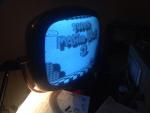
It's in verry, very nice condition. Too bad I'm not the set's owner      Here it is playing some Perry Mason. There are still some faint vertical bars on the left. it just so happens this sets owner also dropped off an Admiral 26R12 with the same chassis for restoration. My plan is to restore that set next and see if it has the bars. If not, I'll compare them side by side and try to pinpoint any differences.  
|
|
#27
12-10-2011, 09:33 AM
|
|||
|
|||
|
Bob, I can't look at mine because it is 737 miles away! I took it to Florida already. And those transformers are on the way to Chicago. It is a shame that the 16R12 that I got had a smashed cabinet. I would have restored both of them.
|
|
#29
12-10-2011, 12:10 PM
|
||||
|
||||
|
Quote:
Phil Nelson
|
|
#30
12-10-2011, 10:10 PM
|
||||
|
||||
|
Quote:
I'd bet you dollars to donuts, that the "vertical lines" pictured in the left of your two Perry Mason photos posted later, is actually video ringing. Look for loose tube shields and bad tubes (substitute, as a checker probably won't catch it) between the video detector and the CRT. If no progress there, do a very careful voltage check of those circuits and look especially for any open (test by jumping them) electrolytics in or near the video circuit. I've also seen overshoot on the AGC line in the IF cause a problem that looks very very similar, but this failure usually also mucks up the grey-scale, so it is a lot less likely suspect. If you have a color bar-dot generator, use that on cross-hatch bars while testing as the picture will remain constant while you check and the vertical bars should easily trigger the ringing. If they don't I'm barking up the wrong tree. James
|
| Audiokarma |
 |
|
|






 Linear Mode

