Videokarma.org

Go Back   Videokarma.org TV - Video - Vintage Television & Radio Forums > Early B&W and Projection TV

Notices

We appreciate your help

in keeping this site going.
Reply
 
Thread Tools Display Modes
  #1  
Old 04-03-2020, 03:34 PM
Kevin Kuehn's Avatar
Kevin Kuehn Kevin Kuehn is offline
Workin' Late Again
 
Join Date: Jan 2011
Location: WI
Posts: 3,976
Quote:
Originally Posted by maxhifi View Post
I'd be curious what others think of it, if anyone wants to try with their TV. Modern program material like DVD video appears to have quite a high contrast range, which really exaggerates the issue caused by lack of DC restoration, I think this was a very worthwhile thing to do.
I have this Setchell Carlson P65 I restored several years ago that suffers form this same issue. Same basic circuit and CRT type as your TV, although it is a transformer powered set. Sams shows 50vpp video going to the CRT. If I recall correctly I can easily operate this one outside the cabinet. Hopefully I'll be able to take some voltage measurements to see how closely this regulates sync pulse level.


Reply With Quote
  #2  
Old 04-03-2020, 05:32 PM
Kevin Kuehn's Avatar
Kevin Kuehn Kevin Kuehn is offline
Workin' Late Again
 
Join Date: Jan 2011
Location: WI
Posts: 3,976
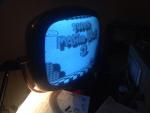
Got the chassis out and warmed up. The video source is a Pioneer VCR/DVD combo with internal rf modulator playing a DVD. The 2nd and 3rd pictures are with the screen brightness set in the middle, contrast about two thirds up. The last picture is what this set has always done between scenes, goes to medium grey with retrace lines. I suppose that happens because of the lack of DC picture level? Have to take a break but hopefully I'll get back to this later this evening. Max, do you recall what type of diode you used?


Reply With Quote
  #3  
Old 04-03-2020, 02:59 PM
old_tv_nut's Avatar
old_tv_nut old_tv_nut is offline
See yourself on Color TV!
 
Join Date: Jul 2004
Location: Rancho Sahuarita
Posts: 7,749
I wouldn't bother changing anything if you have sufficient range now. The reason I asked about the voltage change with scene variation is that it represents a decrease in the accuracy of the DC restoration if the voltage varies. There should be less variation if the wiper is nearer one end than the center.
__________________
www.bretl.com
Old TV literature, New York World's Fair, and other miscellany
Reply With Quote
  #4  
Old 04-03-2020, 05:22 PM
maxhifi's Avatar
maxhifi maxhifi is offline
VideoKarma Member
 
Join Date: Dec 2010
Posts: 1,869
^^That's a very nice looking TV
Reply With Quote
  #5  
Old 04-03-2020, 05:33 PM
Kevin Kuehn's Avatar
Kevin Kuehn Kevin Kuehn is offline
Workin' Late Again
 
Join Date: Jan 2011
Location: WI
Posts: 3,976
Quote:
Originally Posted by maxhifi View Post
^^That's a very nice looking TV
Thanks. They are quite common around here as I live about 100 miles from where they were manufactured.
Reply With Quote
Audiokarma
  #6  
Old 04-03-2020, 06:32 PM
maxhifi's Avatar
maxhifi maxhifi is offline
VideoKarma Member
 
Join Date: Dec 2010
Posts: 1,869
I used just a regular 1N4007, because I have a bulk pack of them. Just make sure whatever you use has an adequate voltage rating
Reply With Quote
  #7  
Old 04-03-2020, 09:07 PM
Kevin Kuehn's Avatar
Kevin Kuehn Kevin Kuehn is offline
Workin' Late Again
 
Join Date: Jan 2011
Location: WI
Posts: 3,976
OK, as a baseline I get about 1.5 volts of average DC variation at the output of the detector diode, from bright to dark scenes. When I say average, I mean that's what my scope is telling me when I look at the composite signal at the detector output. Then at the cathode of the CRT, without the restoration circuit, I see about 10V DC in variation, but that appears to be faster transients. With the restoration circuit in place I only see about 5V DC change. My first thought was that that small variation can't be very useful restoration, but then I don't know what would be considered acceptable. This was while watching my first season Gilligan's Island DVD. Right now I'm having a hard time convincing myself it's beneficial. I need to spend some more time with this as it's much harder to analyze with the scope than I anticipated. It's possible I'm one of those individuals that's not sensitive to background level.
Reply With Quote
  #8  
Old 04-03-2020, 09:52 PM
maxhifi's Avatar
maxhifi maxhifi is offline
VideoKarma Member
 
Join Date: Dec 2010
Posts: 1,869
Try watching something more recent, which was filmed at night. Old TV shows were made for old low contrast TV sets, so they probably will show the least benefit.
Reply With Quote
  #9  
Old 04-03-2020, 11:15 PM
Kevin Kuehn's Avatar
Kevin Kuehn Kevin Kuehn is offline
Workin' Late Again
 
Join Date: Jan 2011
Location: WI
Posts: 3,976
Quote:
Originally Posted by maxhifi View Post
Try watching something more recent, which was filmed at night. Old TV shows were made for old low contrast TV sets, so they probably will show the least benefit.
Good idea. For now I came up with an alternative that I think is valid. I figured my B&K 1077 would produce a representative light and dark raster that should allow me to take steady DC voltage measurements at the brightness pot wiper. B&K rf output connected through the tuner of the TV. The DC V measurements were taken at the brightness pot wiper which is also the cathode of the diode and top of the .1uf filter cap going to ground.

1. The B&K target measured about 90V DC.

2. Bright raster with no slide measured about 100V DC.

3. Black plastic in place of the slide produced 82V DC.

So a total DC swing of 18V at the wiper.

It clearly shows the diode is in fact rectifying the sync tips. How useful that amount of restoration is I have no idea. To me, visually it's a subtle effect, but like Max mentions I need to find some much better night video to put this to the test watching program material.

Disclaimer:

It's about impossible to take a picture of a dark raster, so the last image is fudged a little. But there were no controls adjusted on the TV while measuring the 3 DC voltages.


Last edited by Kevin Kuehn; 04-03-2020 at 11:21 PM.
Reply With Quote
  #10  
Old 04-03-2020, 11:41 PM
Kevin Kuehn's Avatar
Kevin Kuehn Kevin Kuehn is offline
Workin' Late Again
 
Join Date: Jan 2011
Location: WI
Posts: 3,976
This is how my TV was modified for the above measurements. And I just realized I didn't have the bleeder resistor across the diode when I did this. Not sure what if any effect that will have on the measurements. I had one in there early and didn't see much difference and then forgot to put it back.

Reply With Quote
Audiokarma
  #11  
Old 04-04-2020, 12:07 AM
old_tv_nut's Avatar
old_tv_nut old_tv_nut is offline
See yourself on Color TV!
 
Join Date: Jul 2004
Location: Rancho Sahuarita
Posts: 7,749
Quote:
Originally Posted by Kevin Kuehn View Post
Good idea. For now I came up with an alternative that I think is valid. I figured my B&K 1077 would produce a representative light and dark raster that should allow me to take steady DC voltage measurements at the brightness pot wiper. B&K rf output connected through the tuner of the TV. The DC V measurements were taken at the brightness pot wiper which is also the cathode of the diode and top of the .1uf filter cap going to ground.

1. The B&K target measured about 90V DC.

2. Bright raster with no slide measured about 100V DC.

3. Black plastic in place of the slide produced 82V DC.

So a total DC swing of 18V at the wiper.

It clearly shows the diode is in fact rectifying the sync tips. How useful that amount of restoration is I have no idea. To me, visually it's a subtle effect, but like Max mentions I need to find some much better night video to put this to the test watching program material.
I think you misunderstood. In an ideal case, the brightness voltage and voltage on the 0.1 uf cap would be completely steady, so the sync tips would be clamped to a constant voltage no matter what the video content is.

The indication of the effectiveness of the DC restoration is the DC voltage measurement at the cathode. With no DC restoration, the change from bright scene to black scene will be minimal - it will just be set by the brightness pot. But with the DC restorer, the DC voltage will be high on the black scene and lower on the bright scene. Looking with the scope, set to DC coupling, the dark parts of a bright picture will be the same voltage as the black of a black screen (or almost the same, depending on how complete the DC restoration is).

Looking at your screen pics, you can see plainly that with the test pattern, the blacks are properly black, and with the black image they are still properly black, not gray, so the DC restoration is doing its thing. If you get an old movie that has spooky night scenes where nearly everything is dark, the picture will actually be dark like it should be, instead of foggy medium gray. This will not be visually subtle!

Your measurements at the wiper would indicate that the black level probably shifts about 8 volts when going from bright test pattern to full black. This is small compared to the full 50 v p-p video signal, so is much better than the non-DC- restored original.

If you look with a DC-coupled scope at the cathode, you will be able to see how little the black level shifts compared to the huge changes without DC restoration.
__________________
www.bretl.com
Old TV literature, New York World's Fair, and other miscellany

Last edited by old_tv_nut; 04-04-2020 at 12:10 AM.
Reply With Quote
  #12  
Old 04-04-2020, 12:47 AM
Kevin Kuehn's Avatar
Kevin Kuehn Kevin Kuehn is offline
Workin' Late Again
 
Join Date: Jan 2011
Location: WI
Posts: 3,976
Quote:
Originally Posted by old_tv_nut View Post
I think you misunderstood. In an ideal case, the brightness voltage and voltage on the 0.1 uf cap would be completely steady, so the sync tips would be clamped to a constant voltage no matter what the video content is.

The indication of the effectiveness of the DC restoration is the DC voltage measurement at the cathode. With no DC restoration, the change from bright scene to black scene will be minimal - it will just be set by the brightness pot. But with the DC restorer, the DC voltage will be high on the black scene and lower on the bright scene. Looking with the scope, set to DC coupling, the dark parts of a bright picture will be the same voltage as the black of a black screen (or almost the same, depending on how complete the DC restoration is).

Looking at your screen pics, you can see plainly that with the test pattern, the blacks are properly black, and with the black image they are still properly black, not gray, so the DC restoration is doing its thing. If you get an old movie that has spooky night scenes where nearly everything is dark, the picture will actually be dark like it should be, instead of foggy medium gray. This will not be visually subtle!

Your measurements at the wiper would indicate that the black level probably shifts about 8 volts when going from bright test pattern to full black. This is small compared to the full 50 v p-p video signal, so is much better than the non-DC- restored original.

If you look with a DC-coupled scope at the cathode, you will be able to see how little the black level shifts compared to the huge changes without DC restoration.
Thanks for explaining in greater detail. I installed a 1 meg bleeder across the diode which resulted in less change at the brightness wiper, and the voltage change at the cathode being greater. Seems like what was lost at the brightness wiper was added to the cathode. I find it very difficult to monitor the black level of a playing video on the scope. Using the B&K test pattern was the only way I could see it change, or not.

Last edited by Kevin Kuehn; 04-04-2020 at 12:53 AM.
Reply With Quote
  #13  
Old 04-04-2020, 08:23 AM
Kevin Kuehn's Avatar
Kevin Kuehn Kevin Kuehn is offline
Workin' Late Again
 
Join Date: Jan 2011
Location: WI
Posts: 3,976
I believe a portion of this lack of black level comes from some sets having lower B+ headroom. The B+ on this TV I'm experimenting with has close to 250v vs Max's set at 150v. My contrast control has a range that allows high black level's even without the dc restoration circuit present. I find that most video I watched growing up was fairly consistent within a given program. I suspect there was some type of video compression used during the production process back in the 60's though 70's. I can basically set it and forget it. I'm not sure if modern day video content would be worse in that respect. Honestly I don't have much desire to watch new programing on my vintage sets. I do find the audio processing on today's movies quite poor in comparison to older material. Or possibly there's a trend back towards less processing? With my ageing ears I struggle to hear the quieter passages, and soon after being blown away. IMO too much dynamics. Similarly I don't see the range of video dynamics in nature that we expect to see from from our television sets. When ambient lighting is low the human eye tends to see less contrast.

Last edited by Kevin Kuehn; 04-04-2020 at 08:26 AM.
Reply With Quote
  #14  
Old 04-04-2020, 11:05 AM
maxhifi's Avatar
maxhifi maxhifi is offline
VideoKarma Member
 
Join Date: Dec 2010
Posts: 1,869
I think the human eye sees a far greater range of contrast than vintage TV sets can display. In old TV shows, it seemed common to light up night scenes quite brightly by today's standards in order to get any image on the film, but the more modern trend seems to be a huge range between the brightest and darkest scenes. I would say it is almost analogous to the difference between the noise floor and the loudest possible recording on a 78RPM record versus a digital recording.

This large contrast range really asks a lot of old TVs, and that's why I wanted to try and do something to improve the Marconi, if only slightly. Better yet it seems to me would be some kind of signal processing to dynamically compress the contrast range, like say using a variable mu tube as the video amplifier, to have the effect of turning the contrast down in dark scenes, but I'm afraid I'm not smart enough to design that.
Reply With Quote
  #15  
Old 04-04-2020, 11:33 AM
Kevin Kuehn's Avatar
Kevin Kuehn Kevin Kuehn is offline
Workin' Late Again
 
Join Date: Jan 2011
Location: WI
Posts: 3,976
Well of course the contrast on old sets was/is limited to whatever the CRT face reflects in any given ambient lighting. That's the main reason modern flat screens can produce such apparent contrast. But in IMO it's pushed over the edge, to the point of now being an effect more so than anything you'd see inside or outdoors in natural lighting. Keeping in mind that everyone's eyes aren't calibrated the same, not anymore that our ears are. I've met a few folks that don't see color, or so they say.
Reply With Quote
Audiokarma
Reply


Posting Rules
You may not post new threads
You may not post replies
You may not post attachments
You may not edit your posts

BB code is On
Smilies are On
[IMG] code is On
HTML code is Off

Forum Jump


All times are GMT -5. The time now is 04:40 PM.


Powered by vBulletin® Version 3.8.4
Copyright ©2000 - 2026, Jelsoft Enterprises Ltd.
©Copyright 2012 VideoKarma.org, All rights reserved.