
|
|
|
#1
 11-30-2008, 10:10 PM
|
|||
|
|||
|
Question about Zenith tuner dial
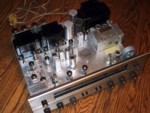
I am working on refurbing my first radio. I usually work on tube amps but just recently I was given a pile of old radios that need some TLC.
My first patient is a Zenith 6D525 also known as "the Toaster". I hoped I could get by with a simply recaping it, but upon turning the chassis over, I discovered that the insulation on every wire in the radio had dried out and turned to clay. It crumbles under my fingers. I'm in the process of rewiring the whole thing. Anyhow, my question is, what does the scale on the bottom of this dial show? The radio is only AM band unless I am missing something. There is no switch to move over to another band and the schematic says its tuning range is 540Kc.-1600Kc. Thanks for your help. 
|
|
#2
11-30-2008, 10:50 PM
|
||||
|
||||
|
The bottom scale corresponds to the actual wavelength in meters of the frequency shown at the other pointer. For instance, 600kHz has a wavelength of 500m.
Tom
__________________
Tom 
|
|
#5
12-01-2008, 08:48 AM
|
||||
|
||||
|
In the early days of radio, the "location" of each station in the radio spectrum was not determined by frequency like it is today, but by wavelength. So, this radio was built during the transition period of measuring by frequency only, and it has both frequency and wavelength.
Wavelength is still used today to name different bands, such as the 49 meter international shortwave broadcasting band, and the 80 meter amateur (Ham) band. Wavelength = 300/Frequency (in MHz)
__________________
I may be growing older, but I refuse to grow up. 
|
| Audiokarma |
|
#6
12-01-2008, 09:05 AM
|
||||
|
||||
|
Just thought of something interesting...
When the wavelength was still in common usage, the FCC created the amateur bands. Nobody was taking these "hobbyists" seriously, and all of the spectrum given to them was "below" 200 meters. Since wavelength numbers get smaller as the frequency goes up, tuning "up" in frequency is going "down" in wavelength. So, amateurs got band segments below 200 meters. Turned out that those "short waves" were the ones that allowed global communication capability, and the 160 meter ham band is now considered "long wave"! There's actually a fascinating book titled: "200 Meters and Down", all about the creation of amateur radio. Long, long out of print, but available pretty often on eBay.
__________________
I may be growing older, but I refuse to grow up.
|
|
#7
12-02-2008, 09:34 AM
|
|||
|
|||
|
Thanks for all the information. Like I said, I usually work on tube amps but have always been interested in radios.
This was a good first project because I had to re-wire the entire thing and got to see the how the circuit is put together and how it differs from a typical amp circuit. This will help expanded my understanding of tubes and how they can be used in a manner other than the basic driver and power tubes I see all the time.
|
|
#8
12-02-2008, 03:03 PM
|
||||
|
||||
|
I have either this same model, or one with the same chassis. (bakelite cabinet with handle on top) I bought it through the mail when I was a kid in the mid-80s. (recapped and nicely polished for $25+ $5 UPS shipping! A good use of my allowance for a week and a half)
Anyway, I remember back then being puzzled by the same thing. I will note that it's a great dial...I always loved to sit and stare at it in the dark, especially if I could find a station playing old radio shows.
__________________
Bryan
|
 |
|
|





 Linear Mode

